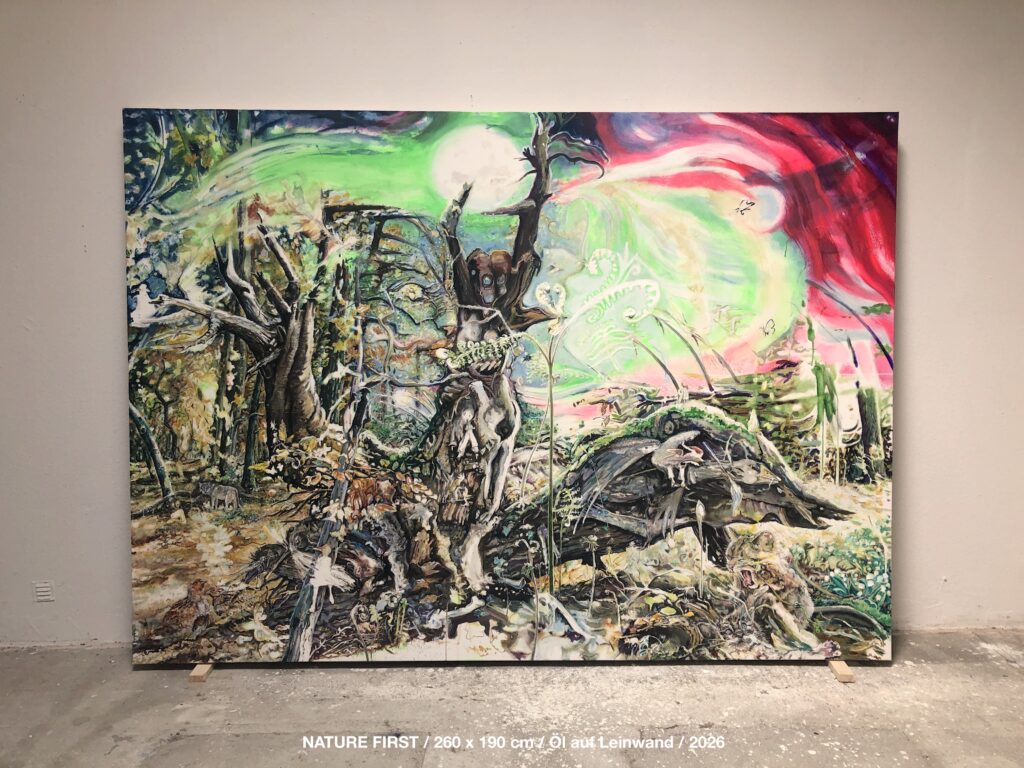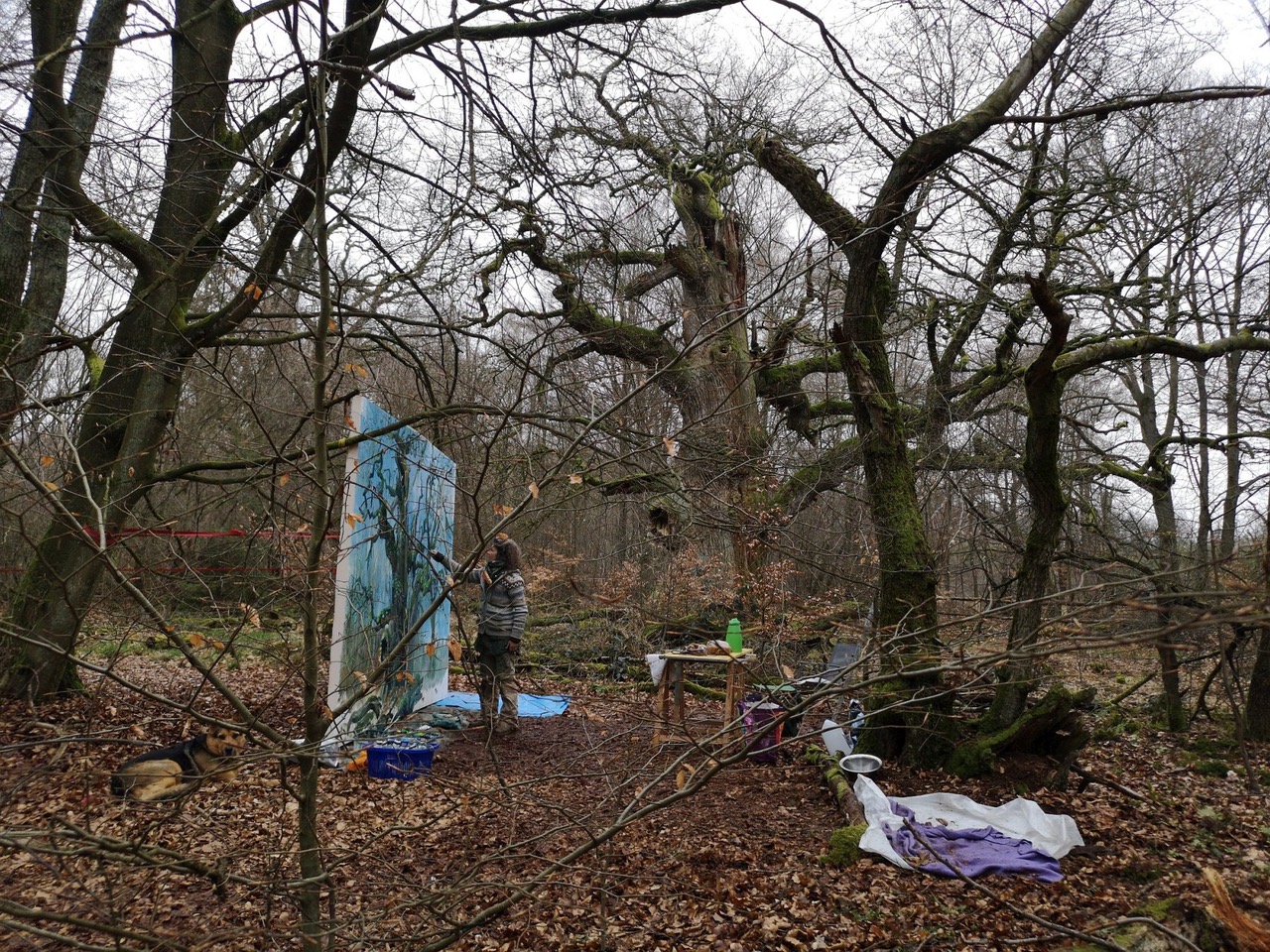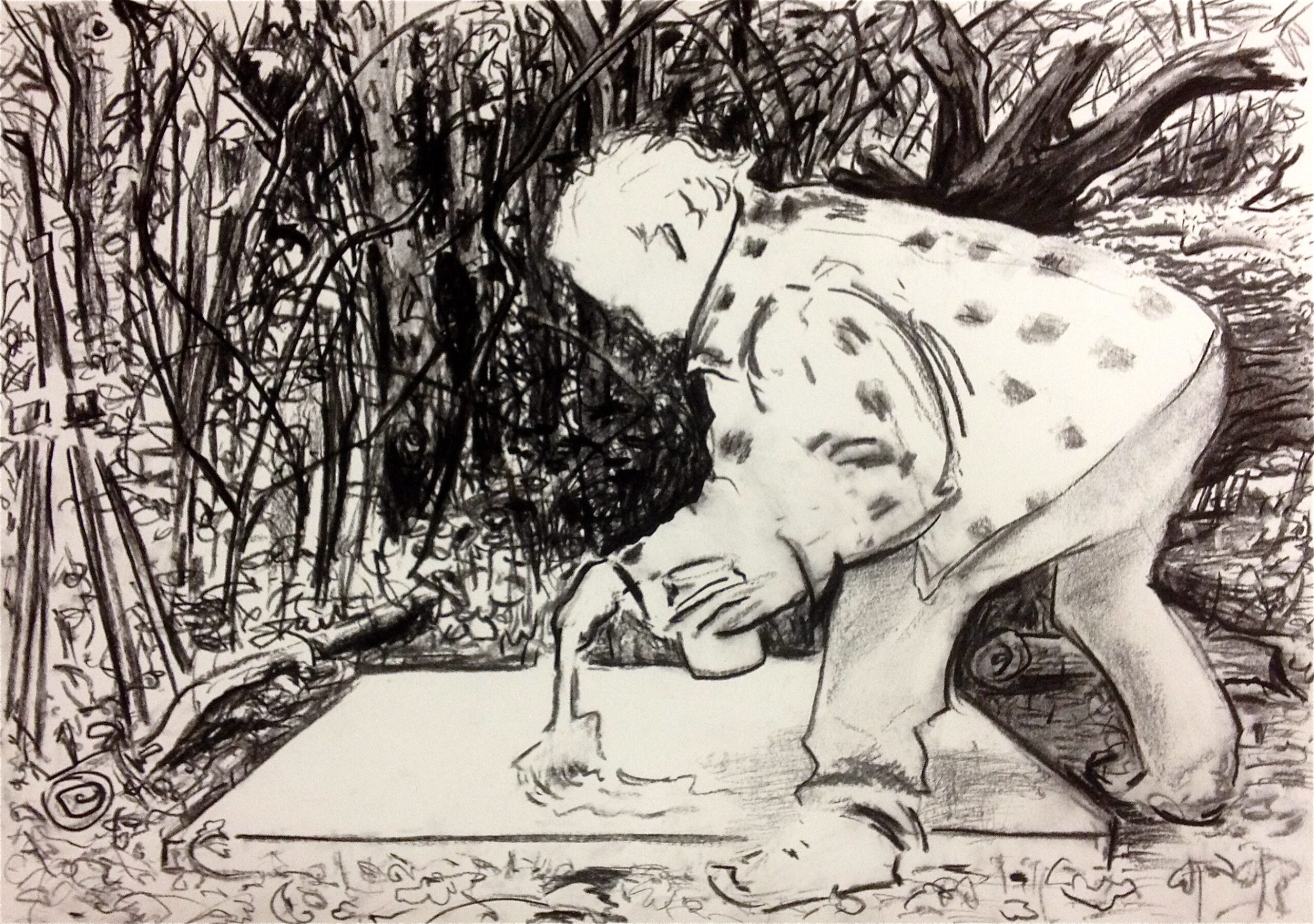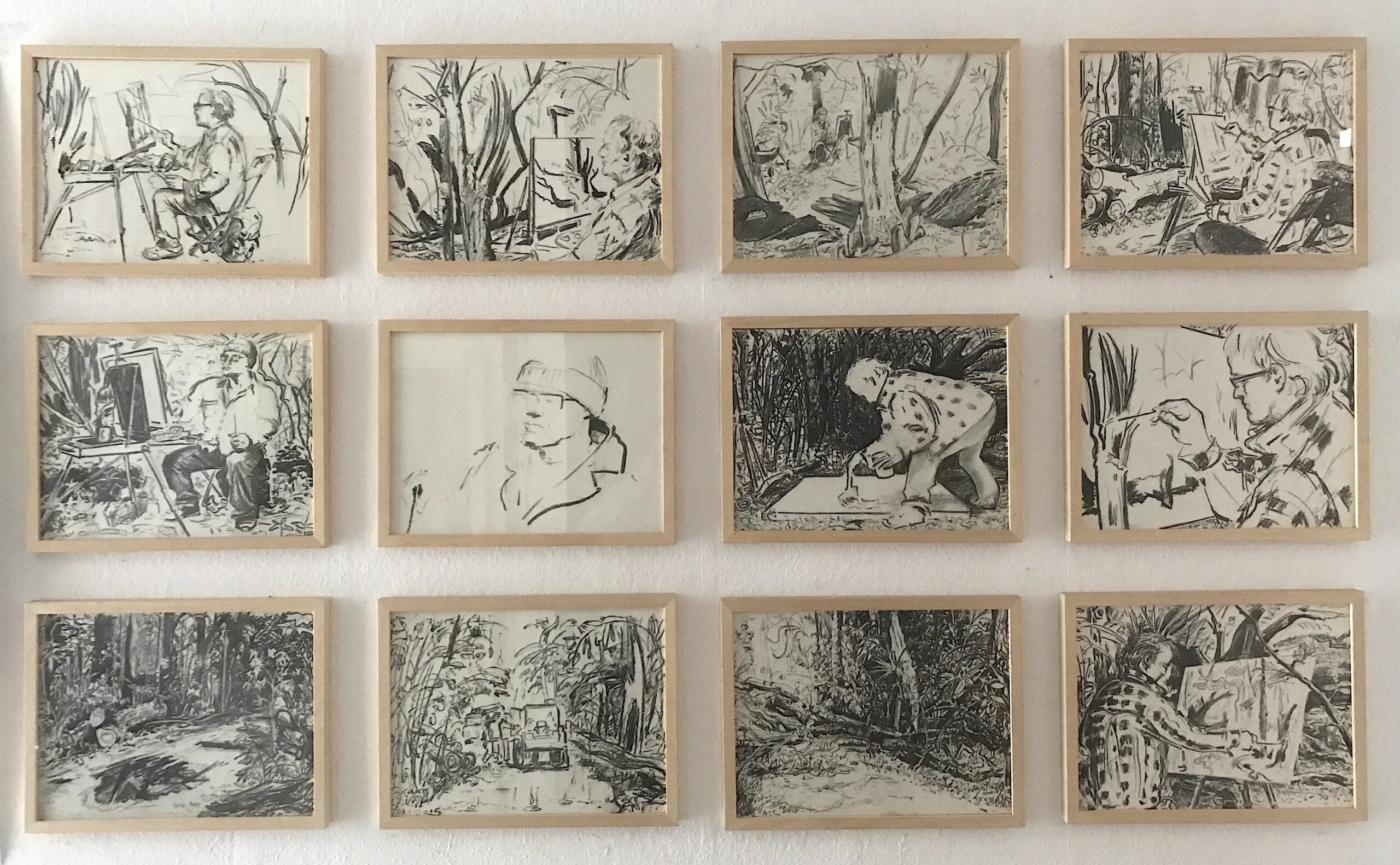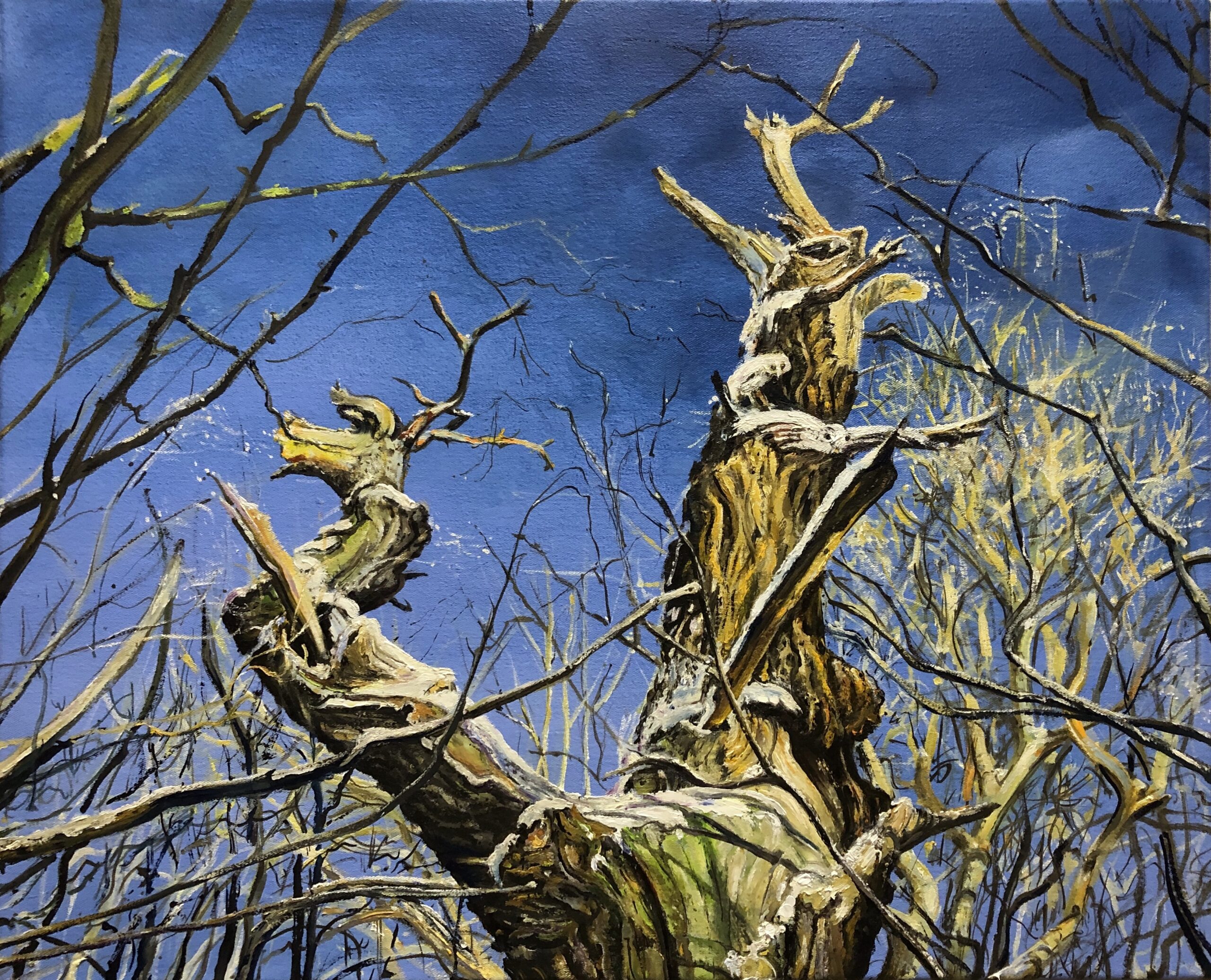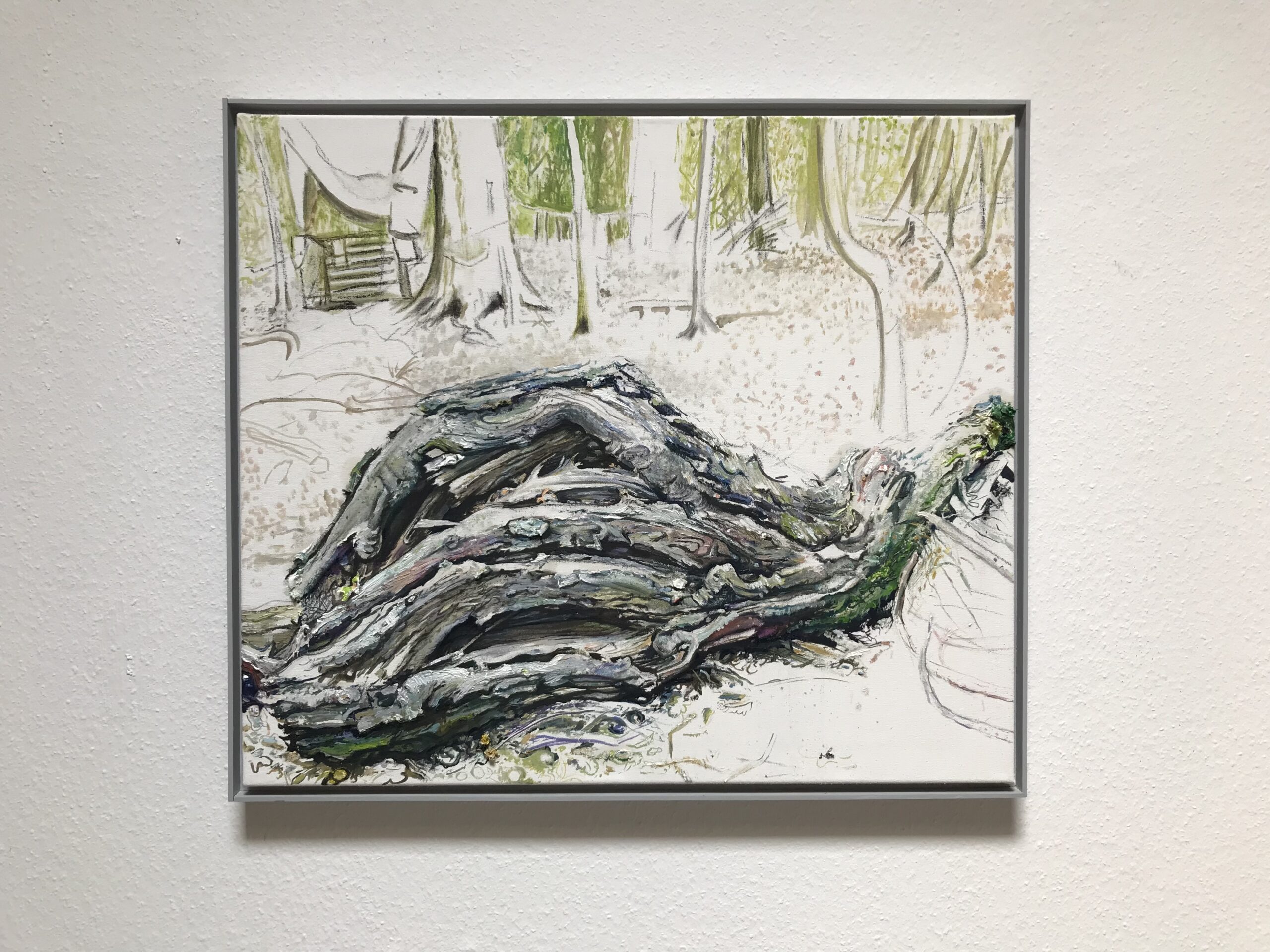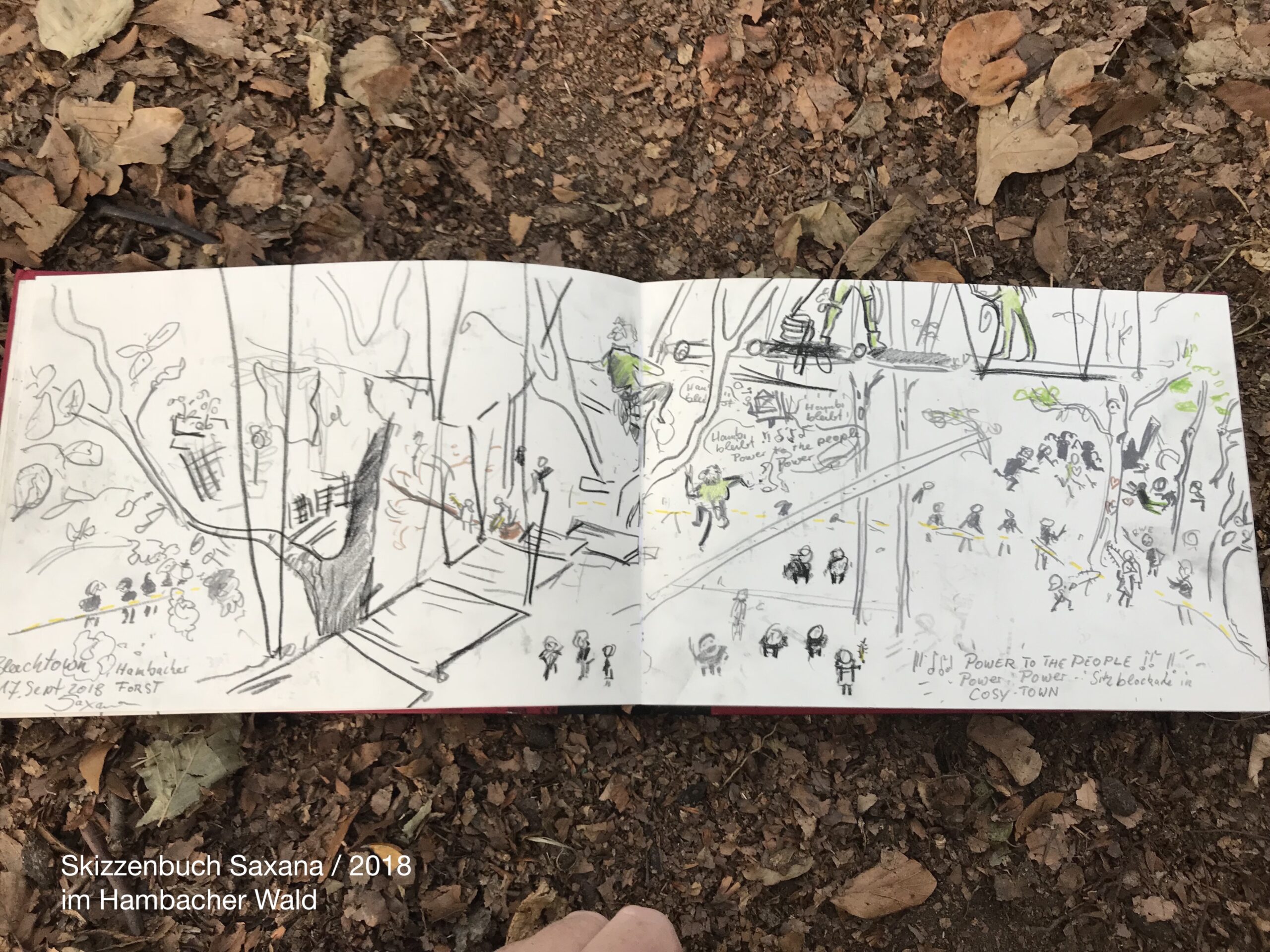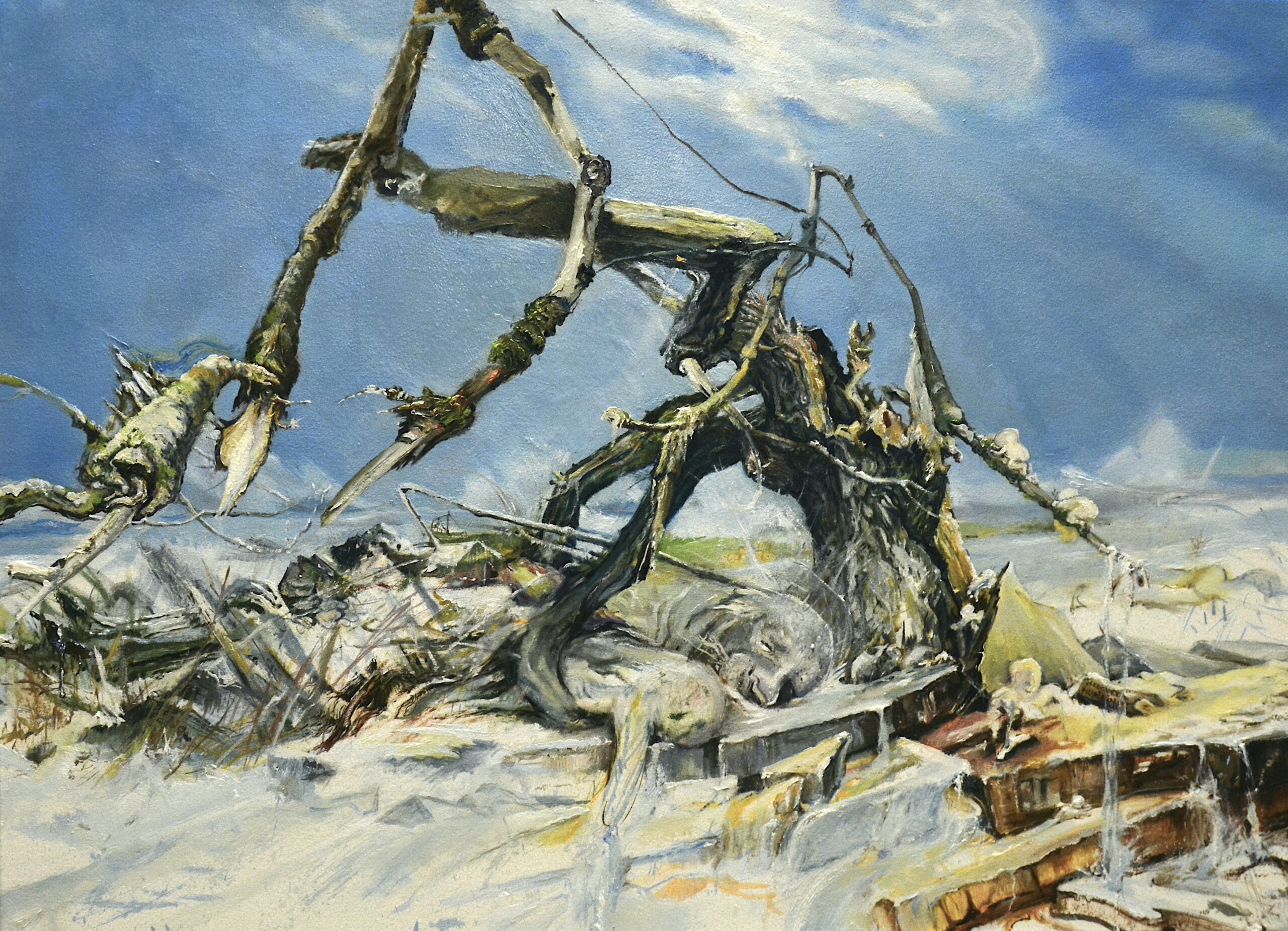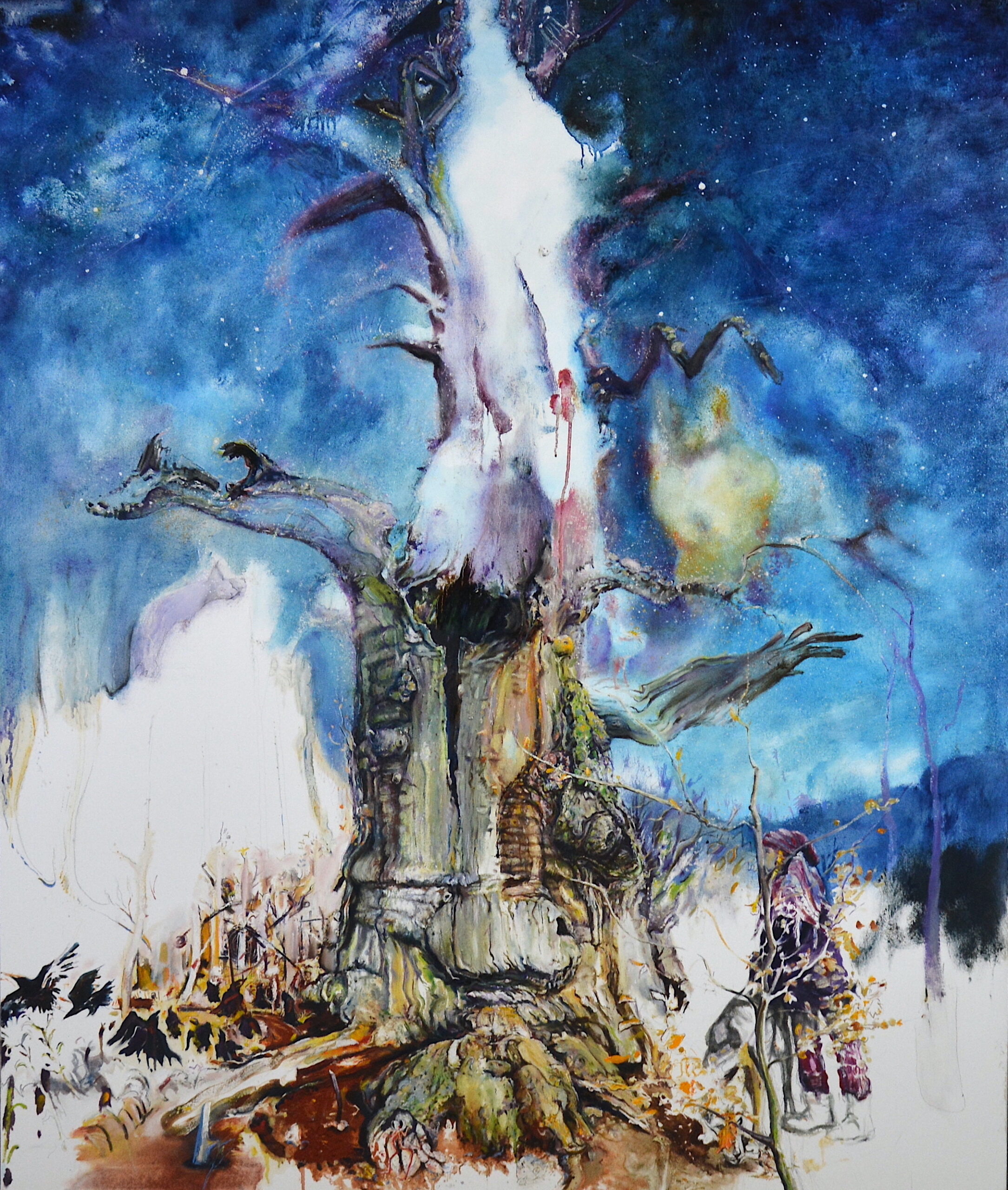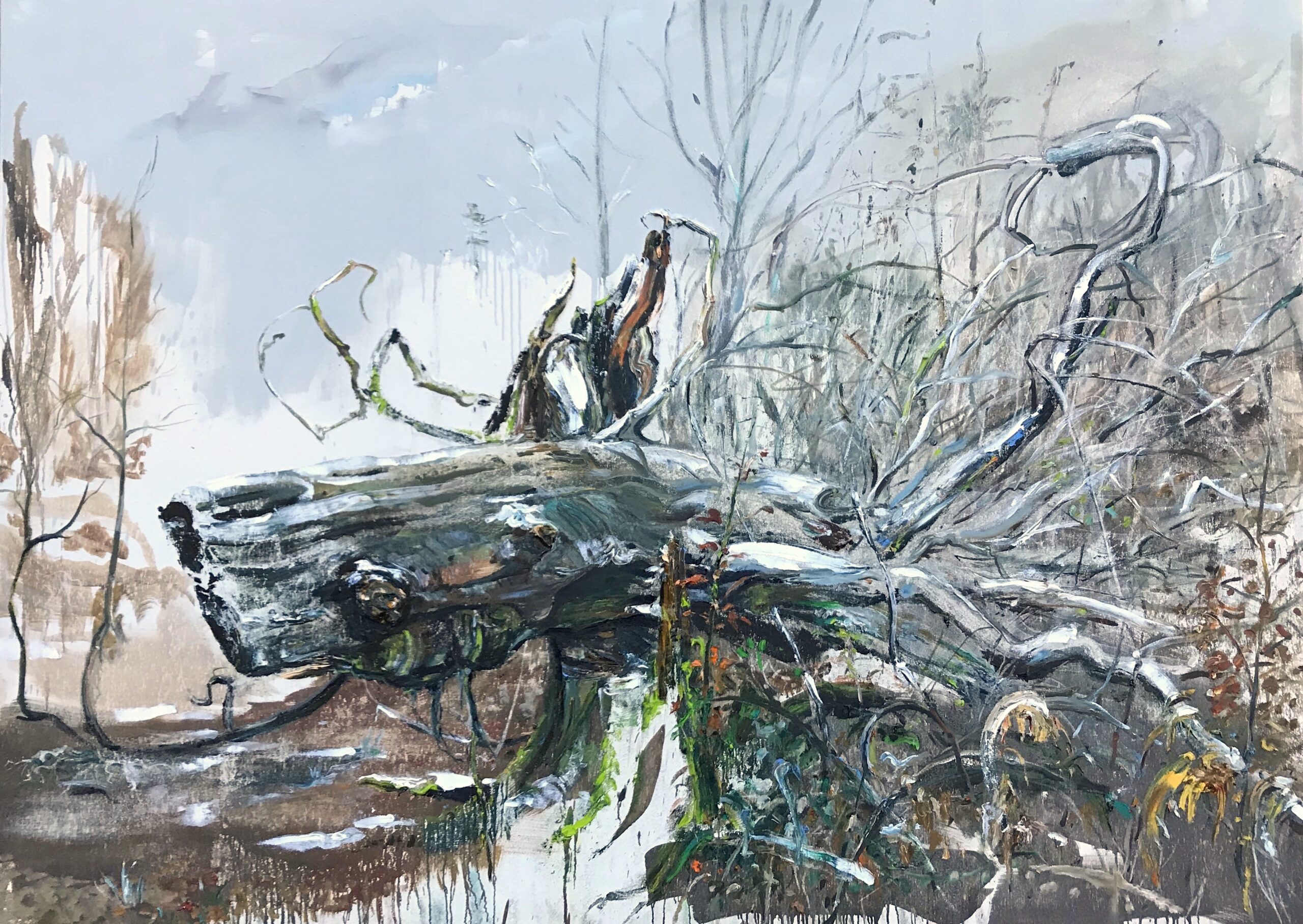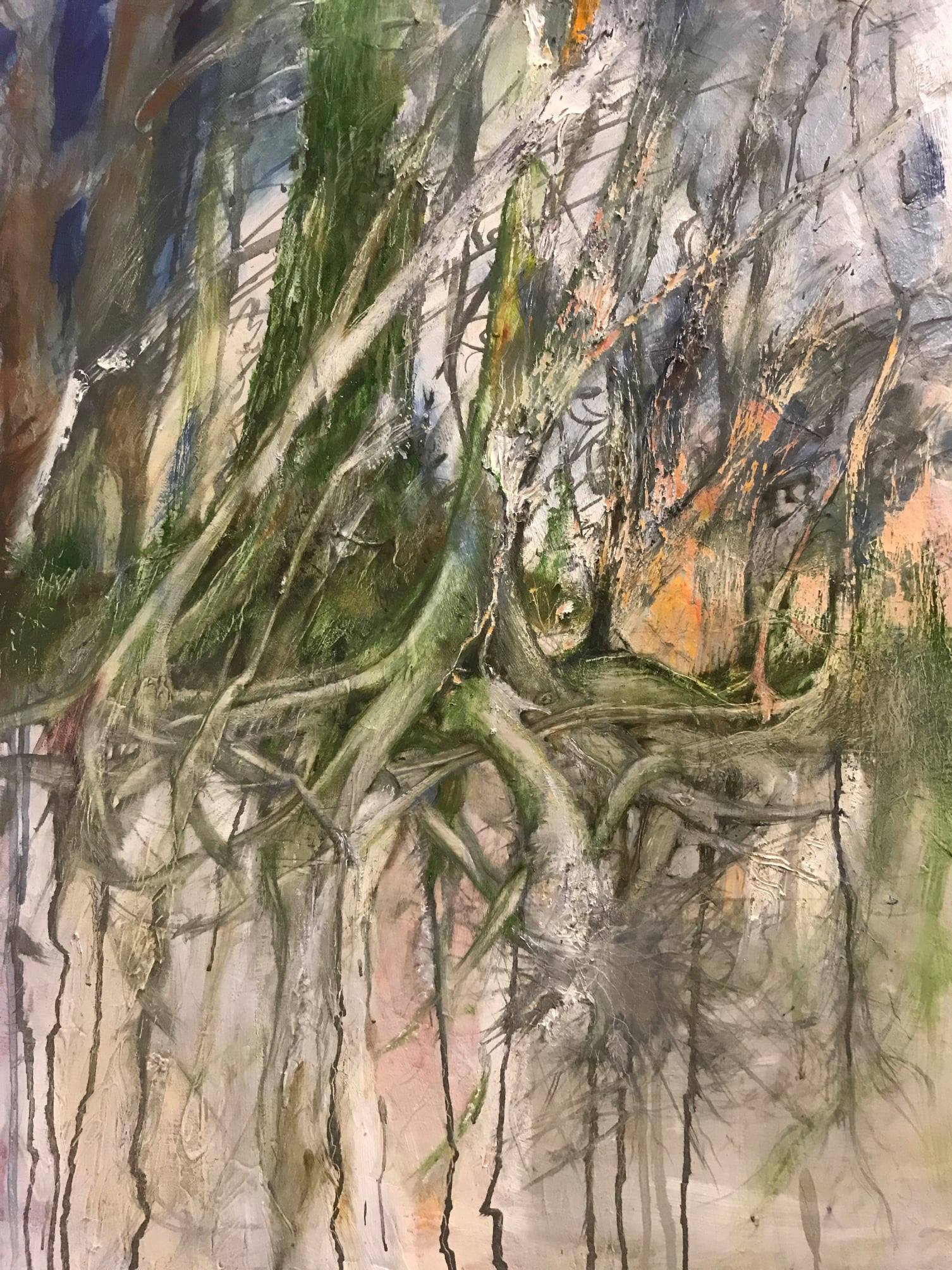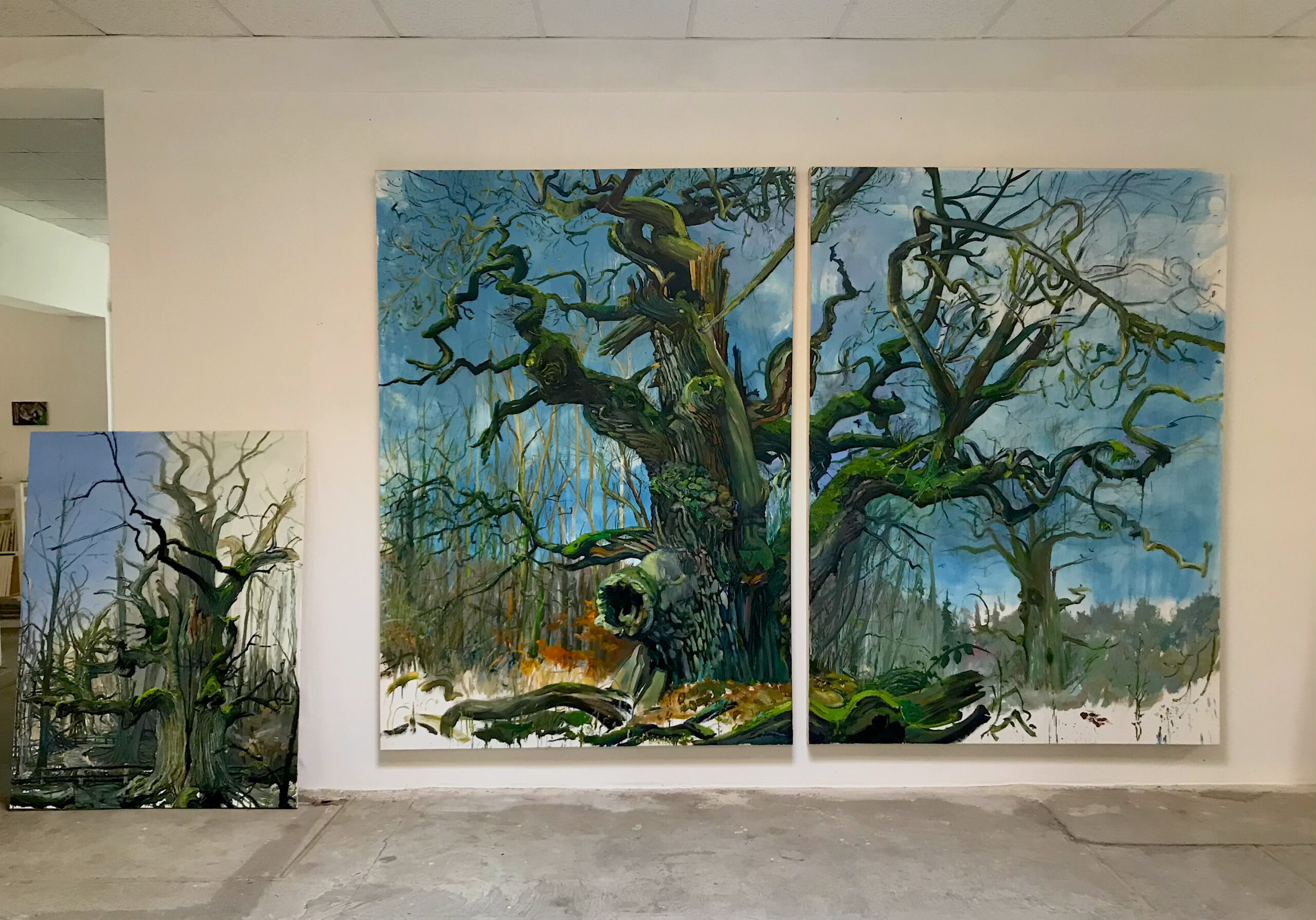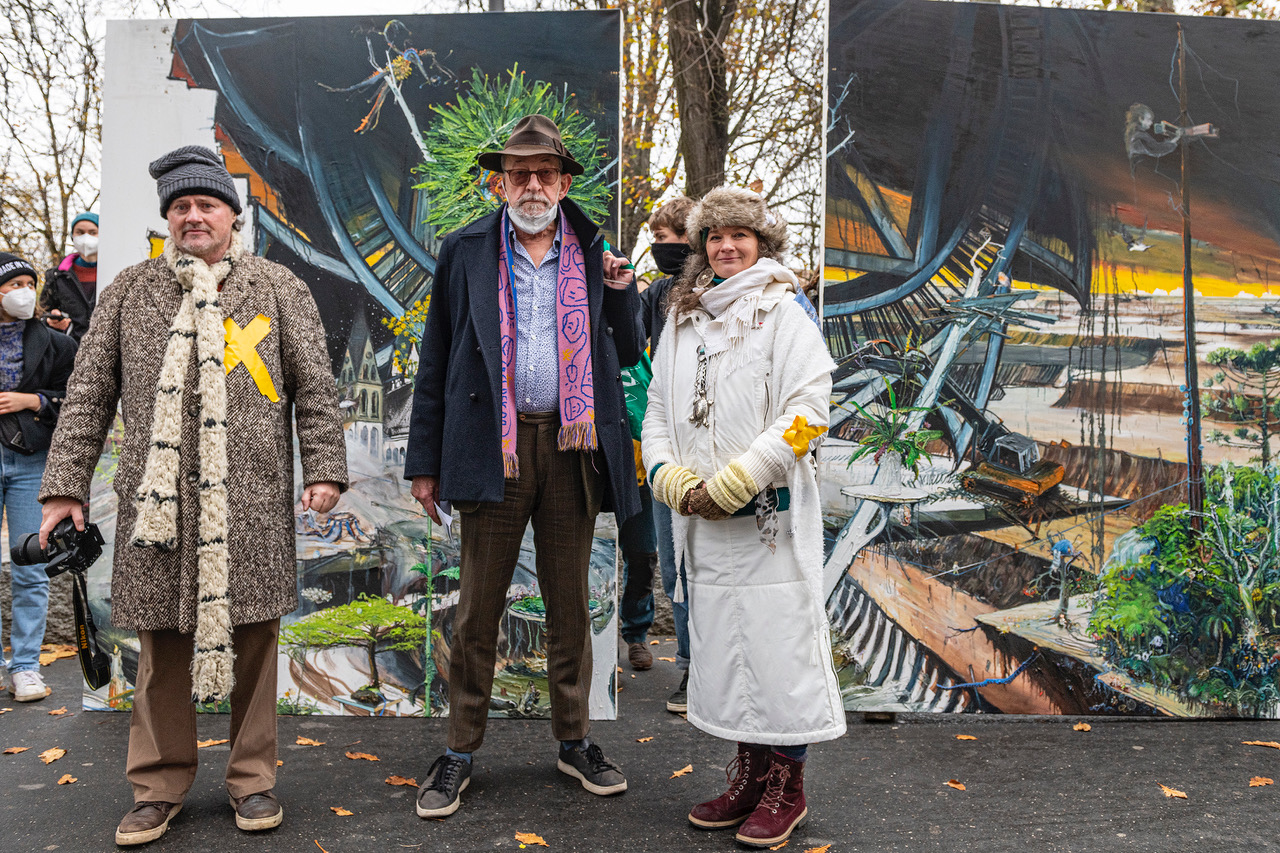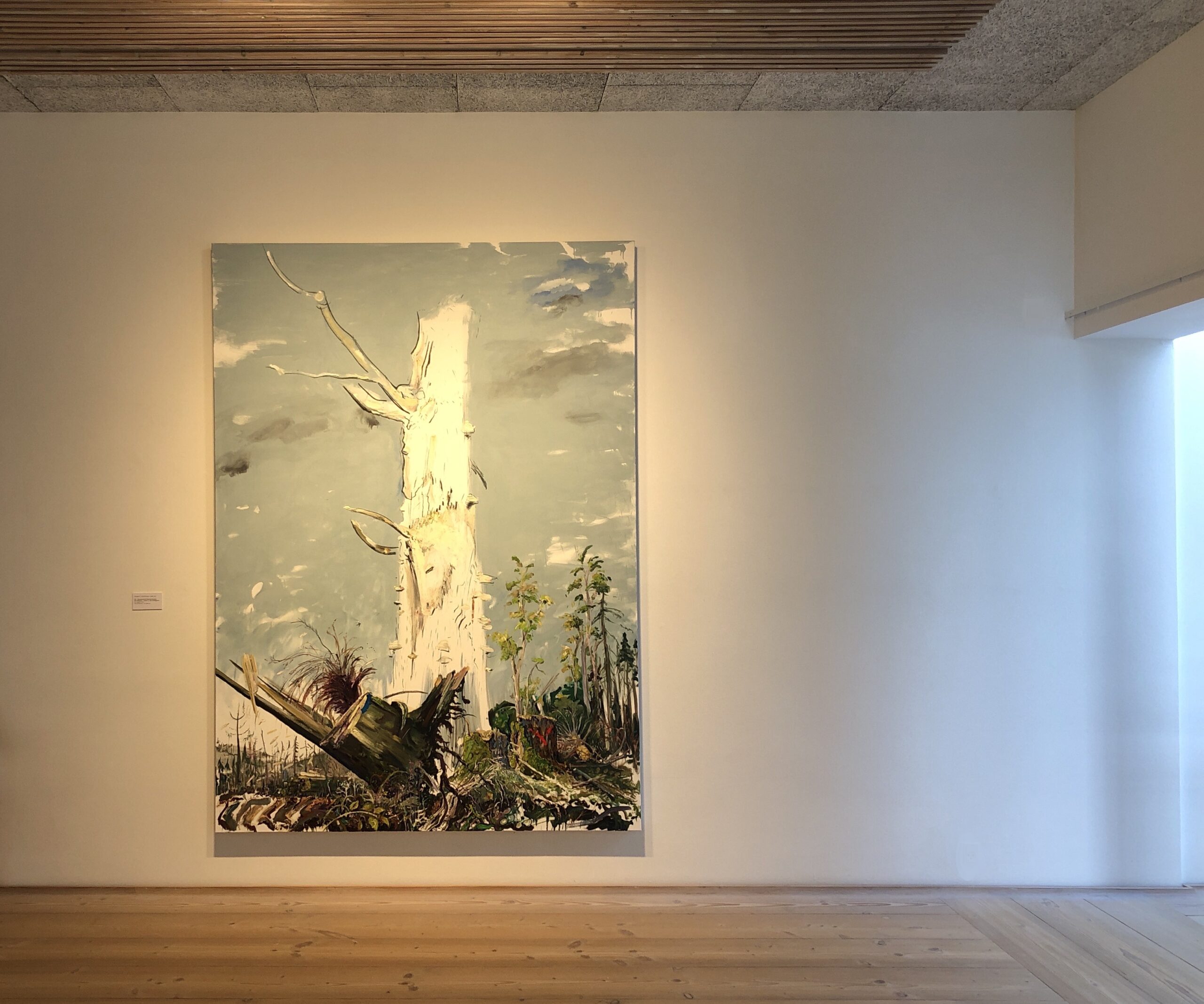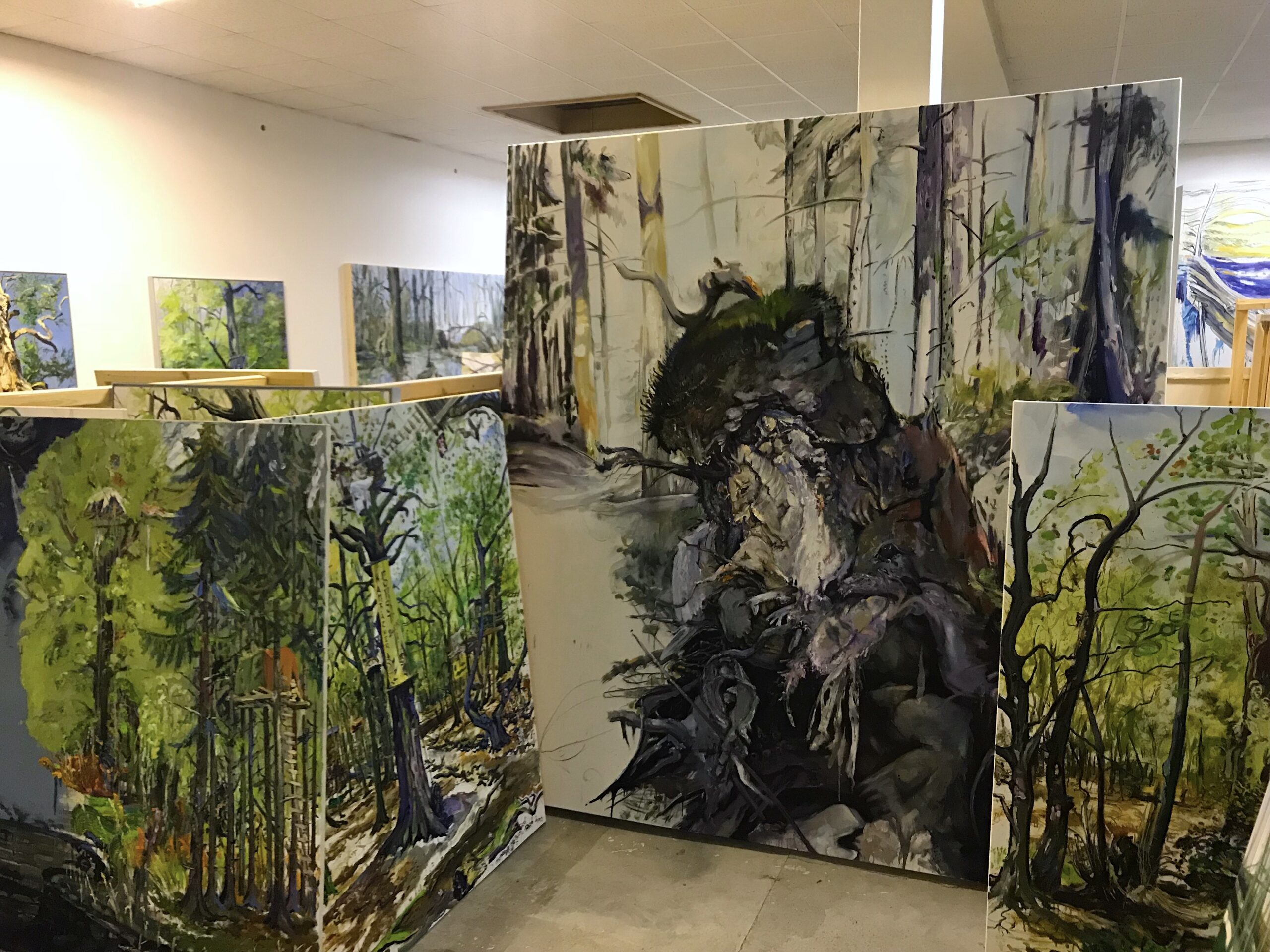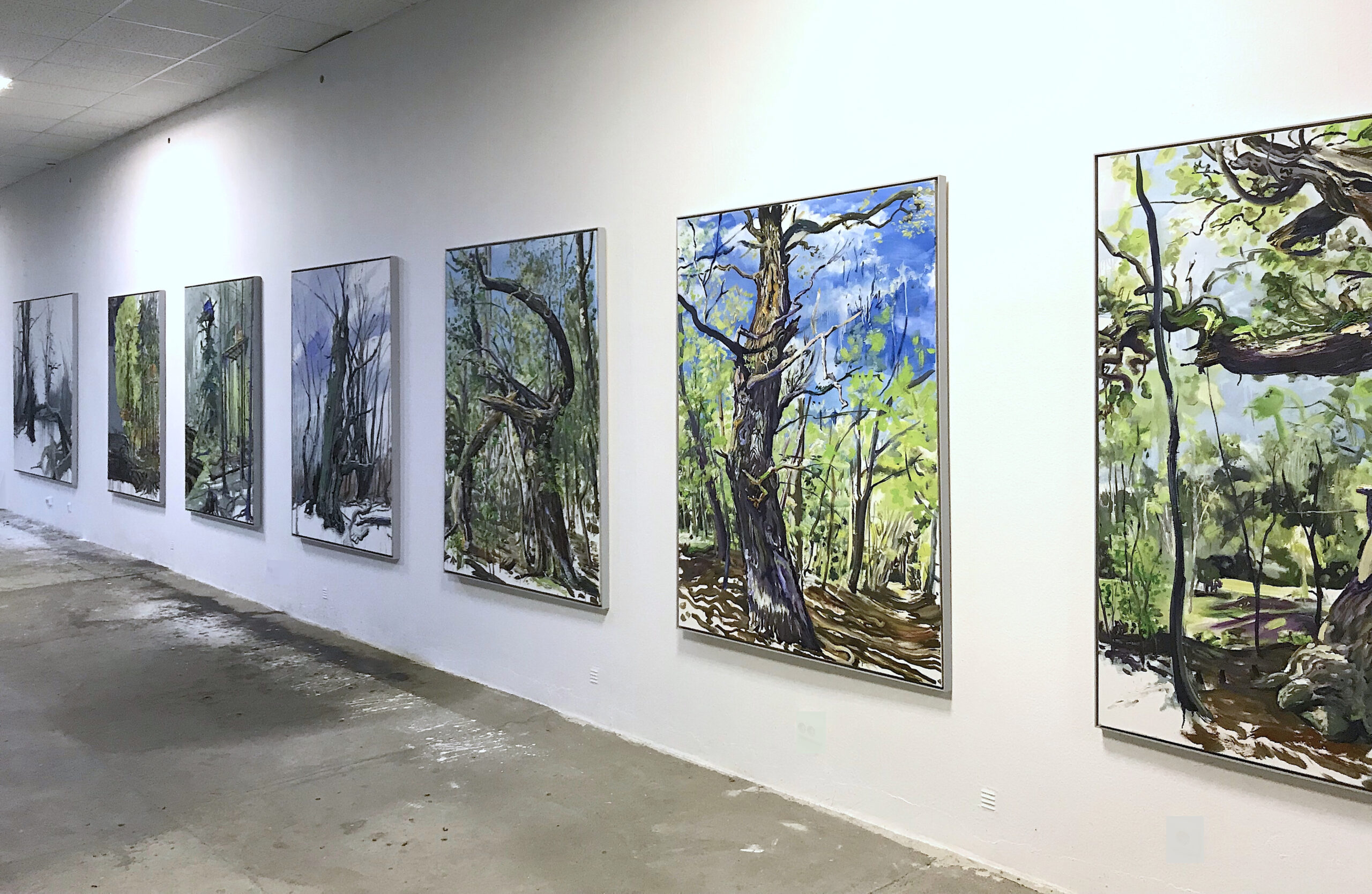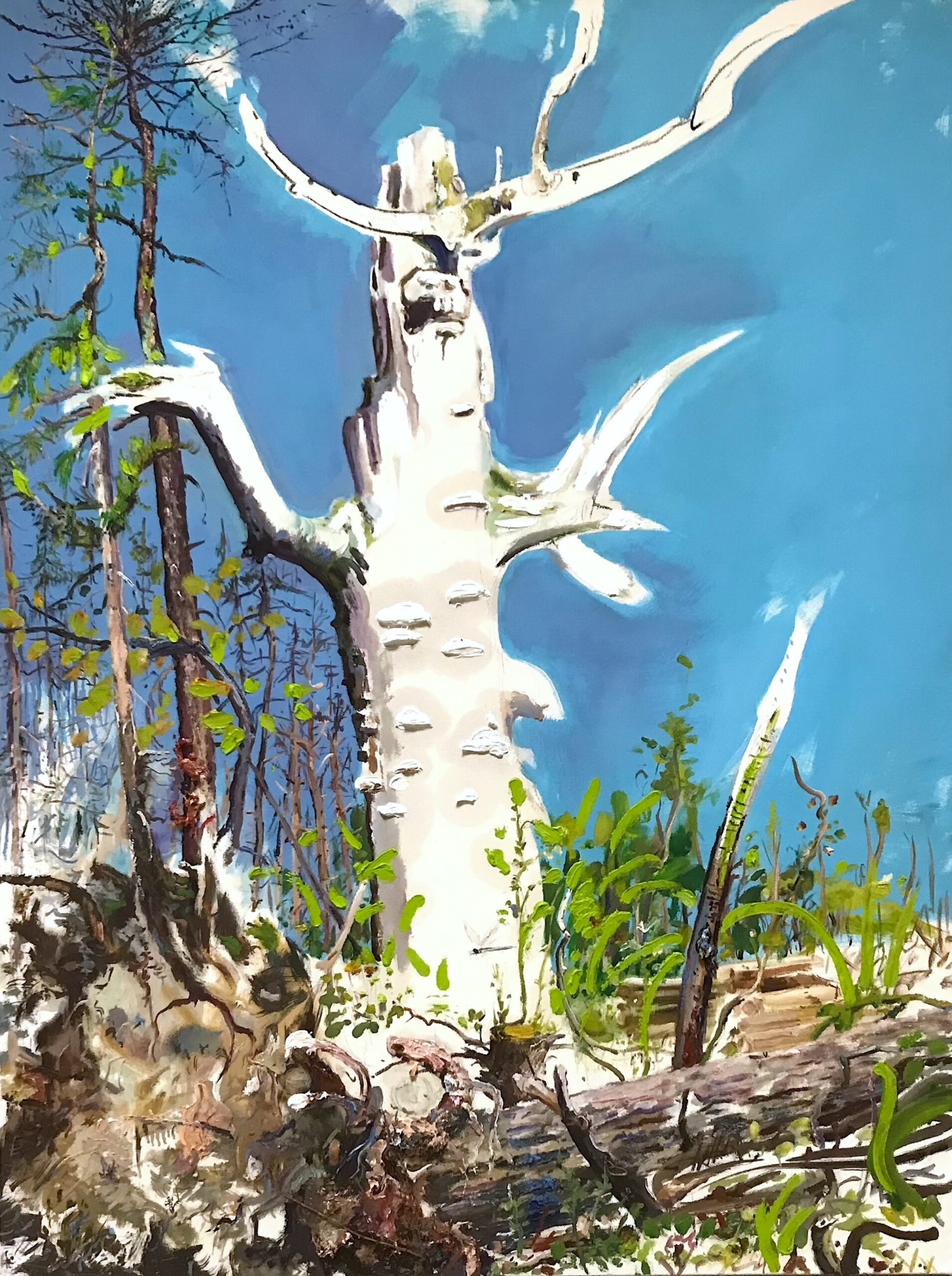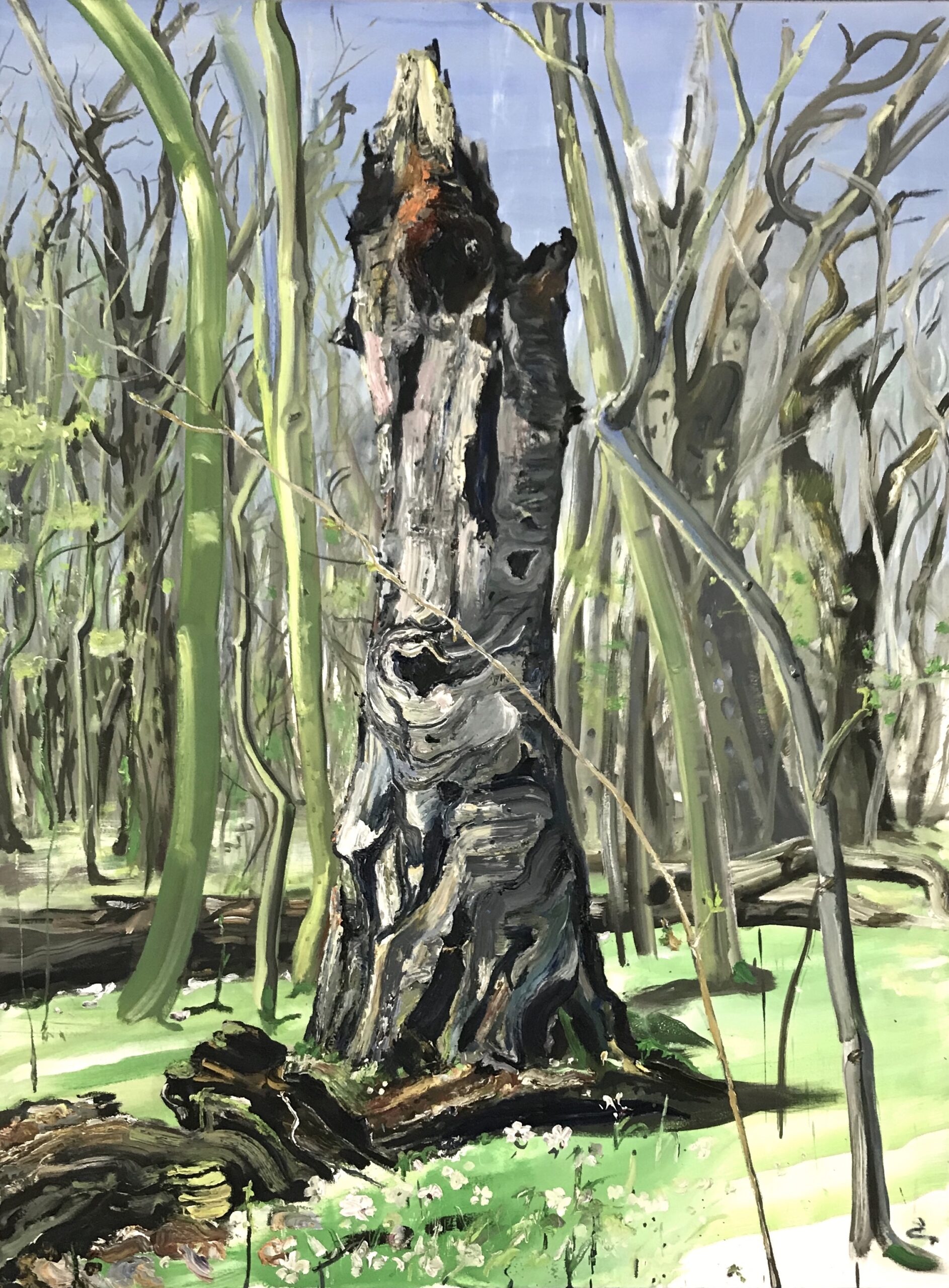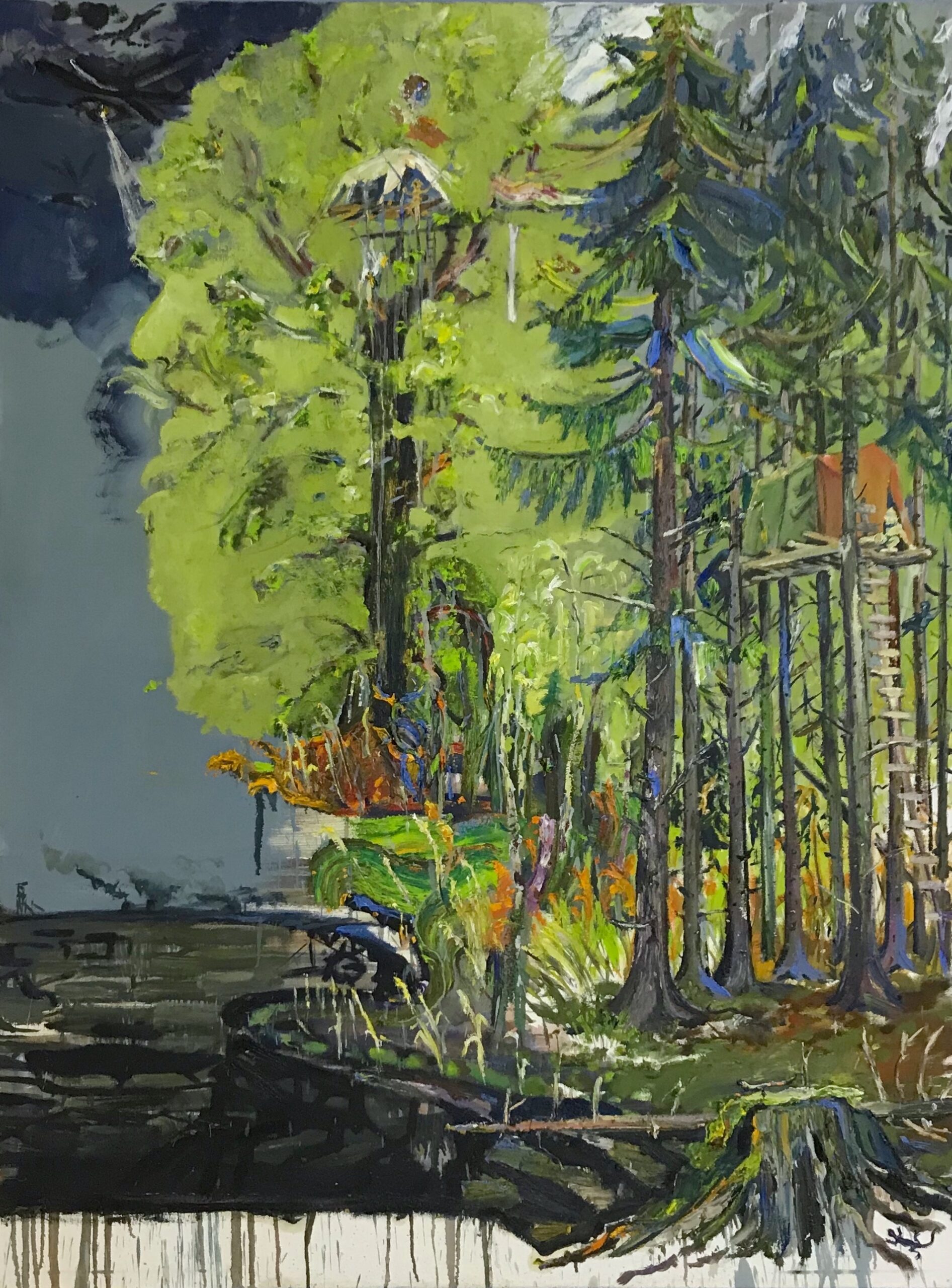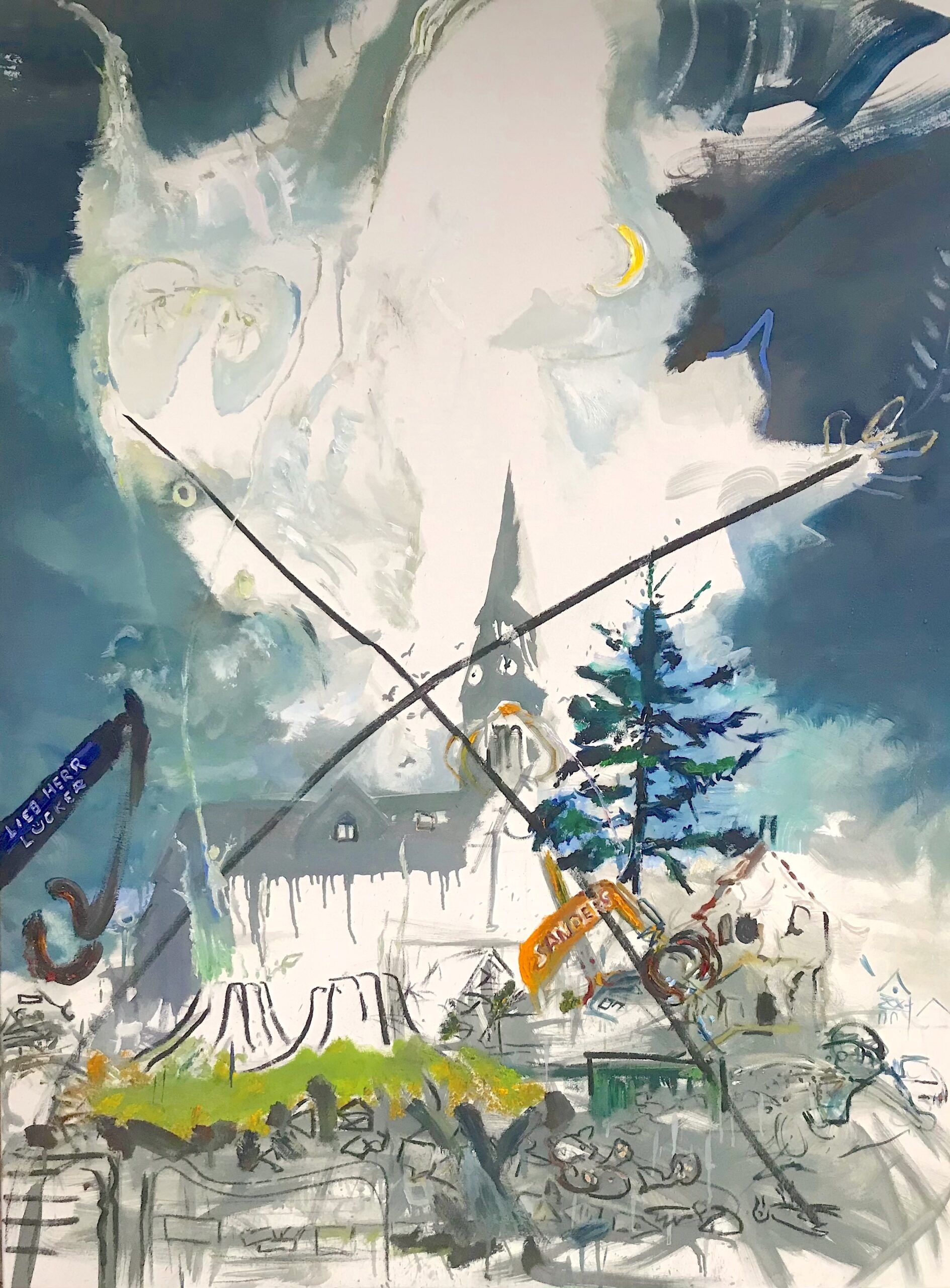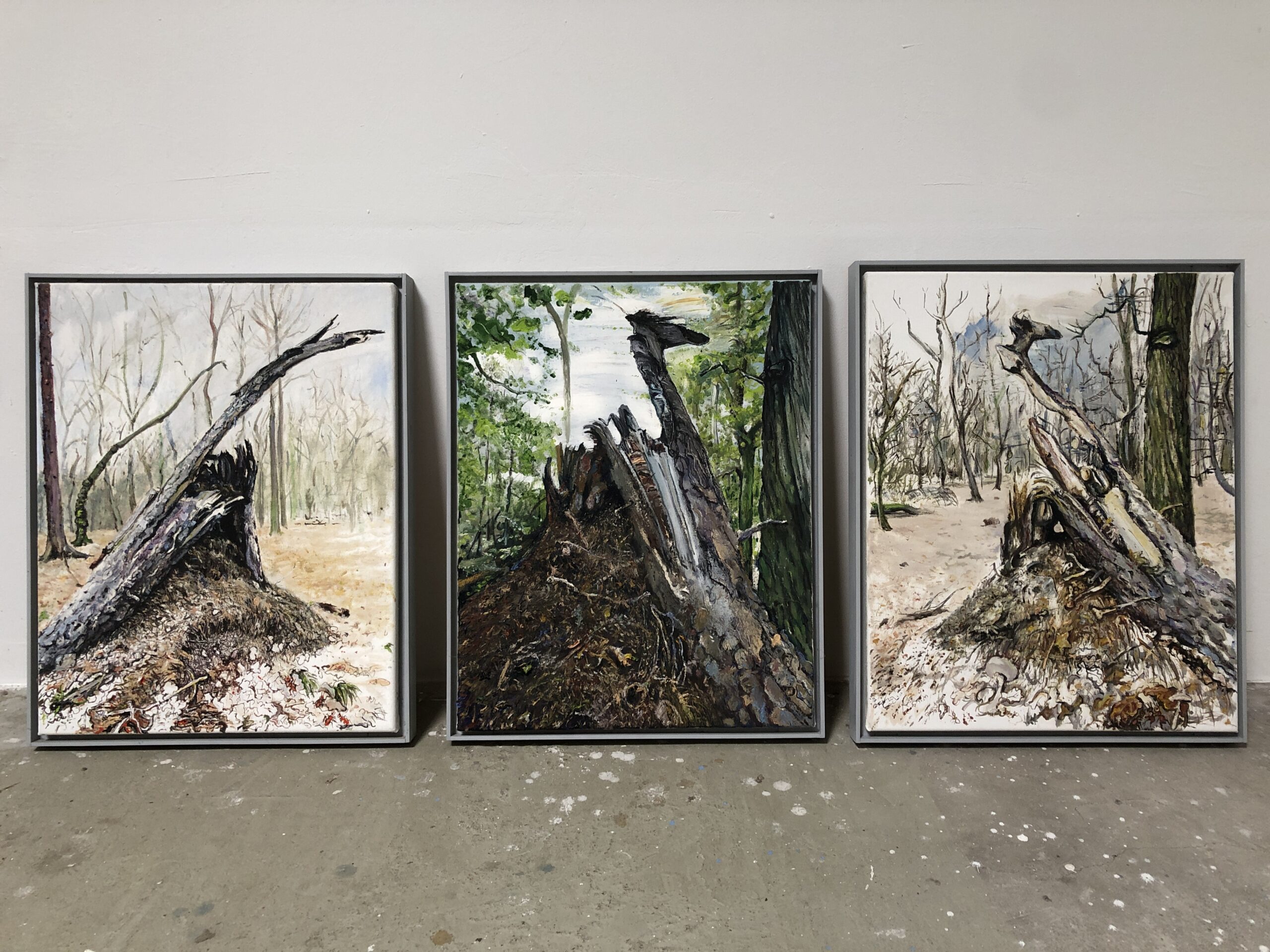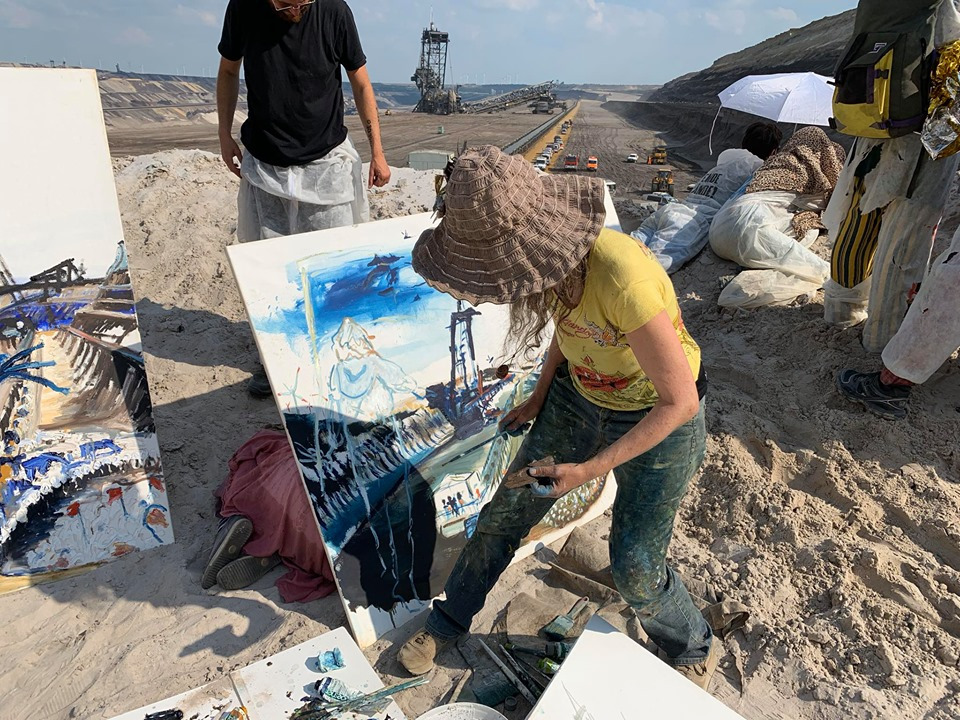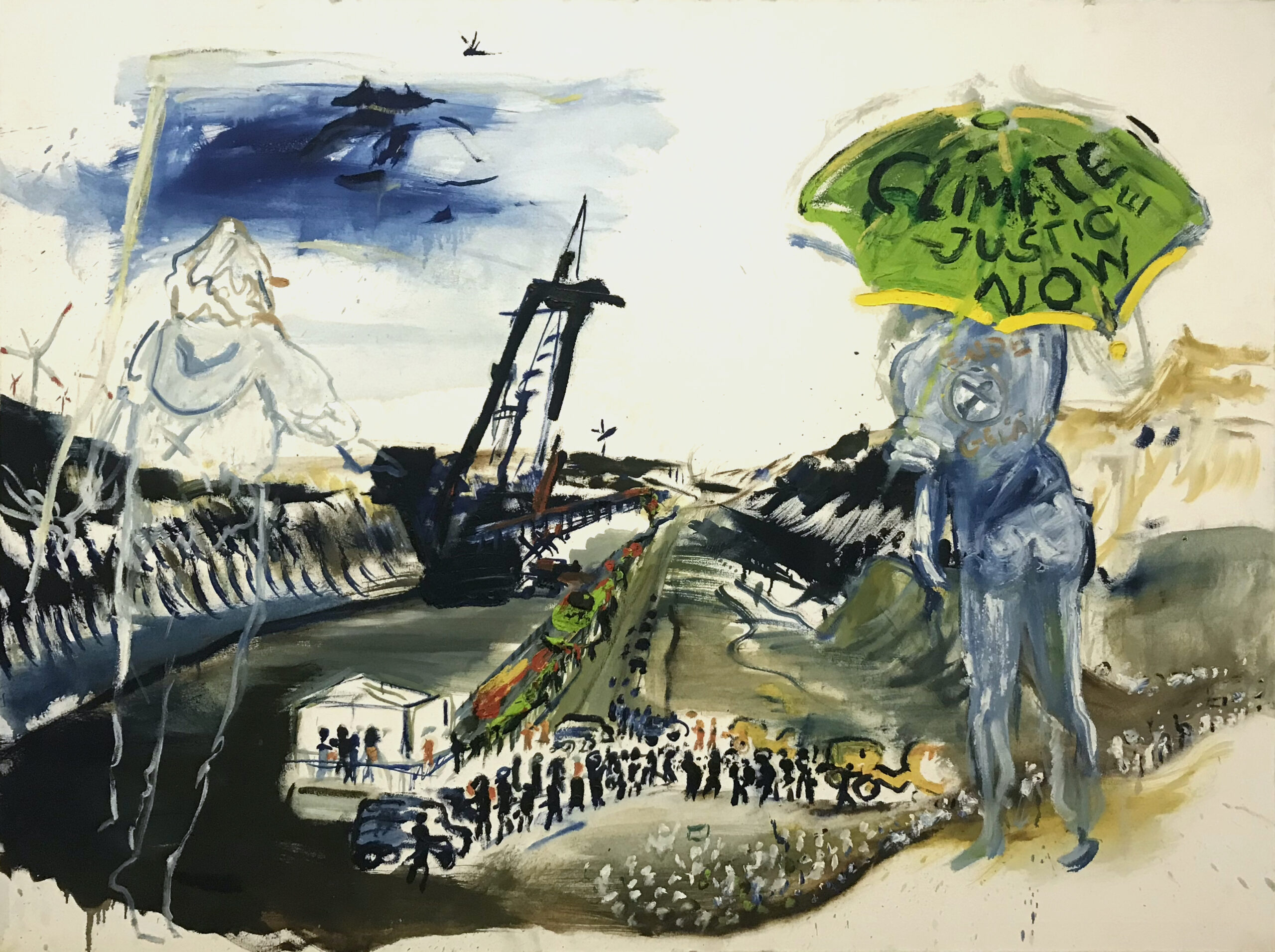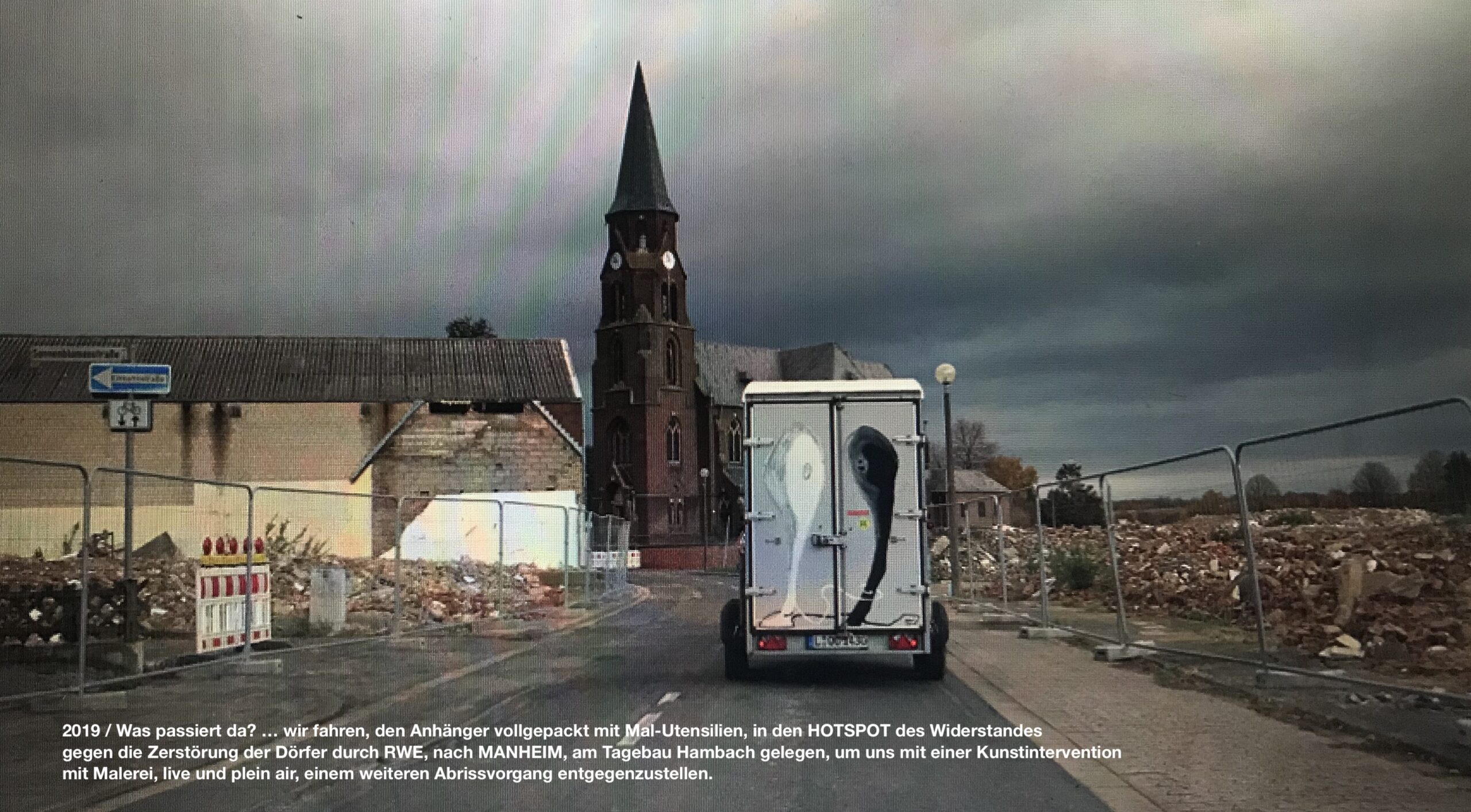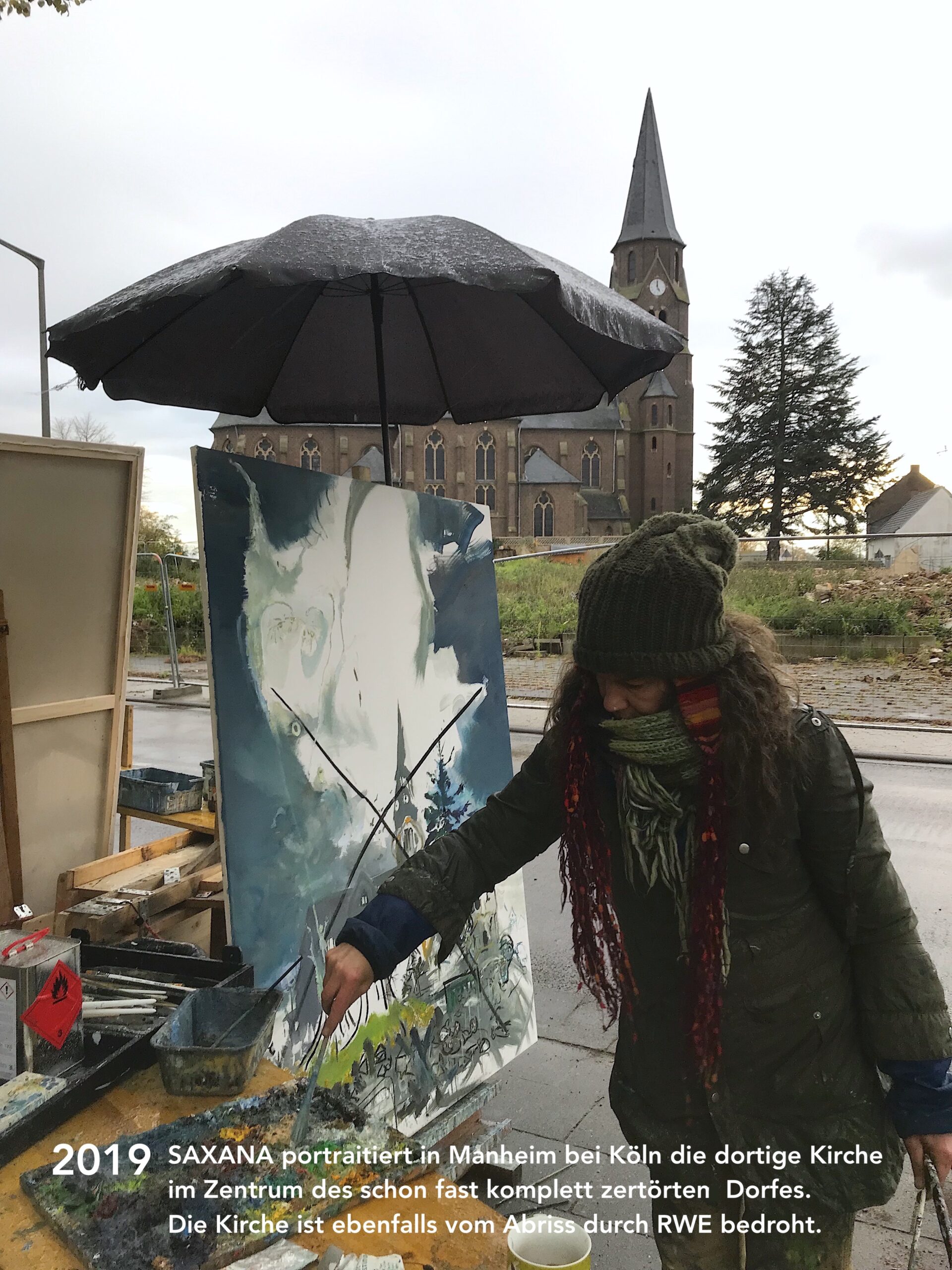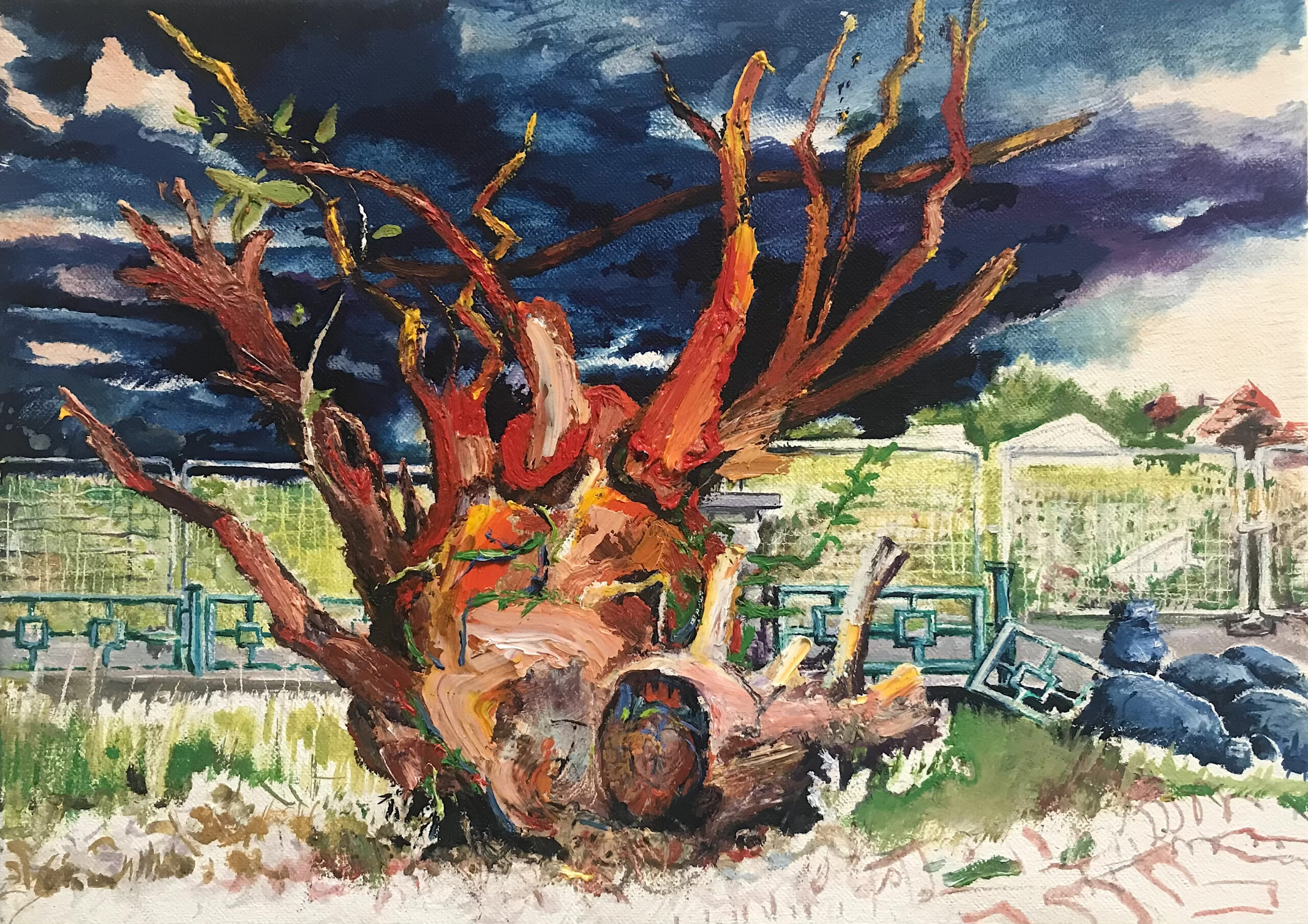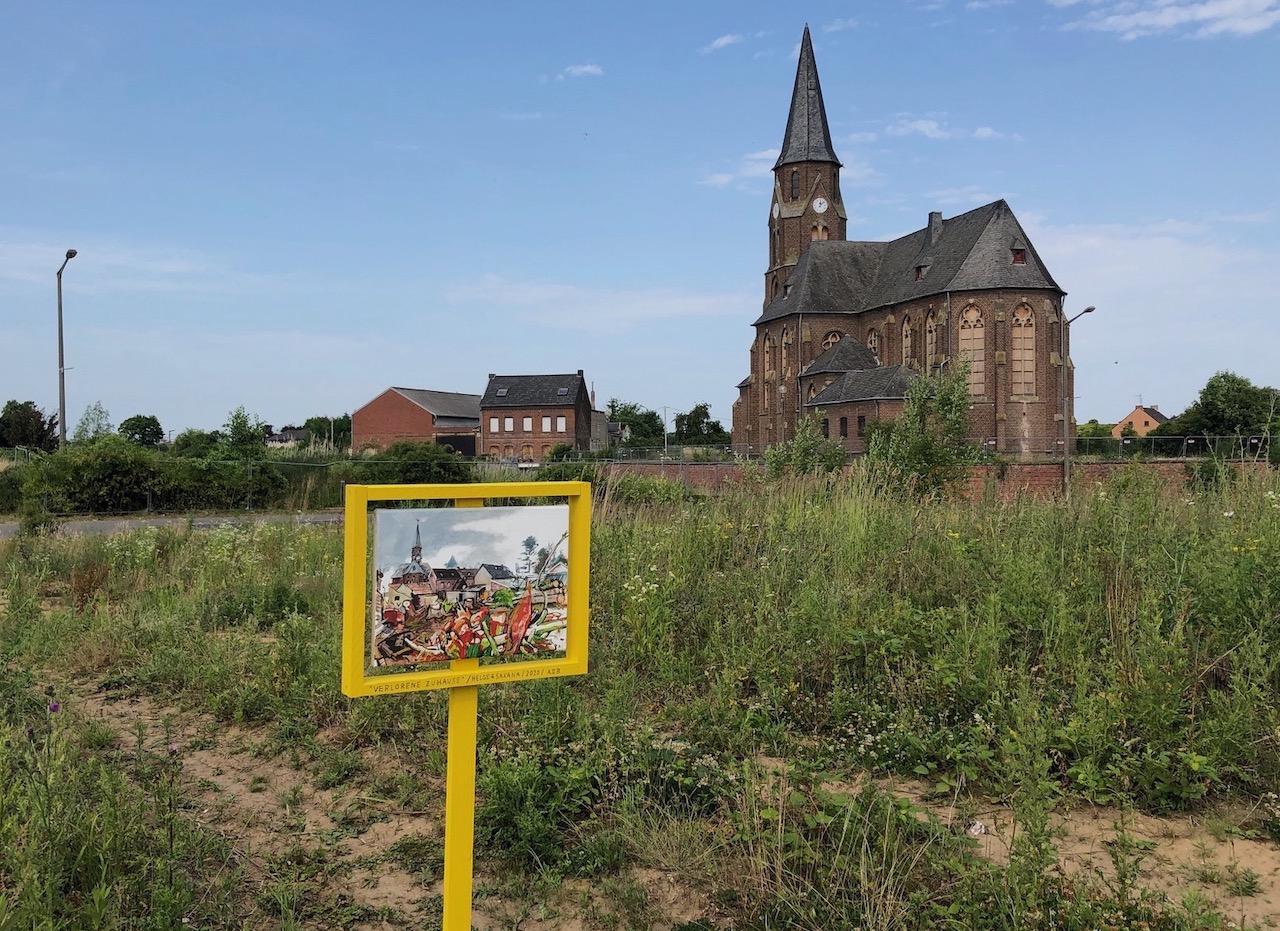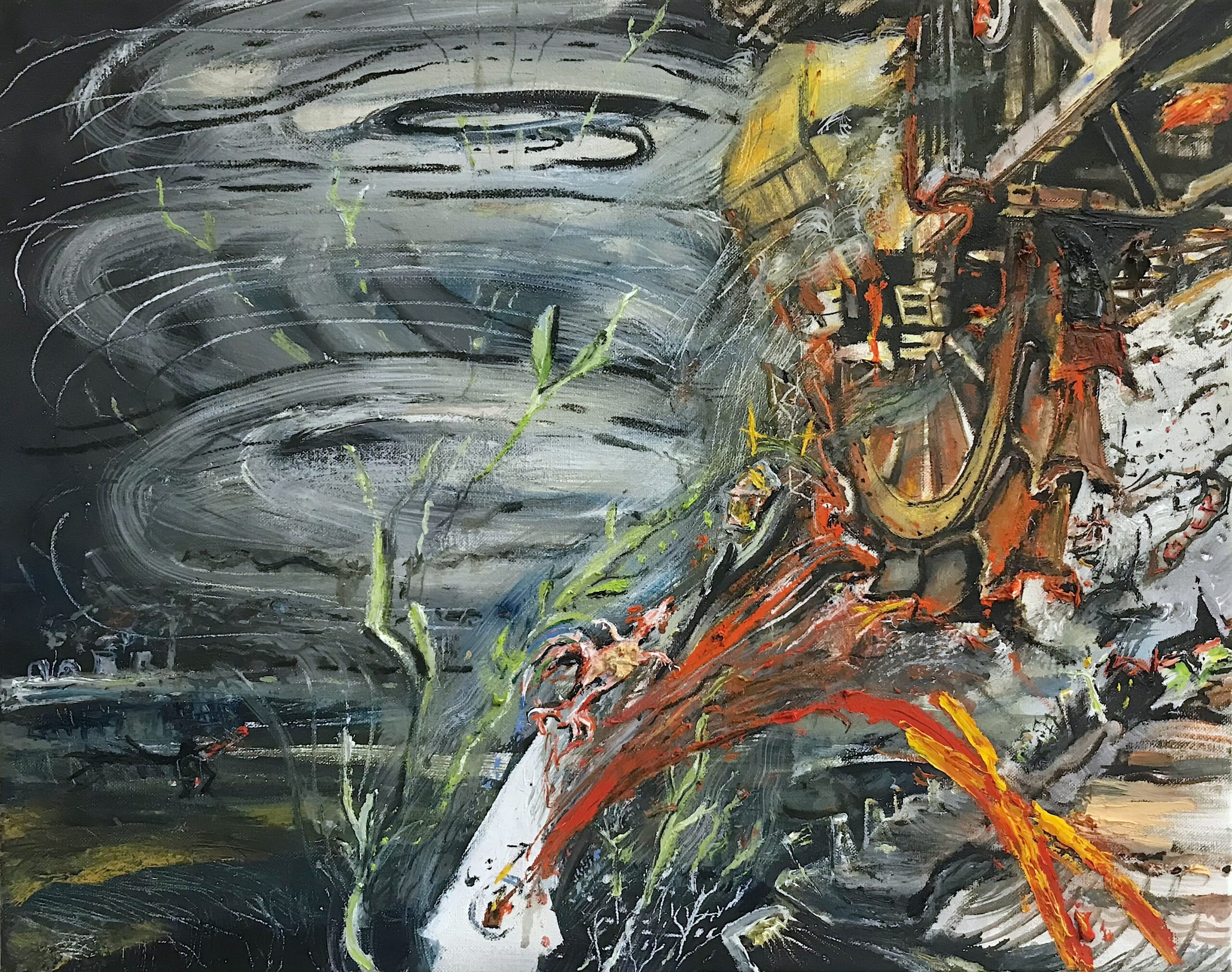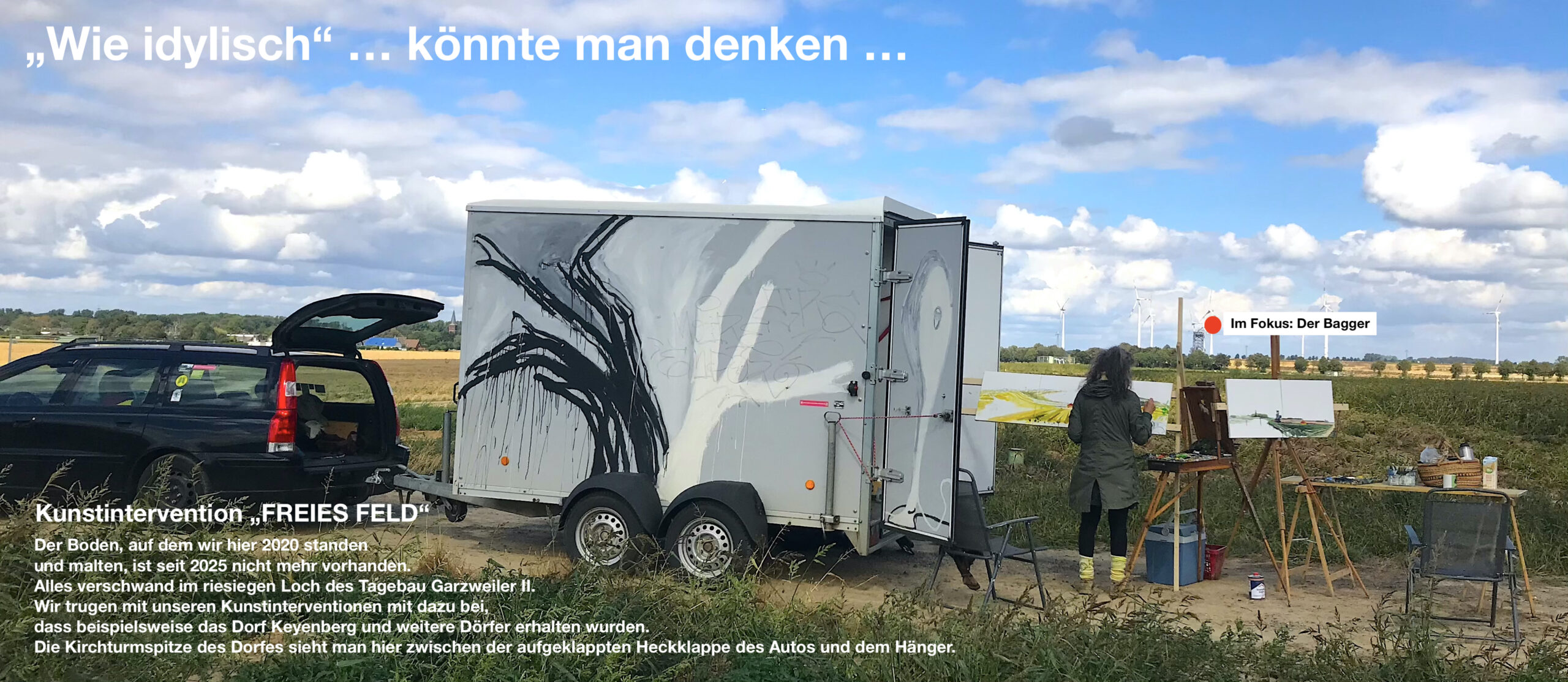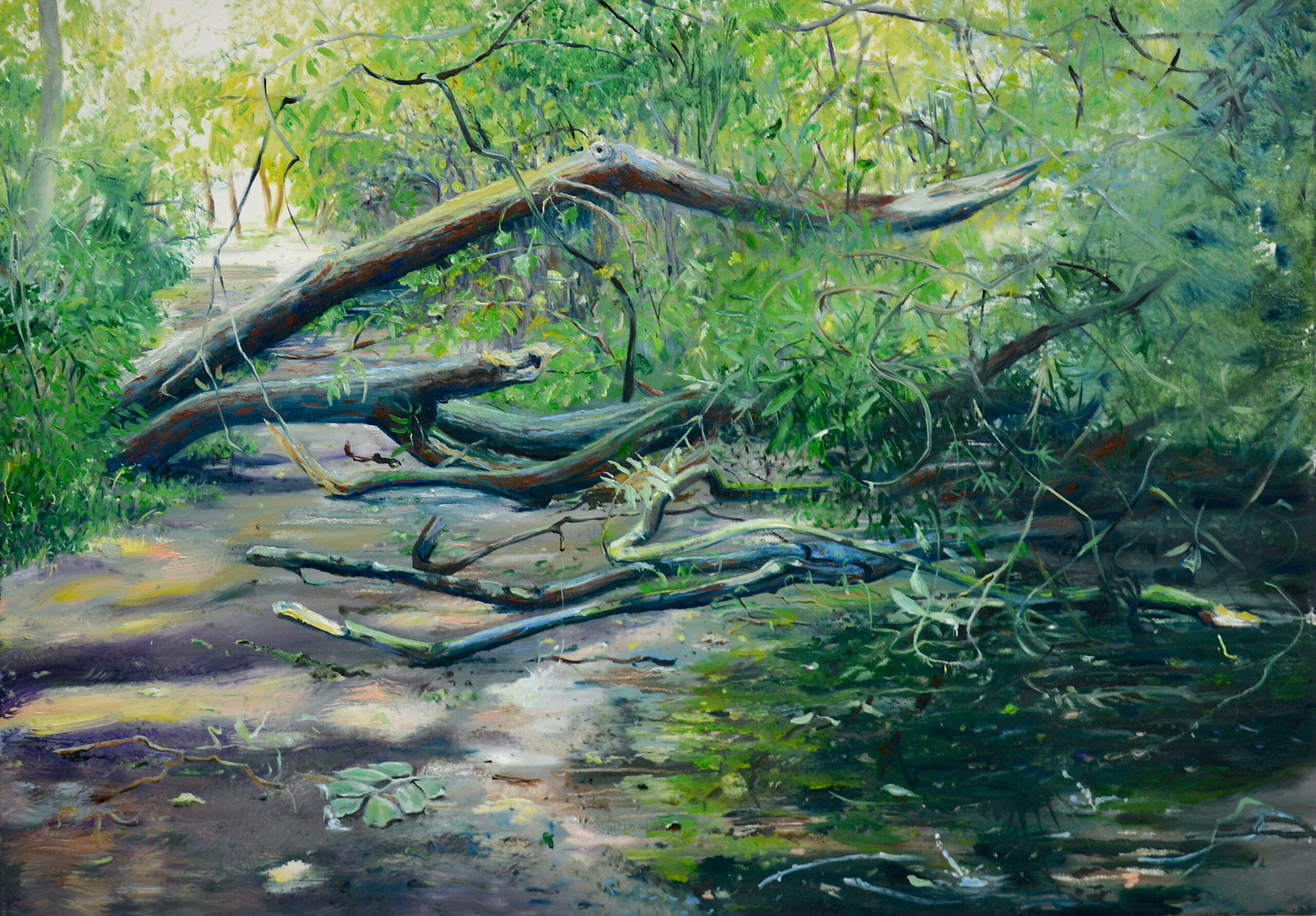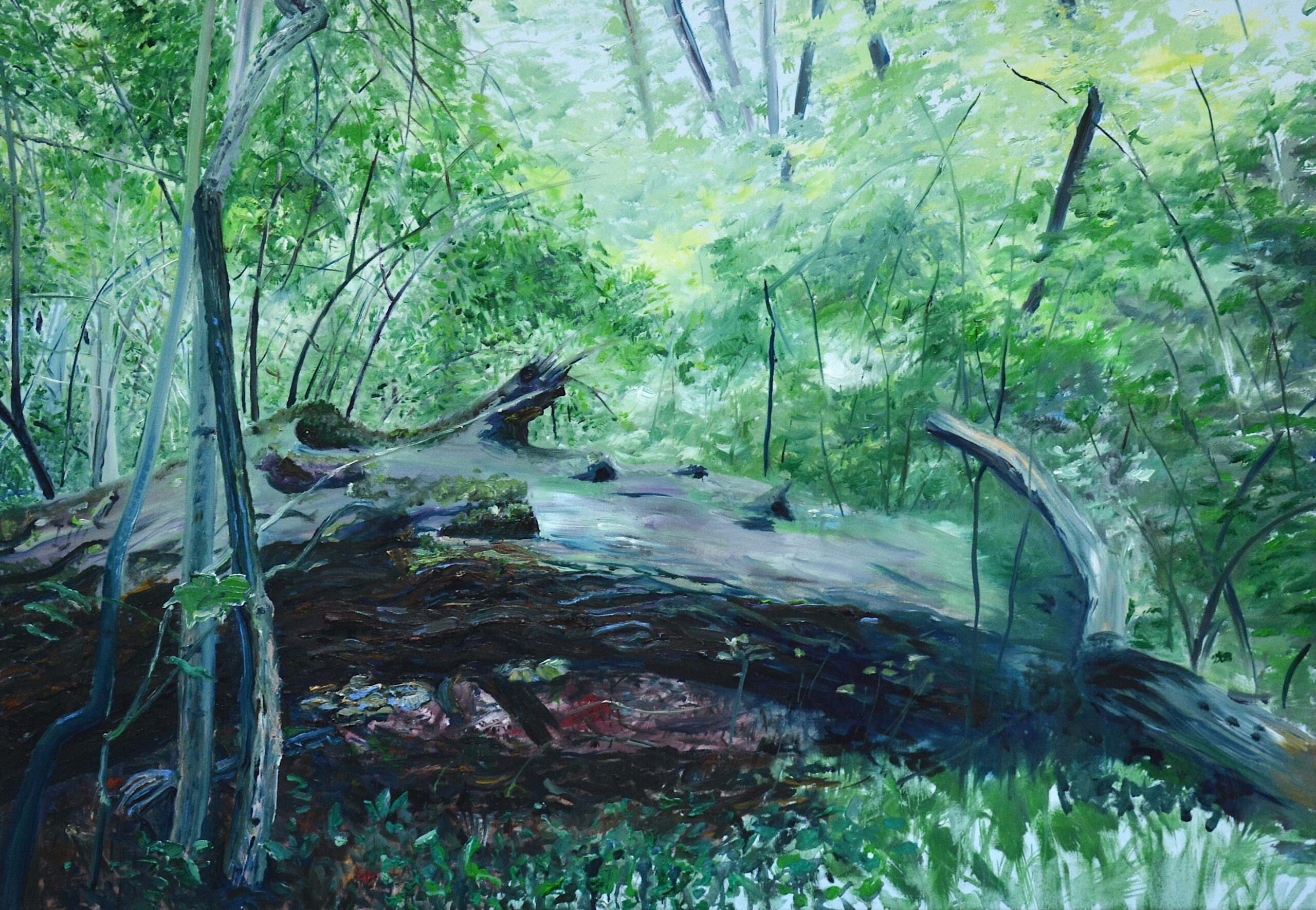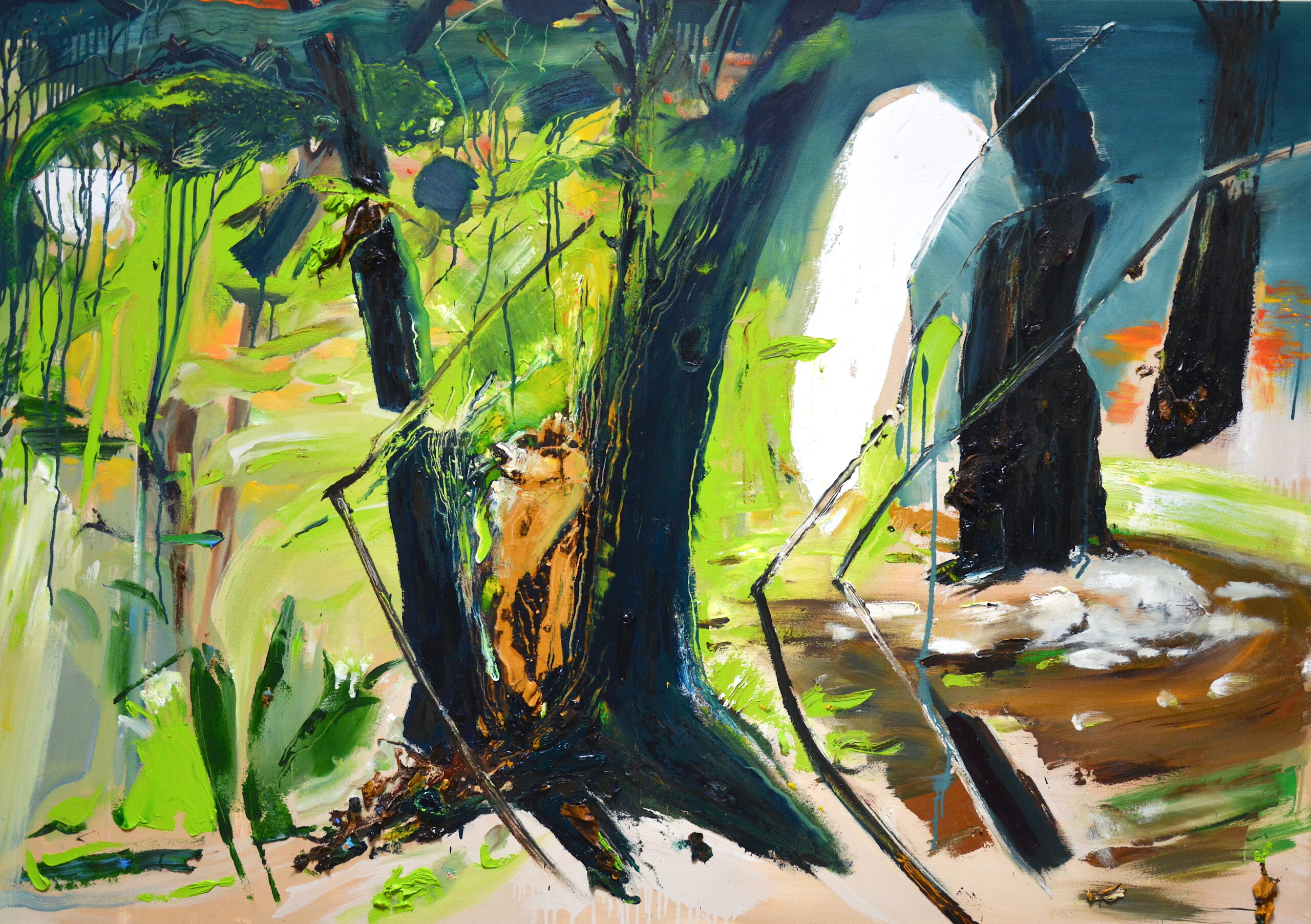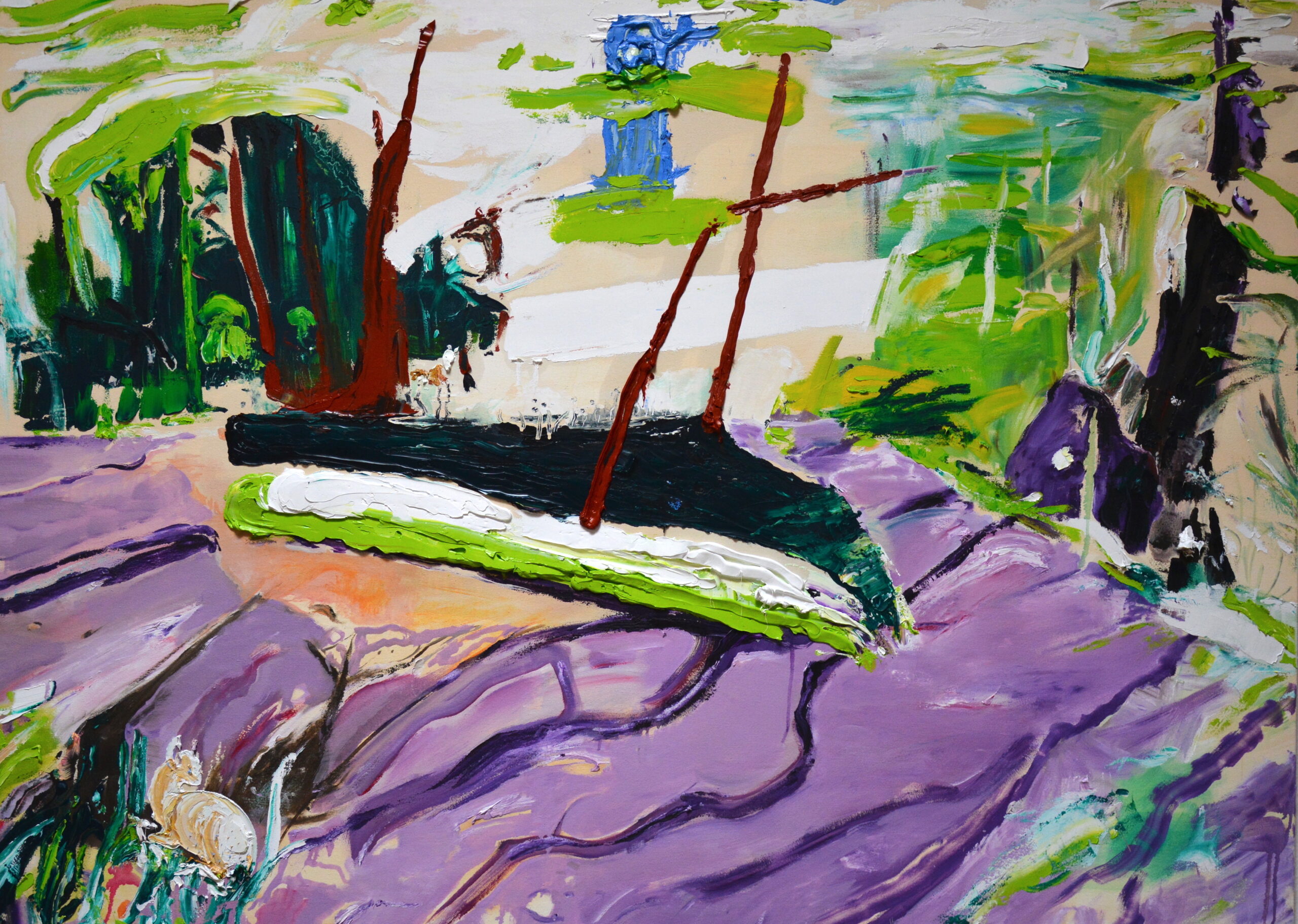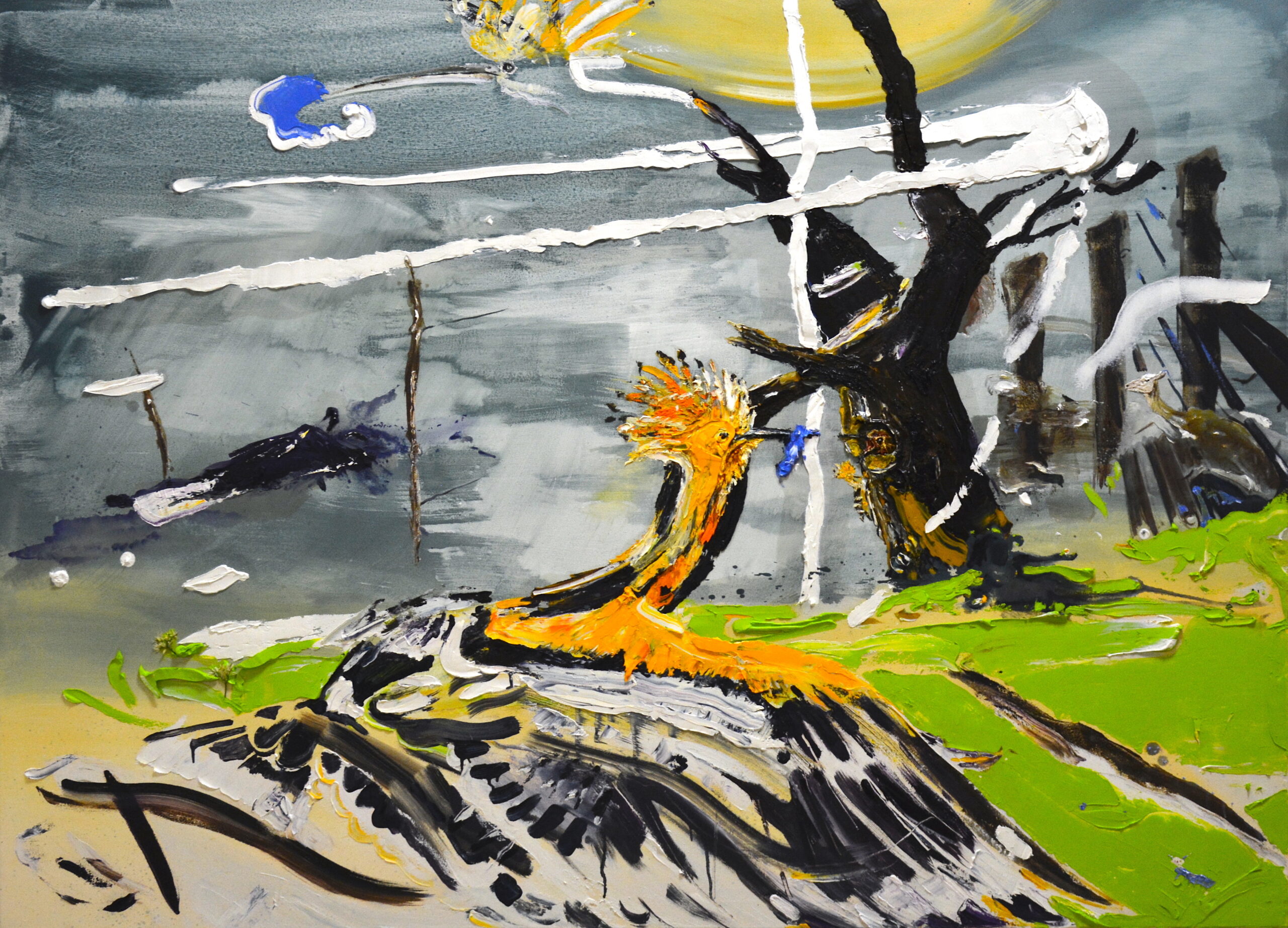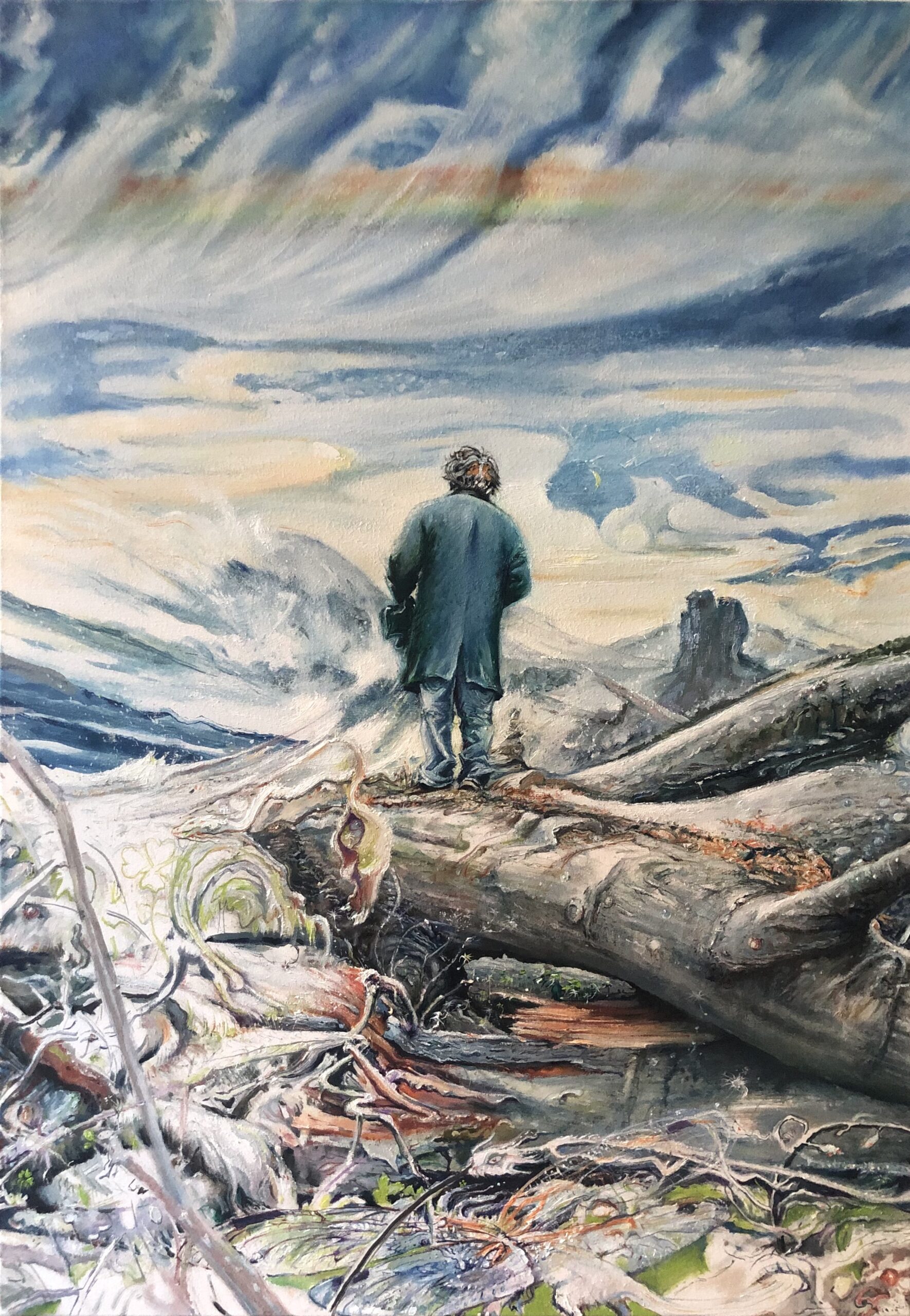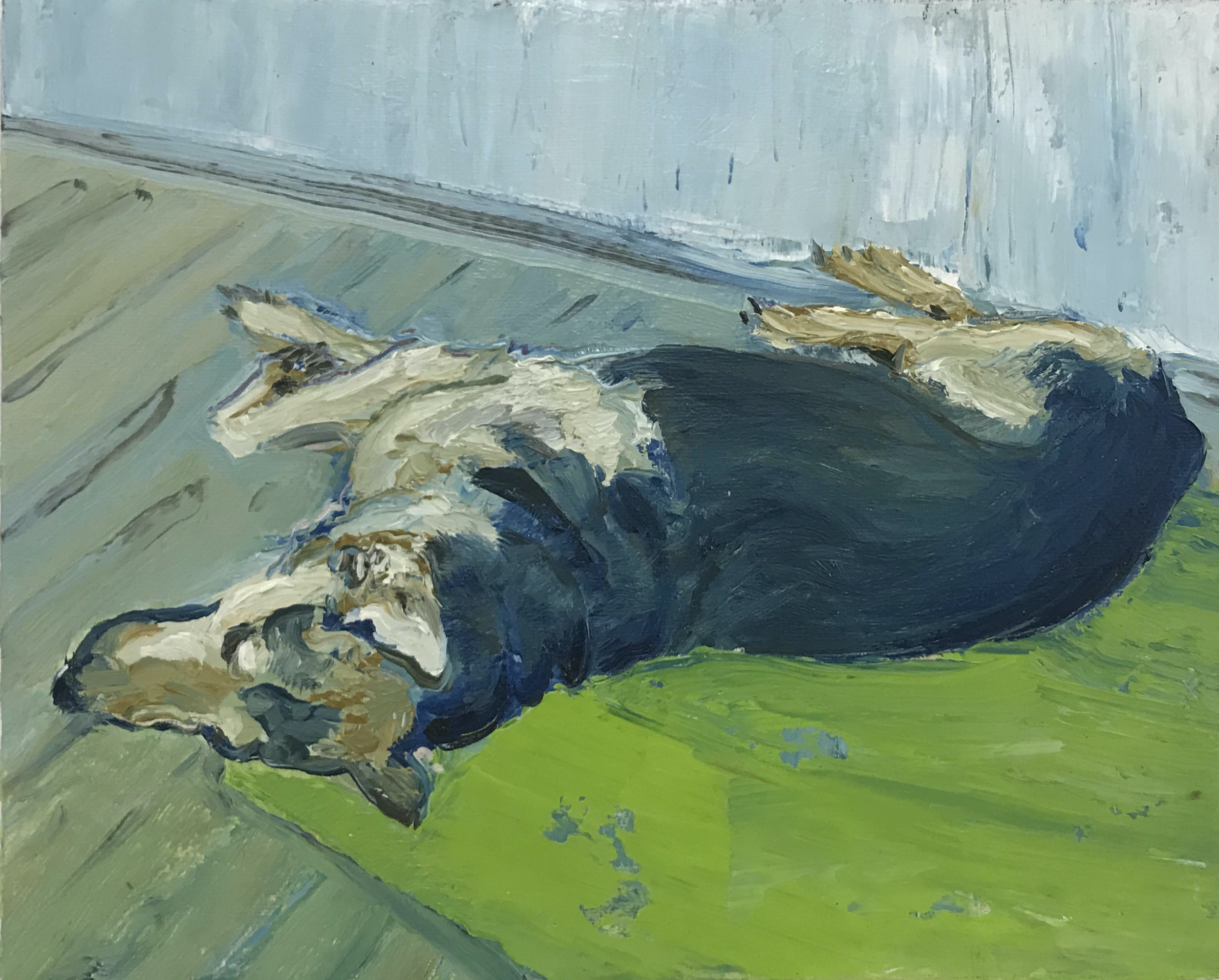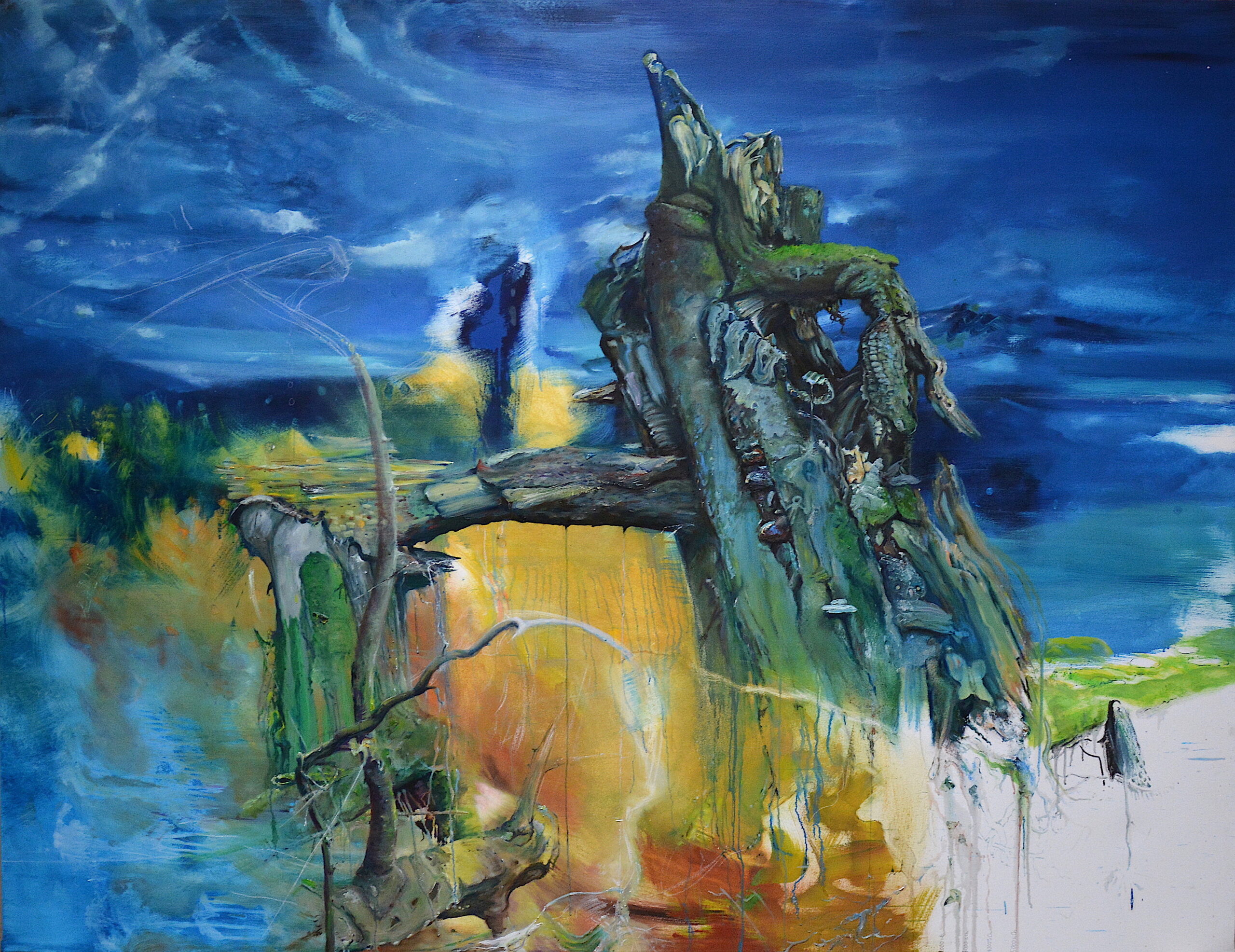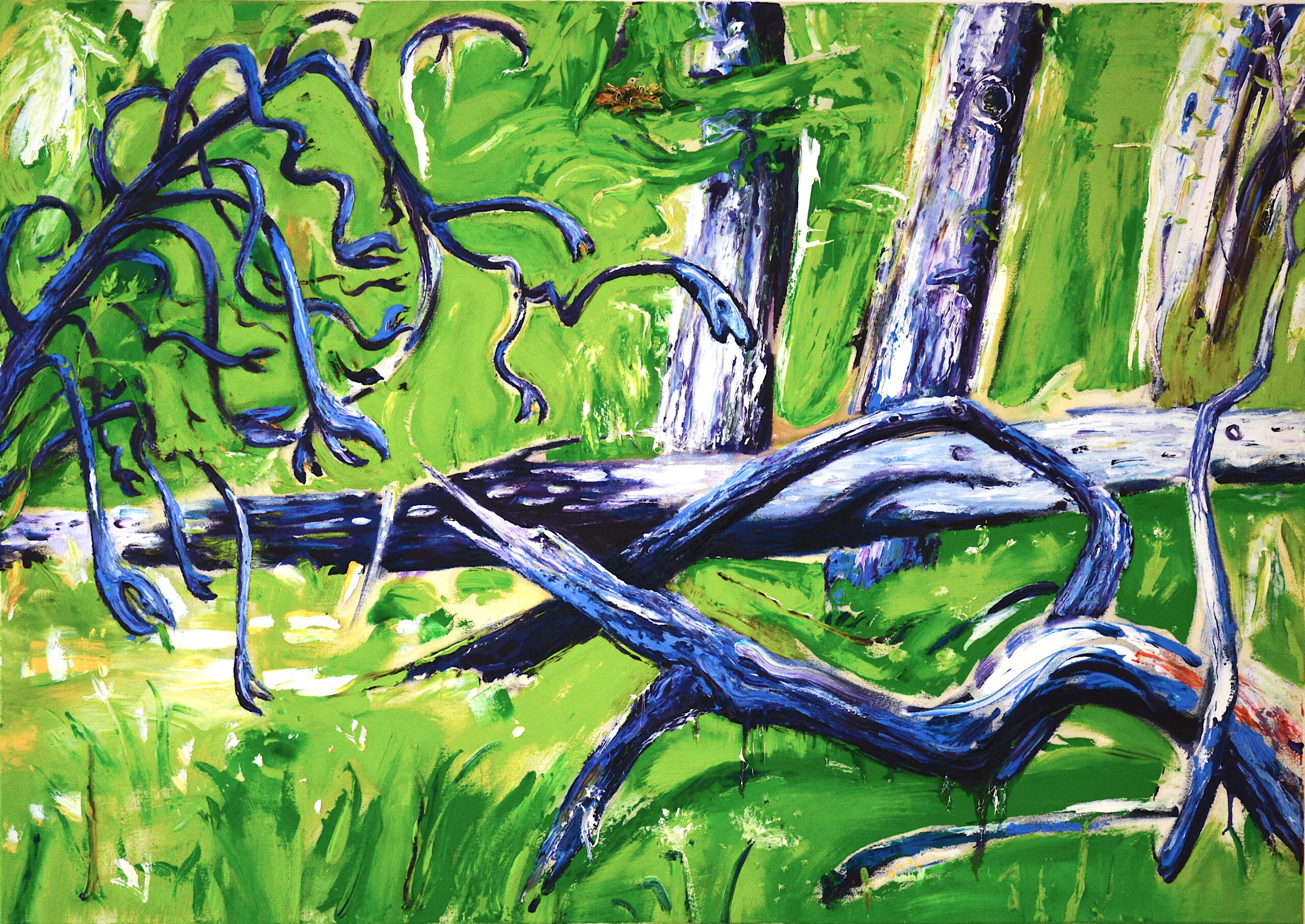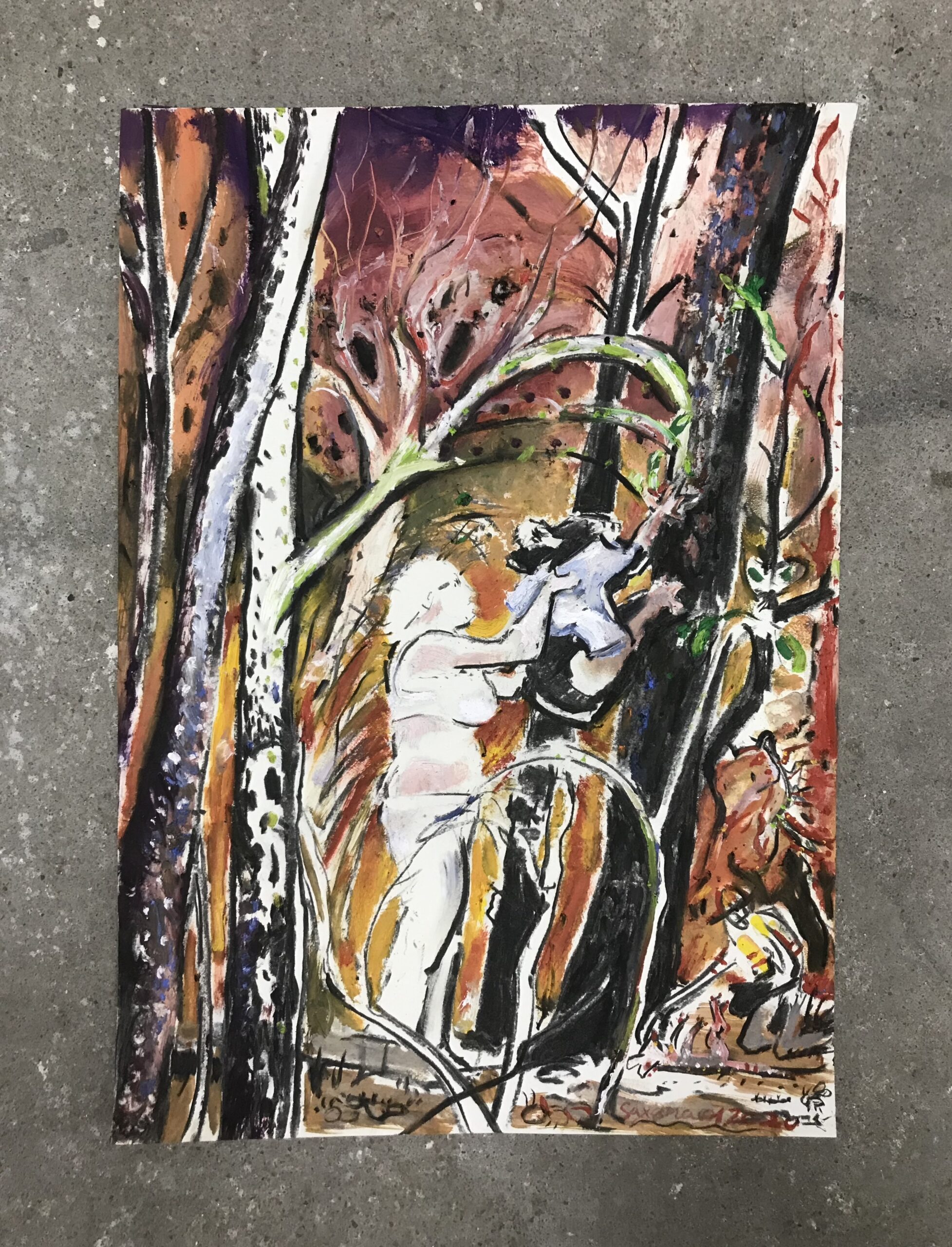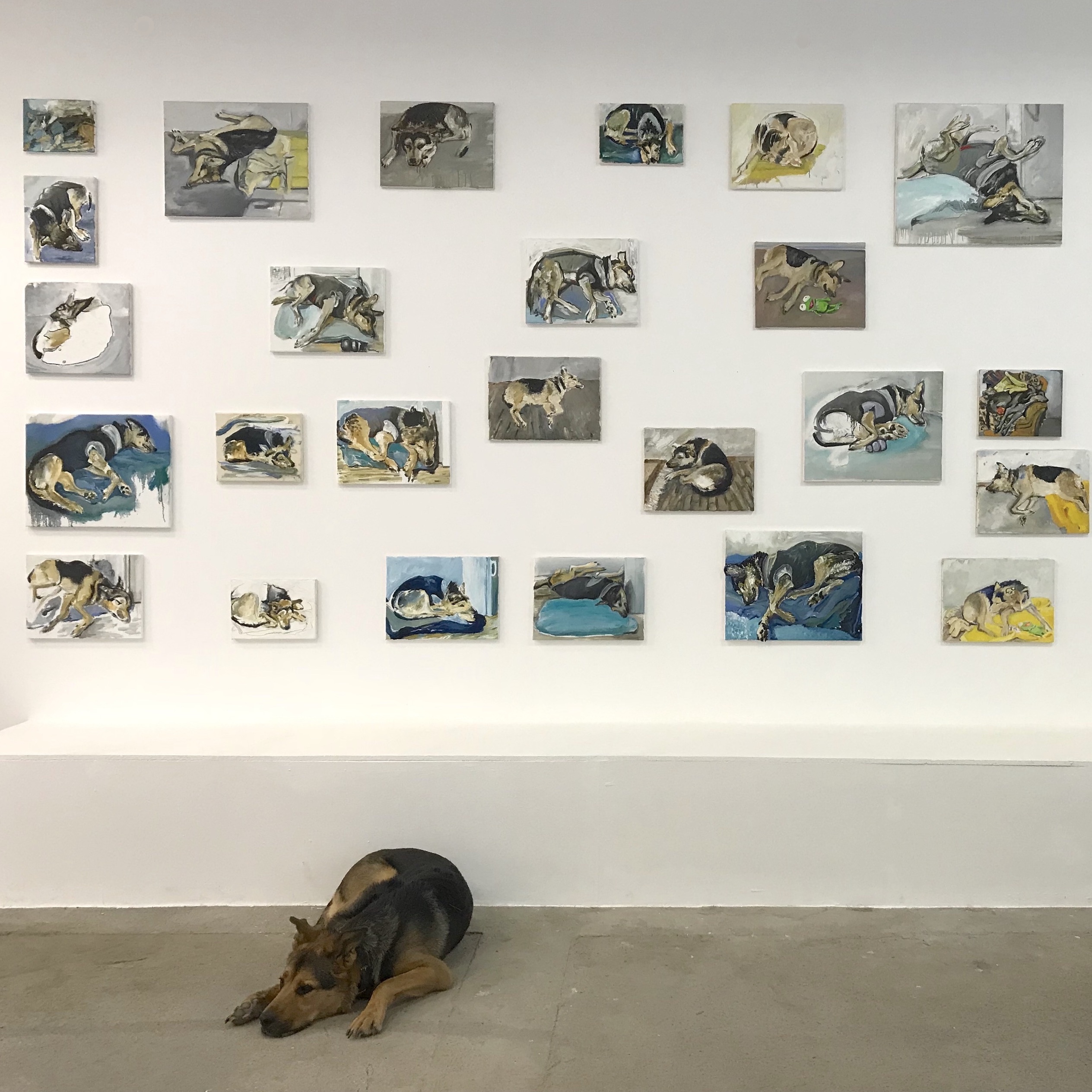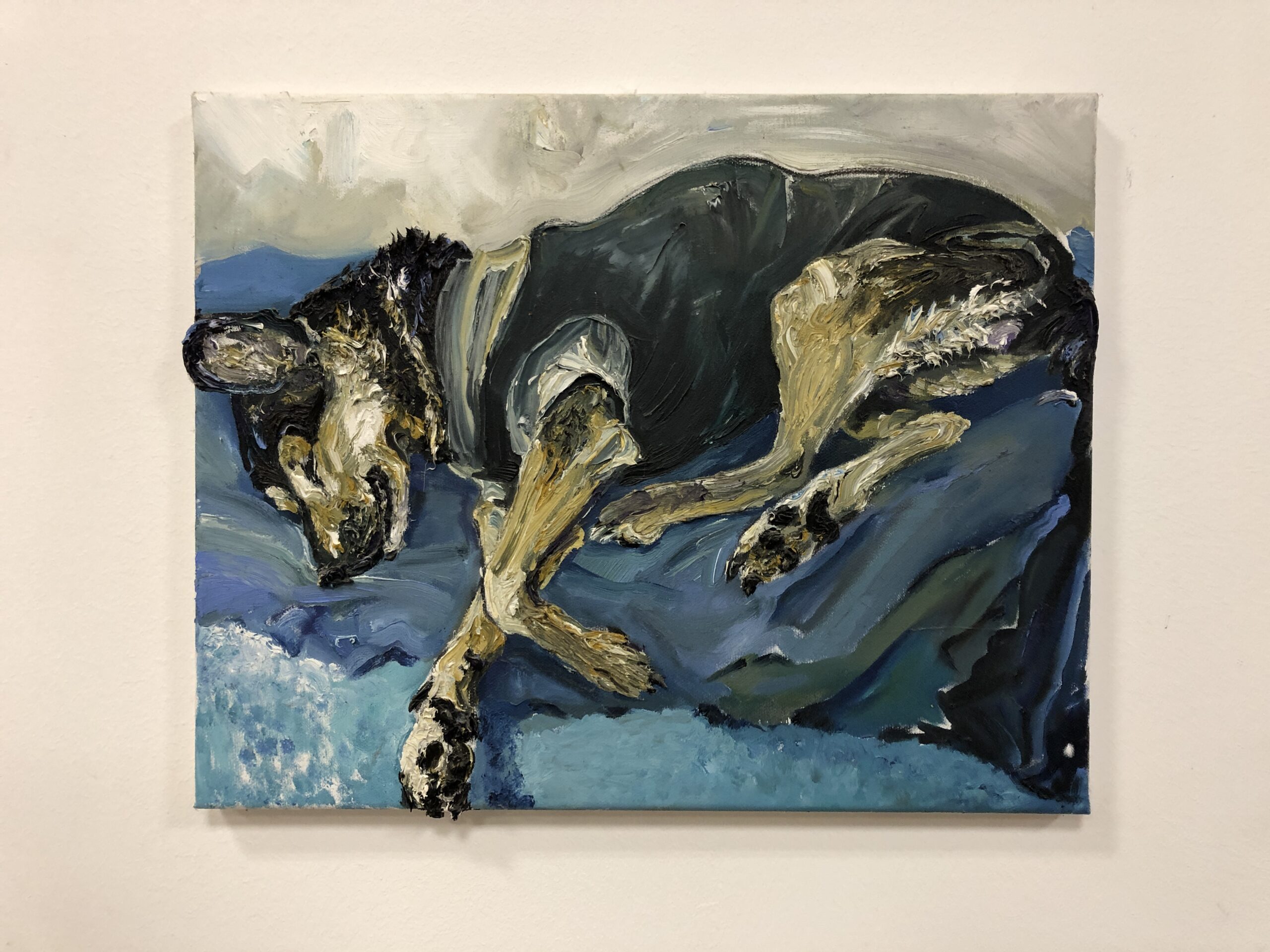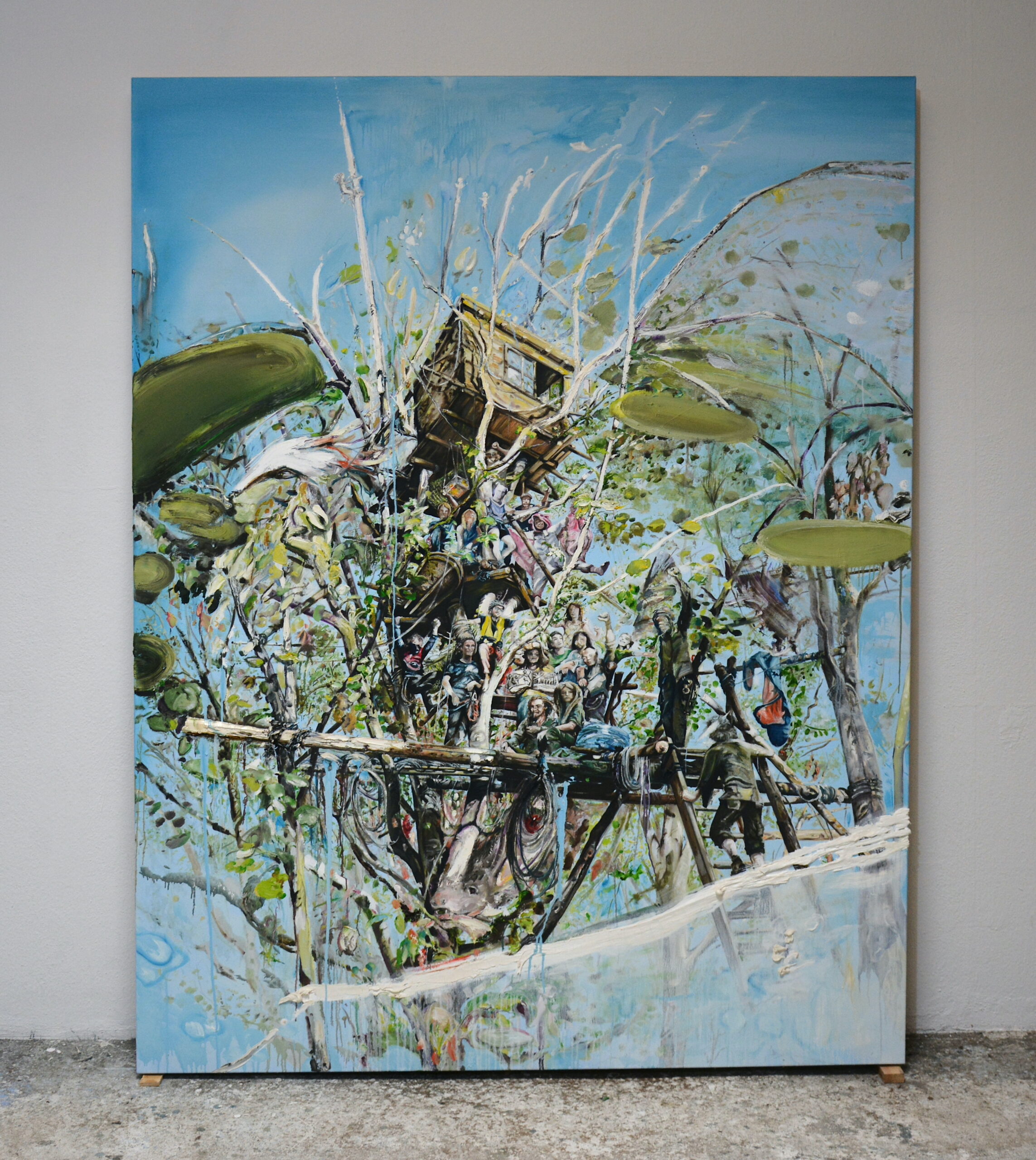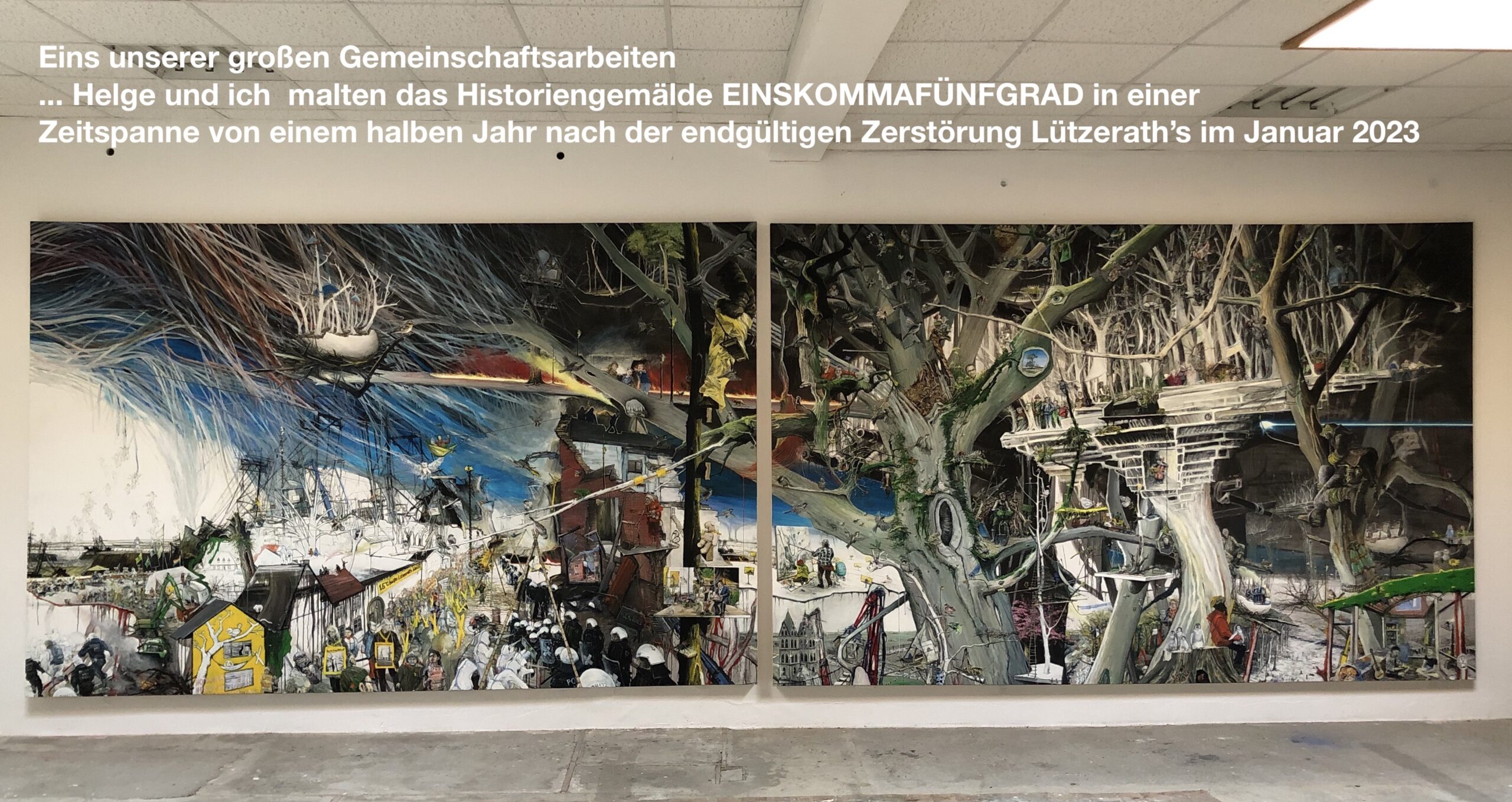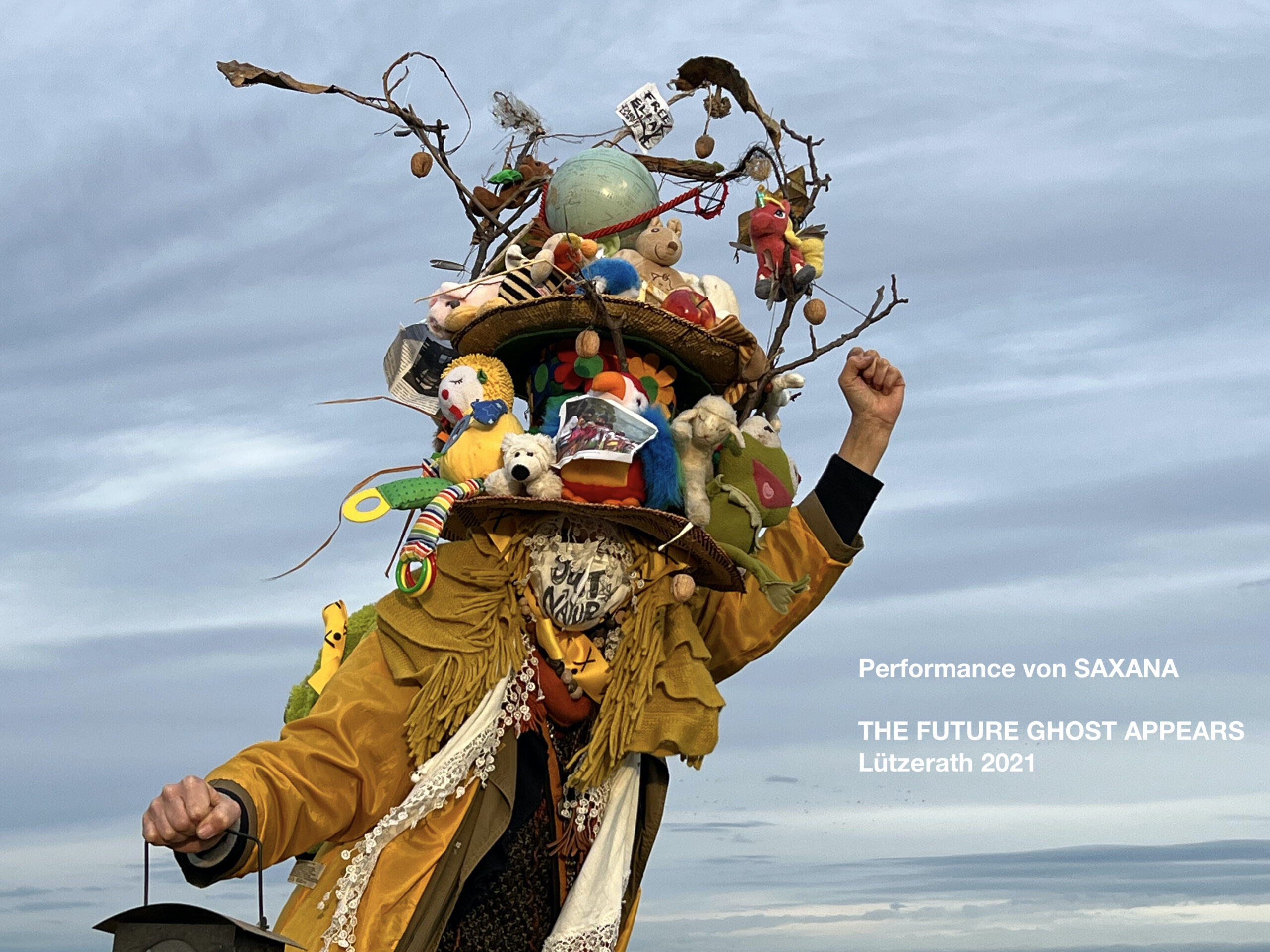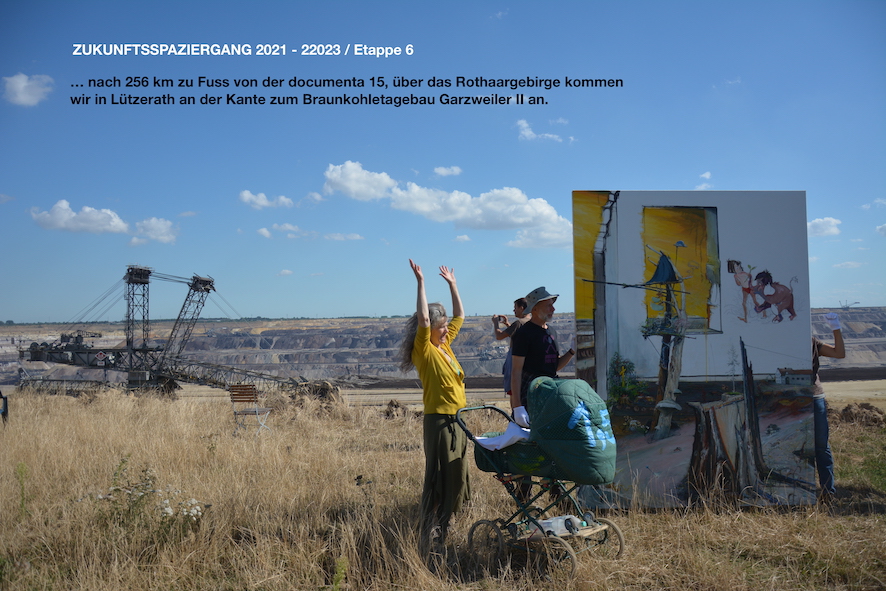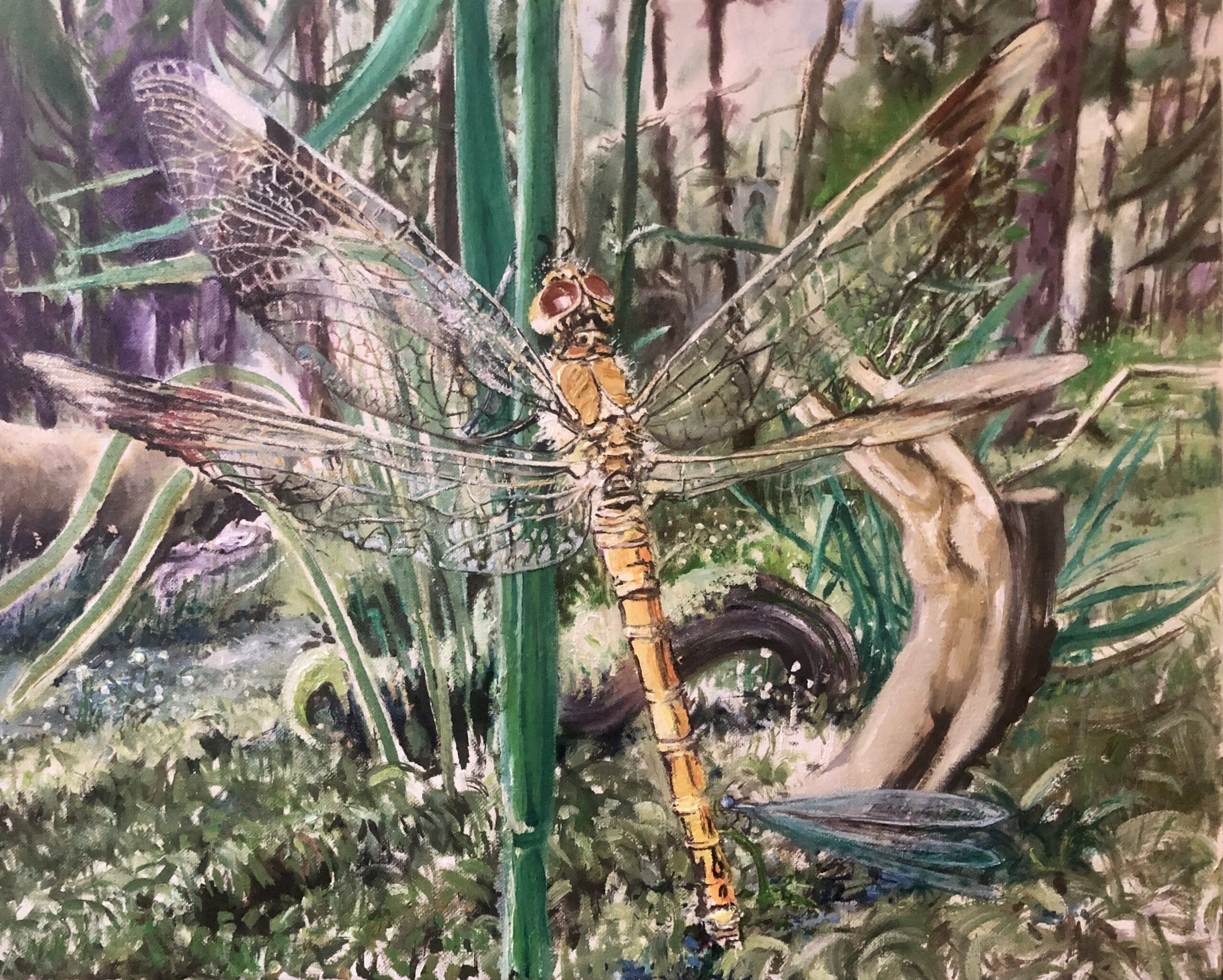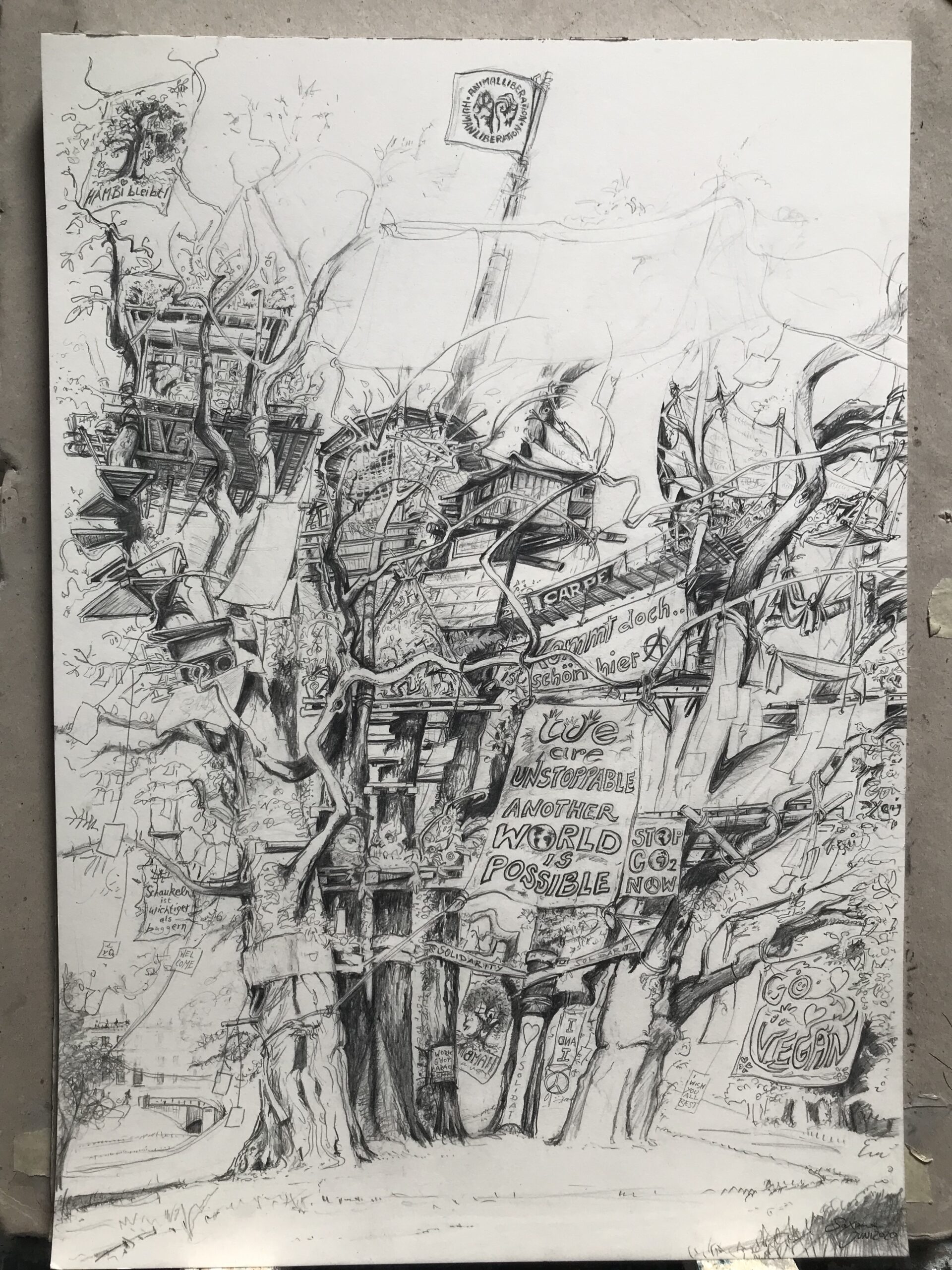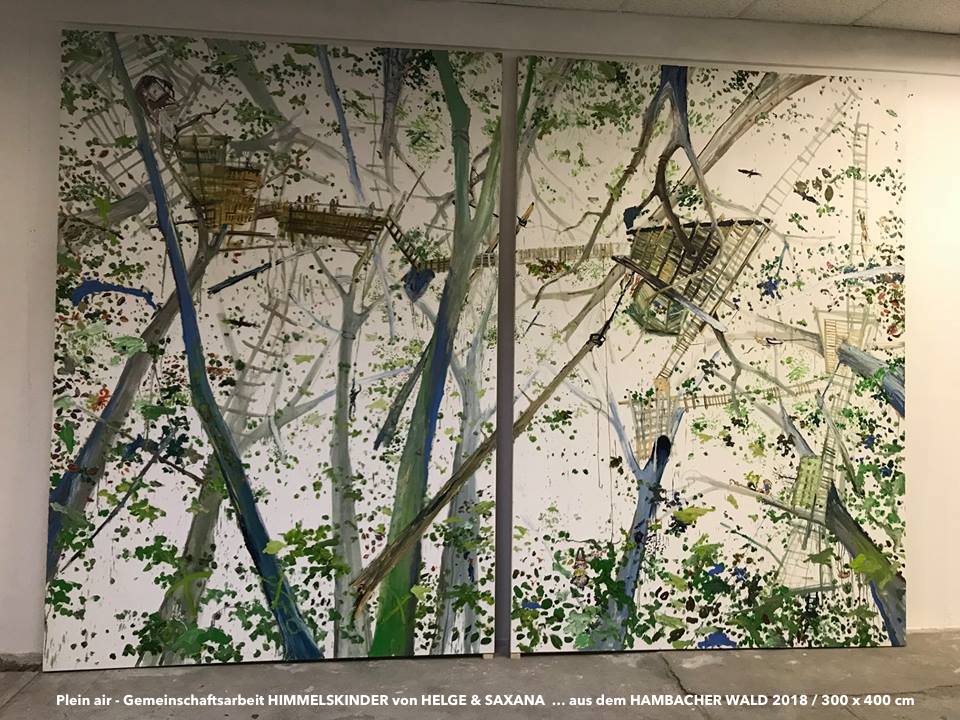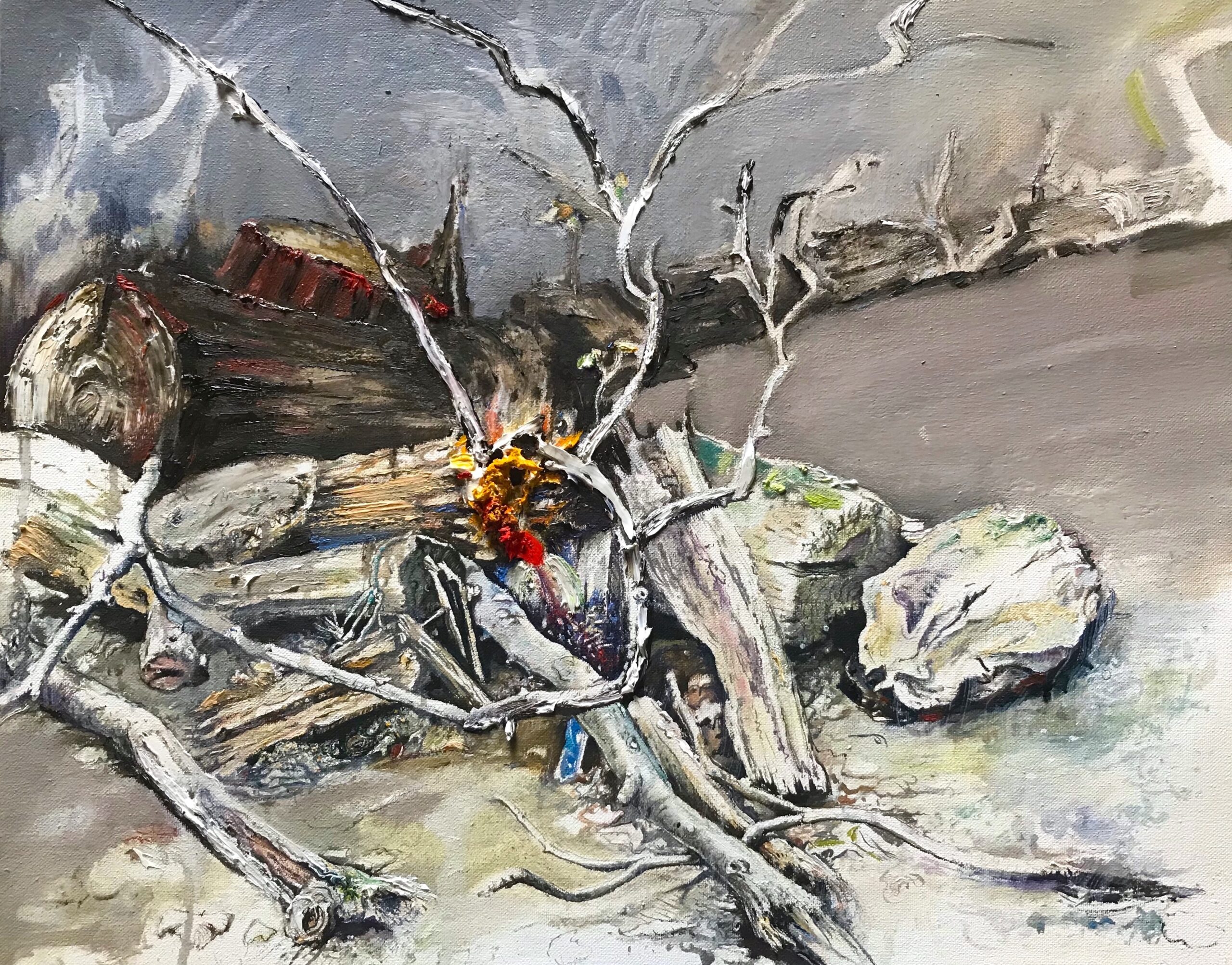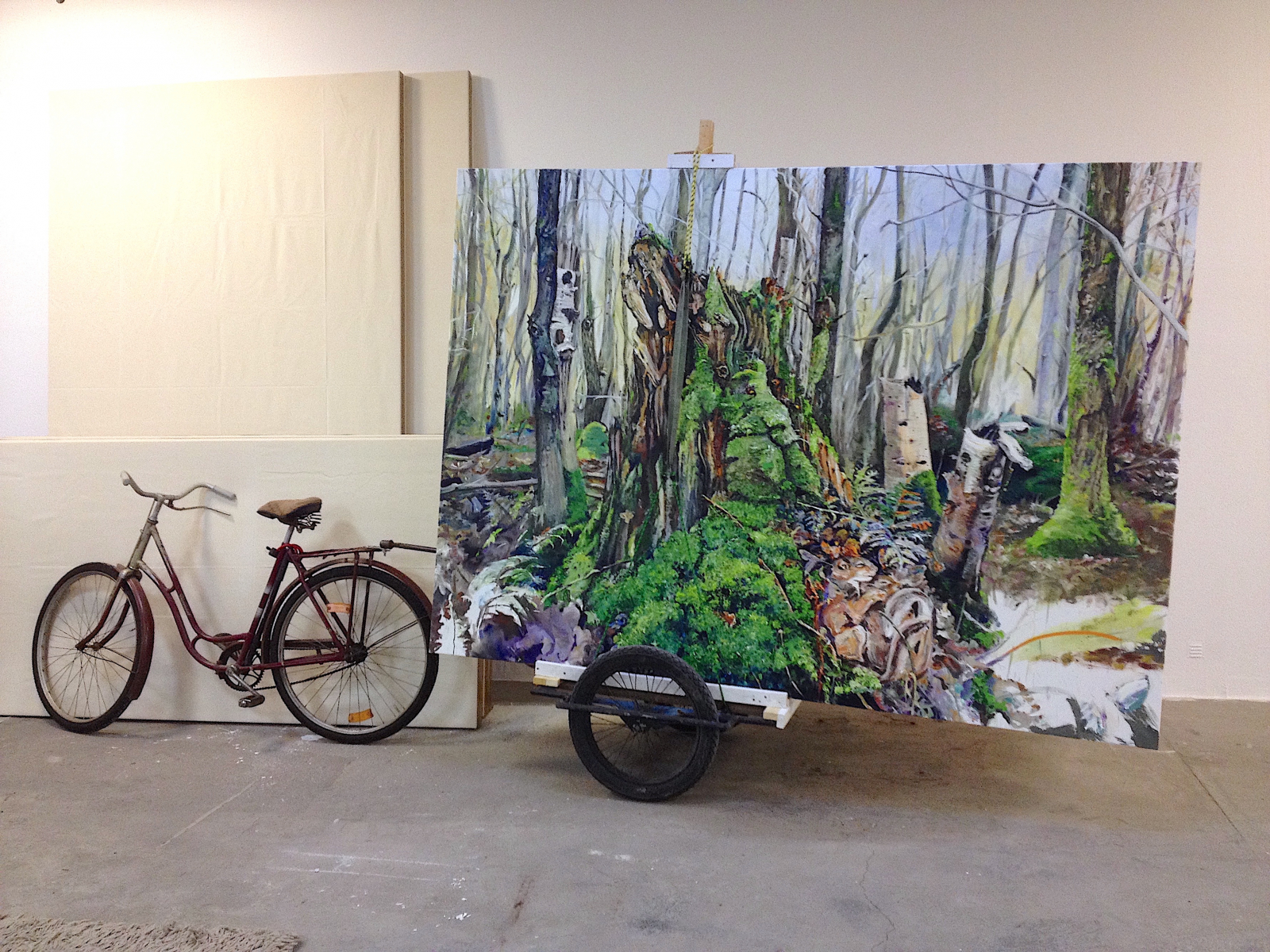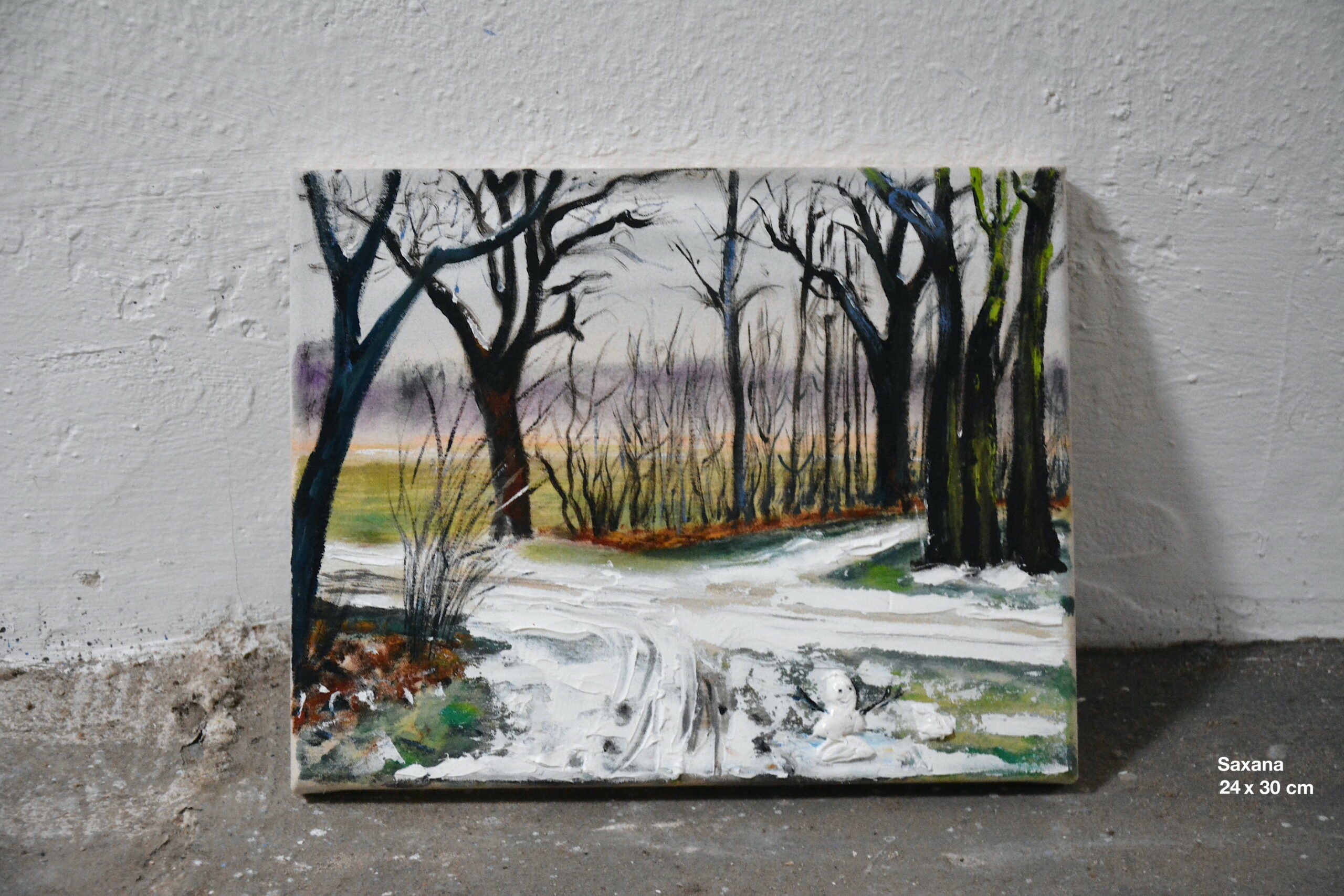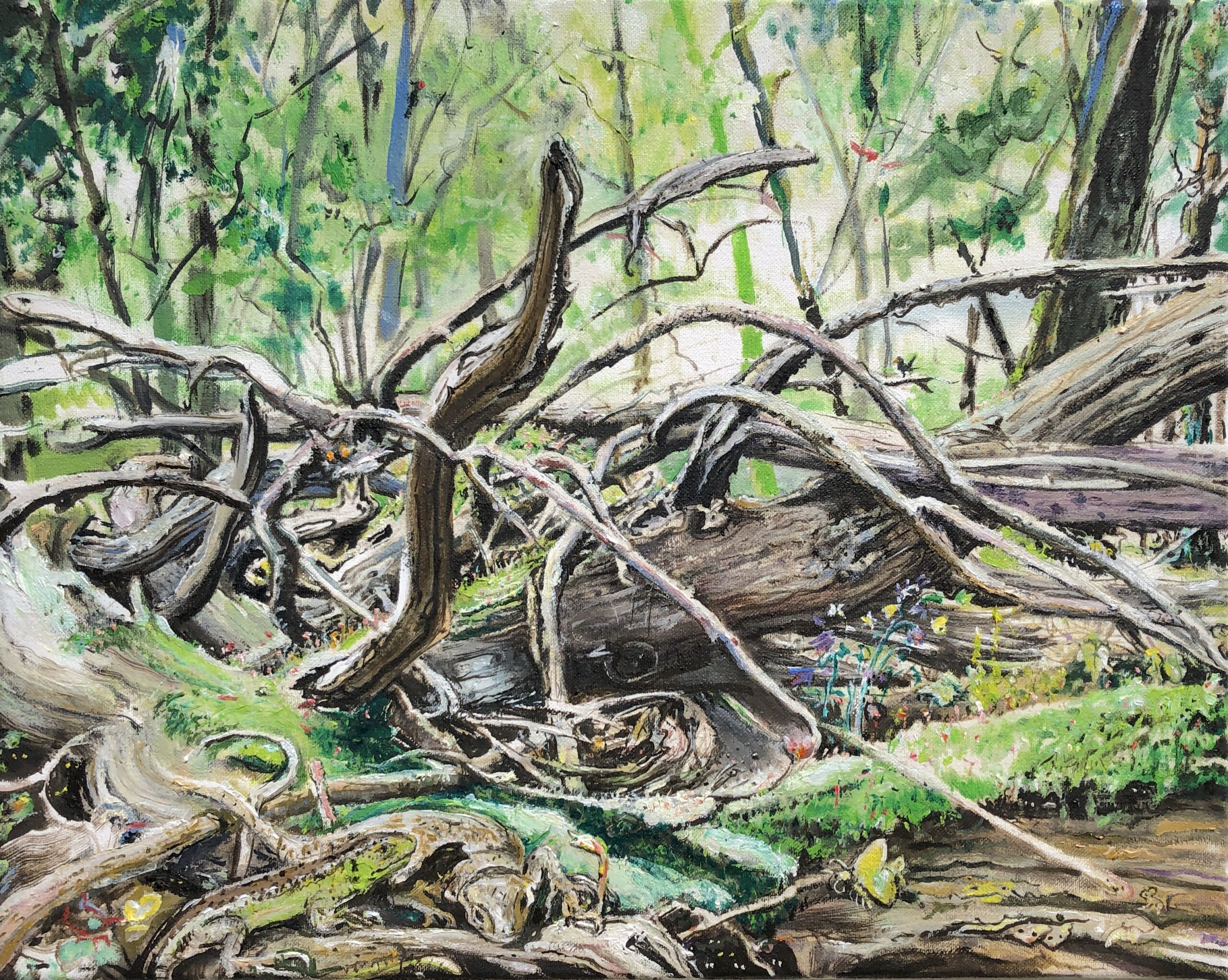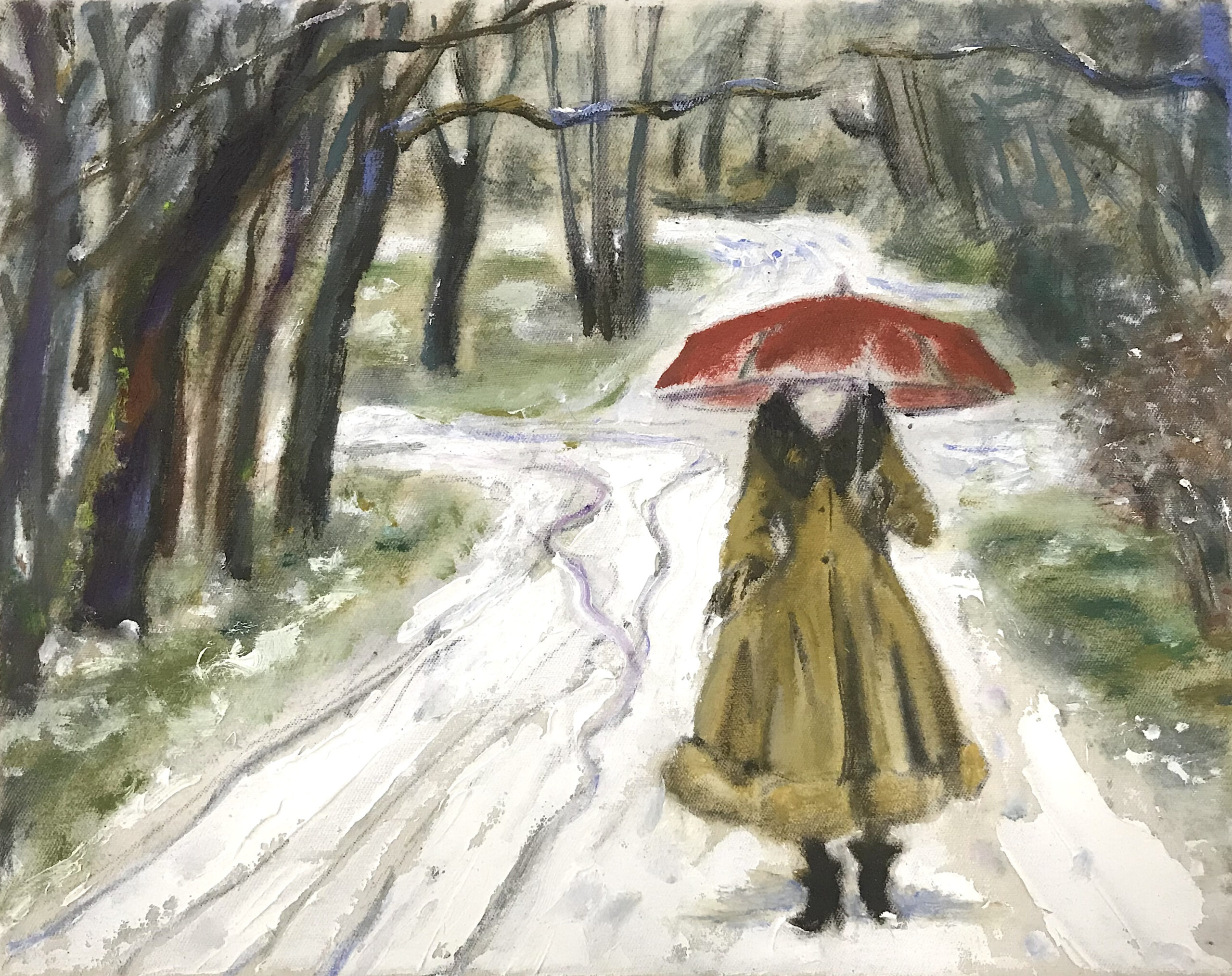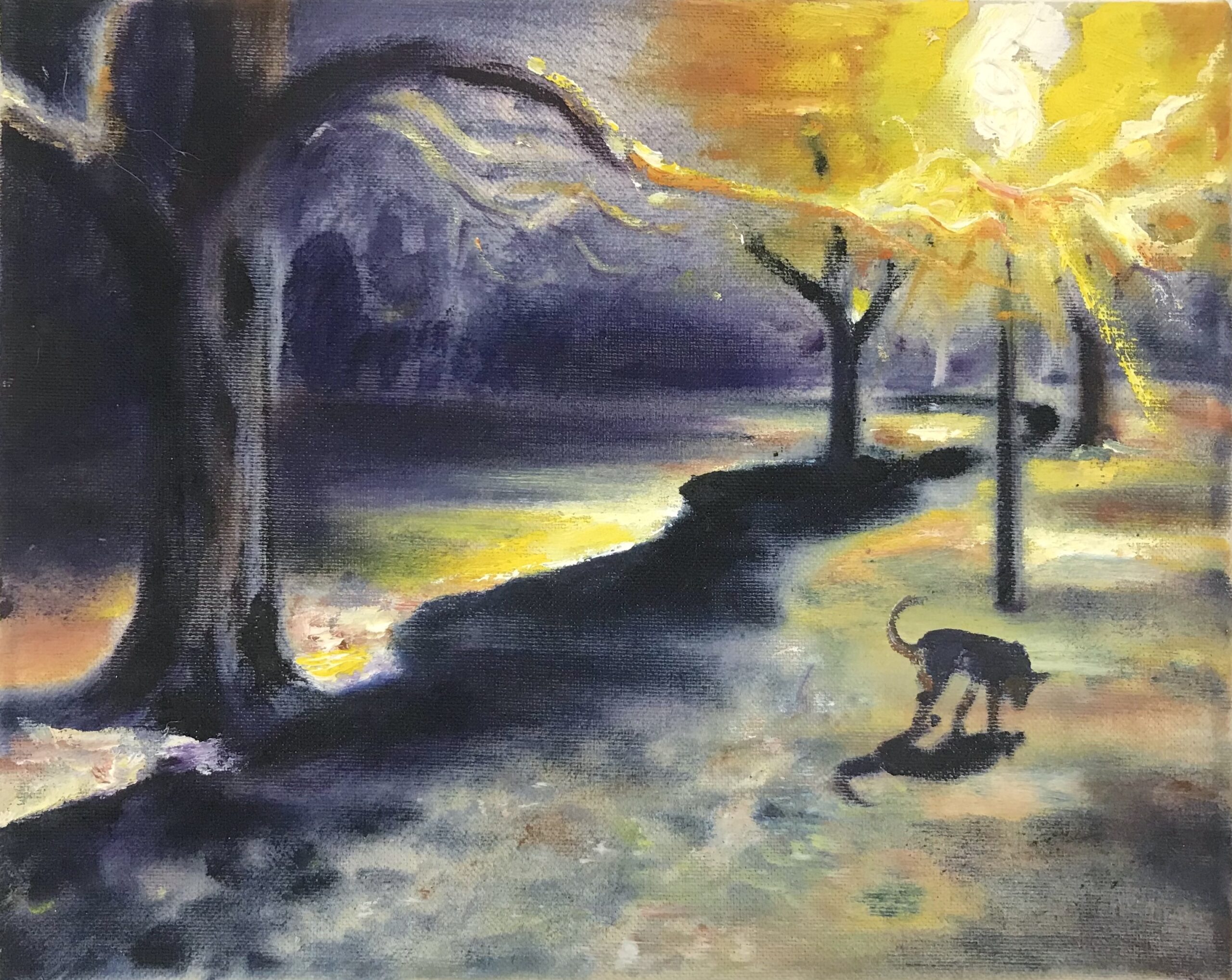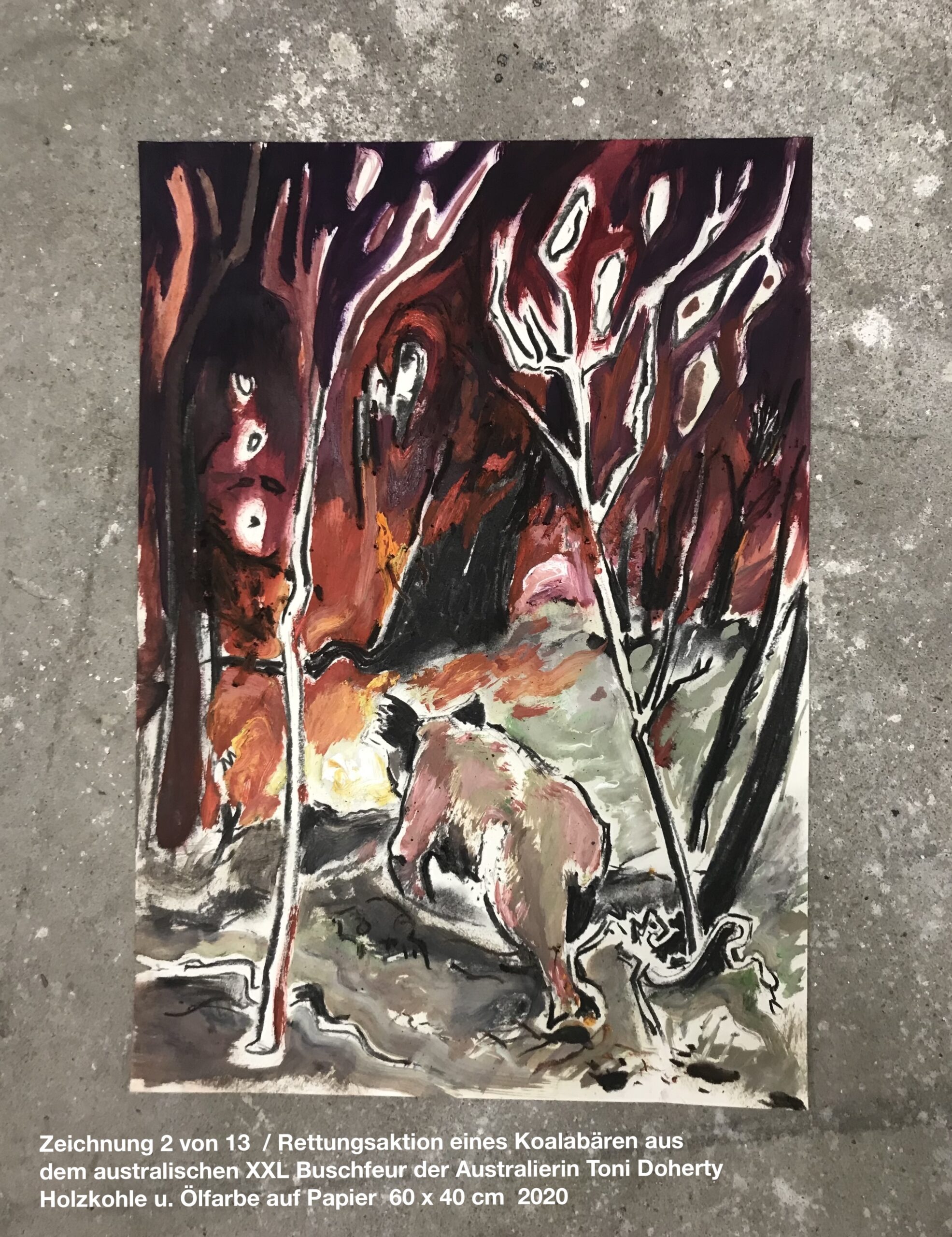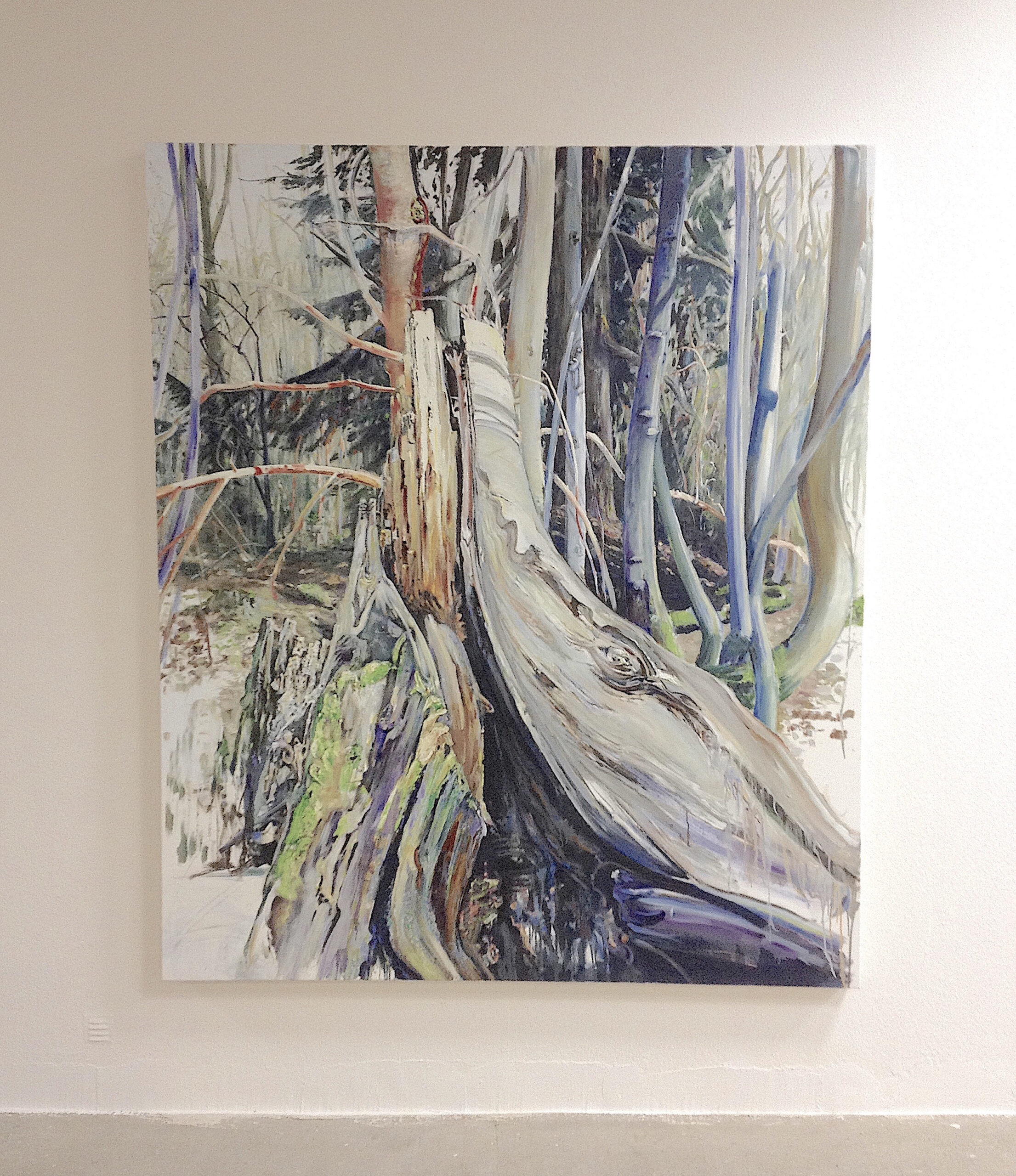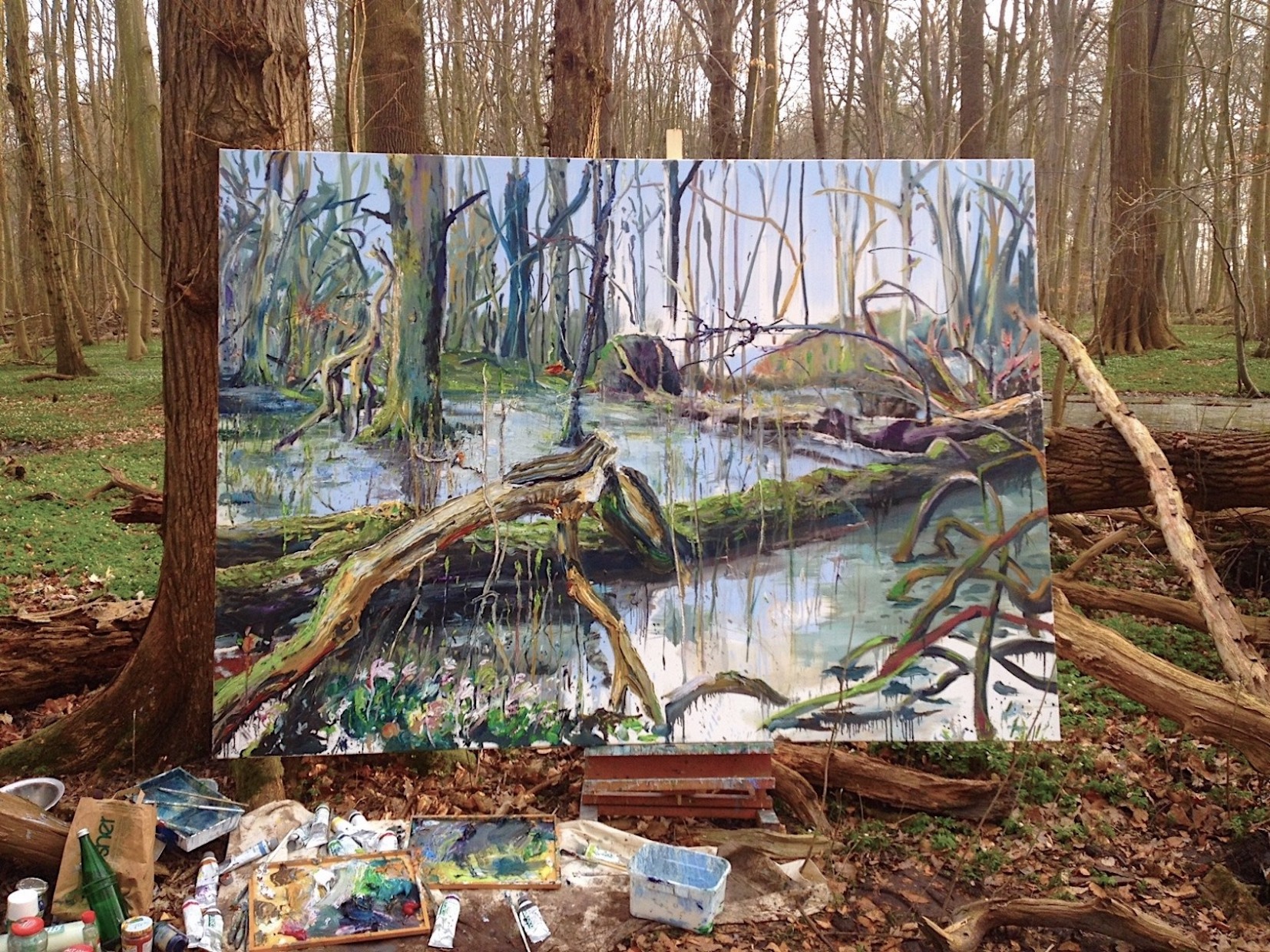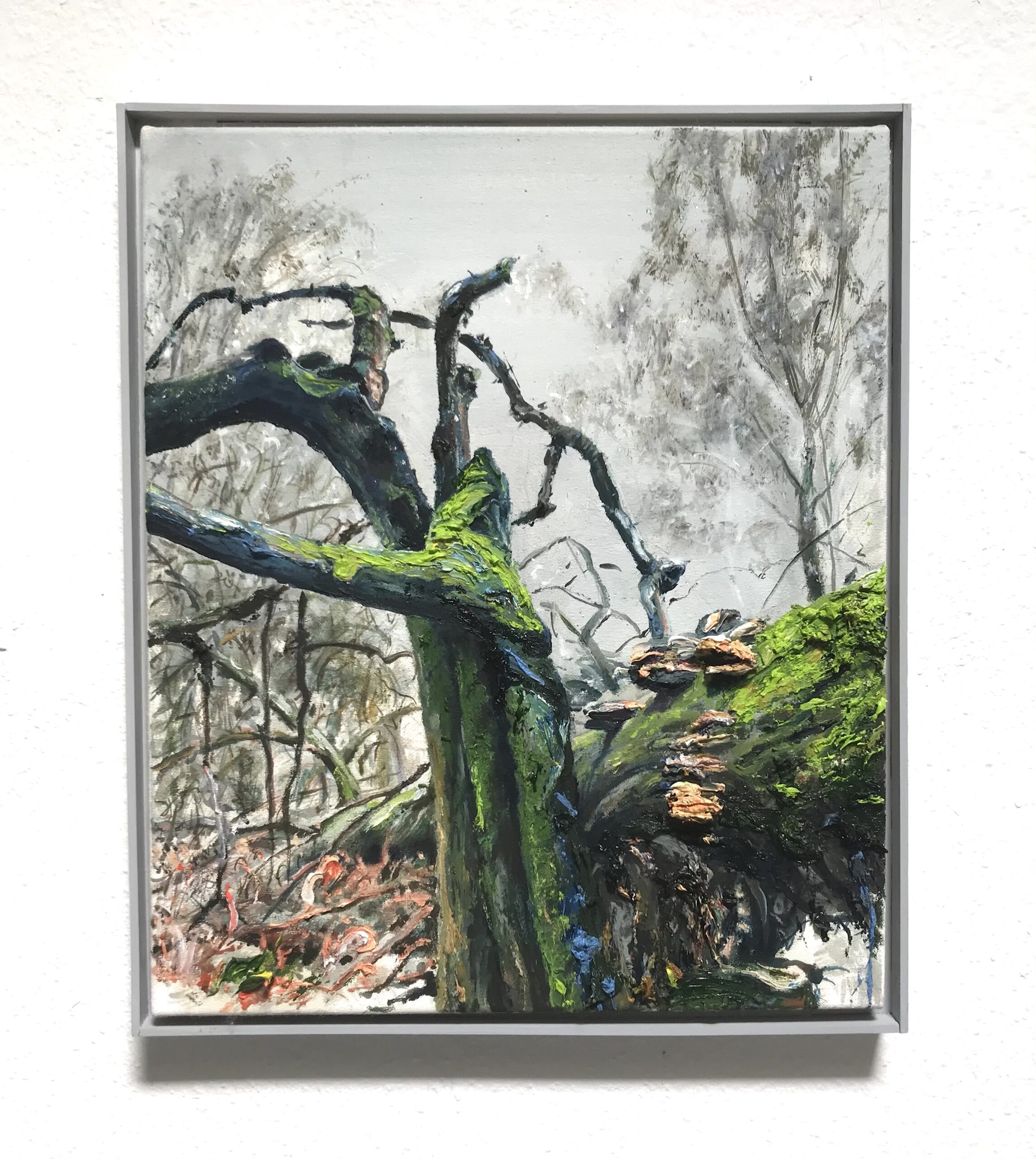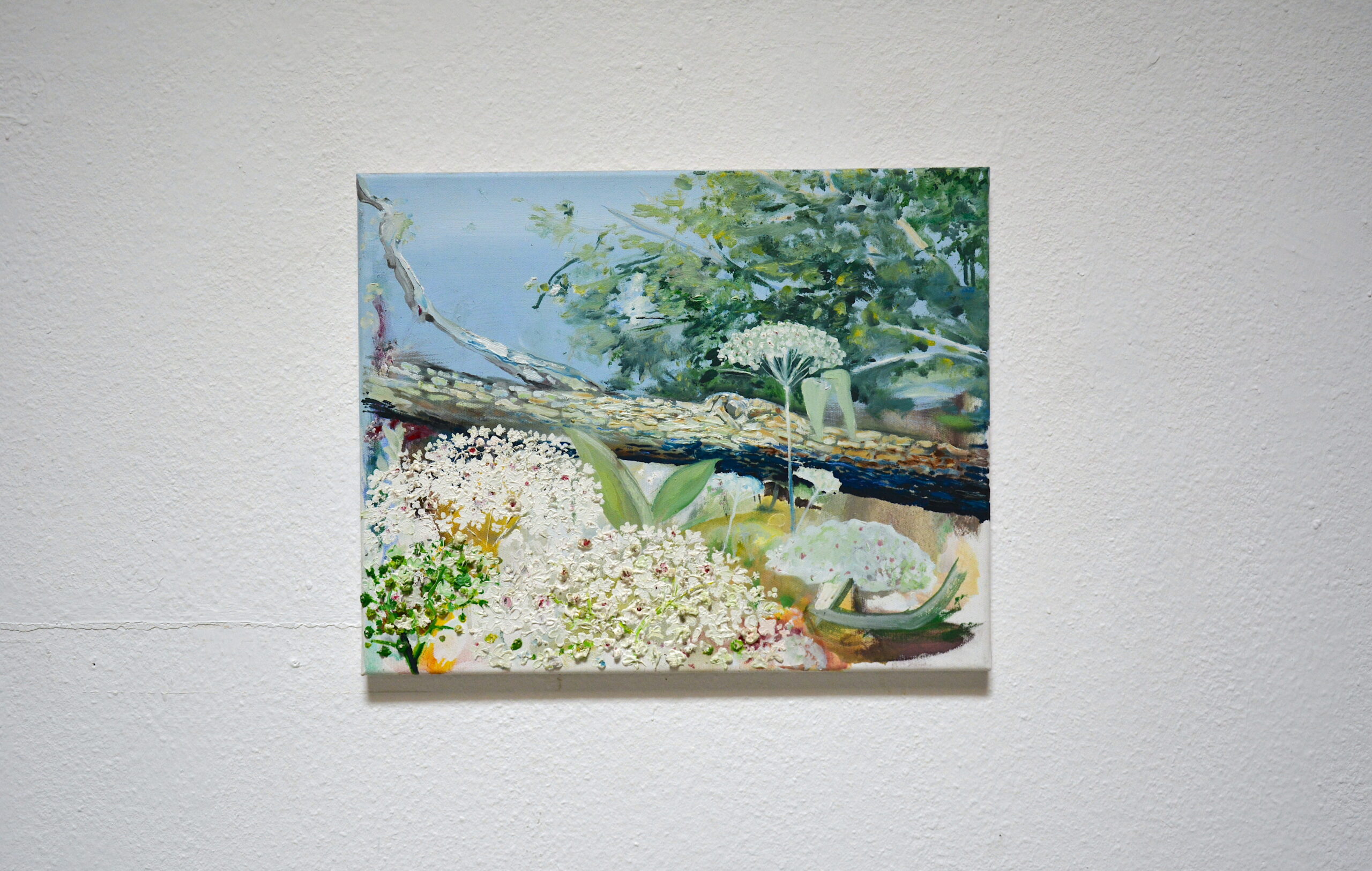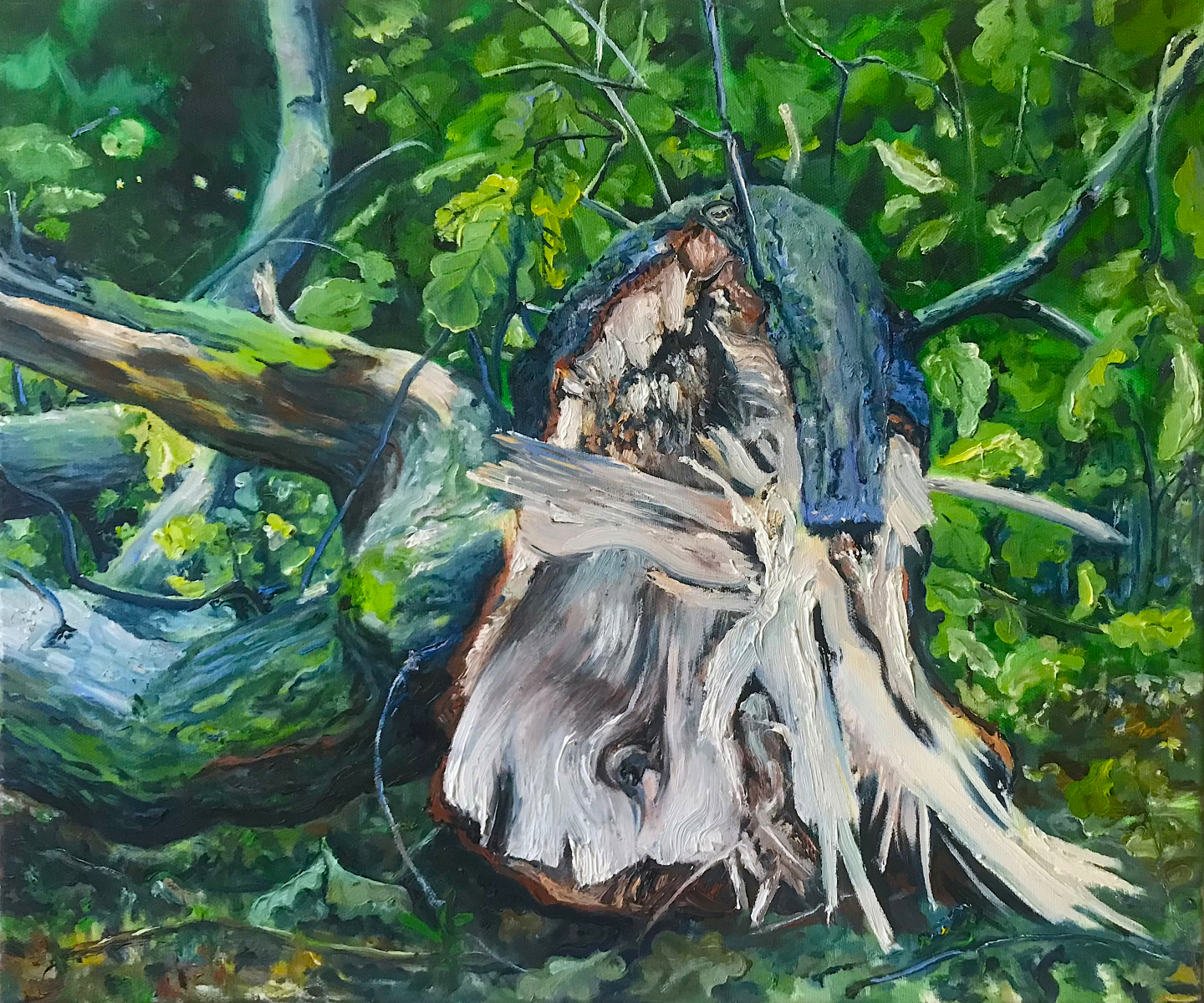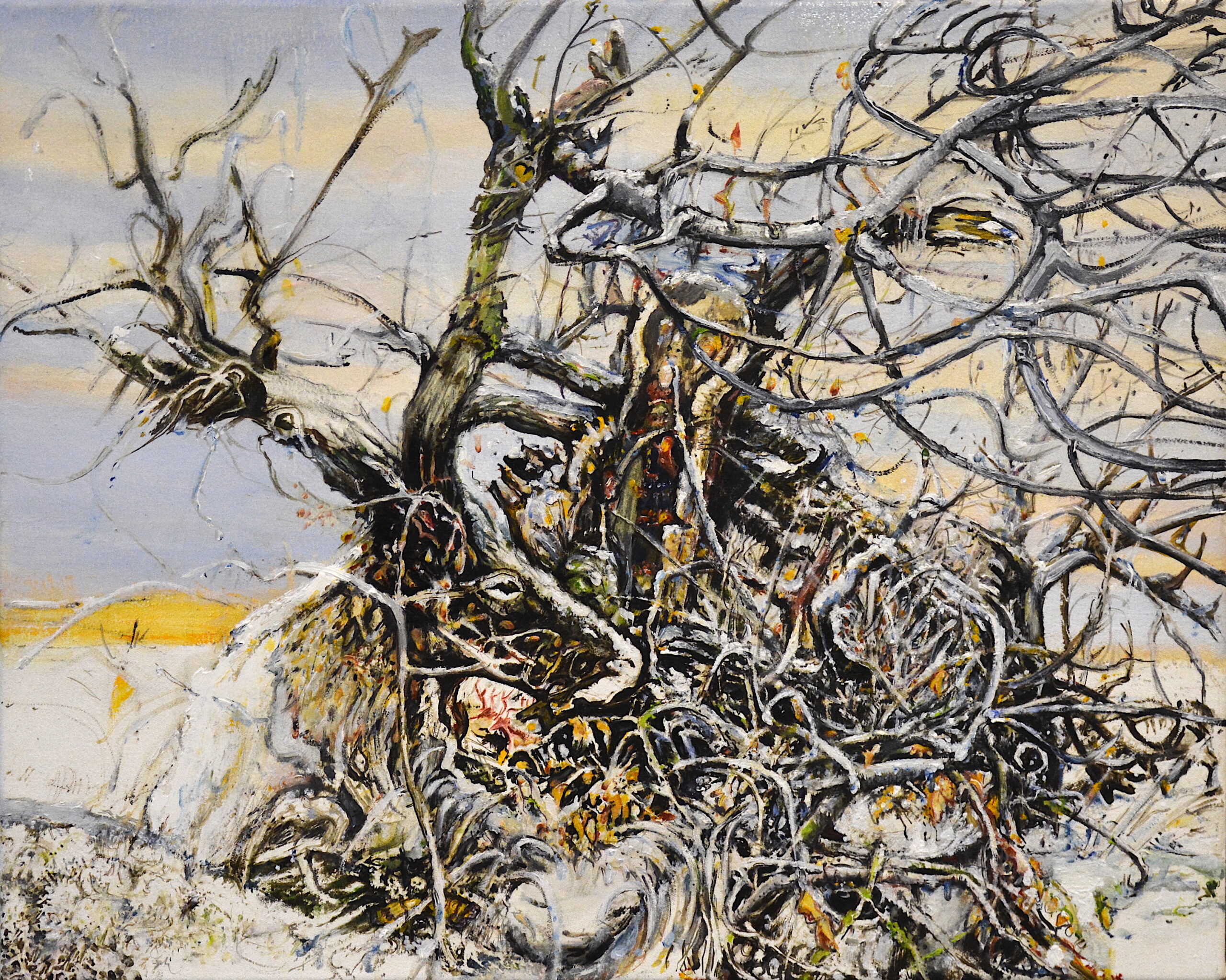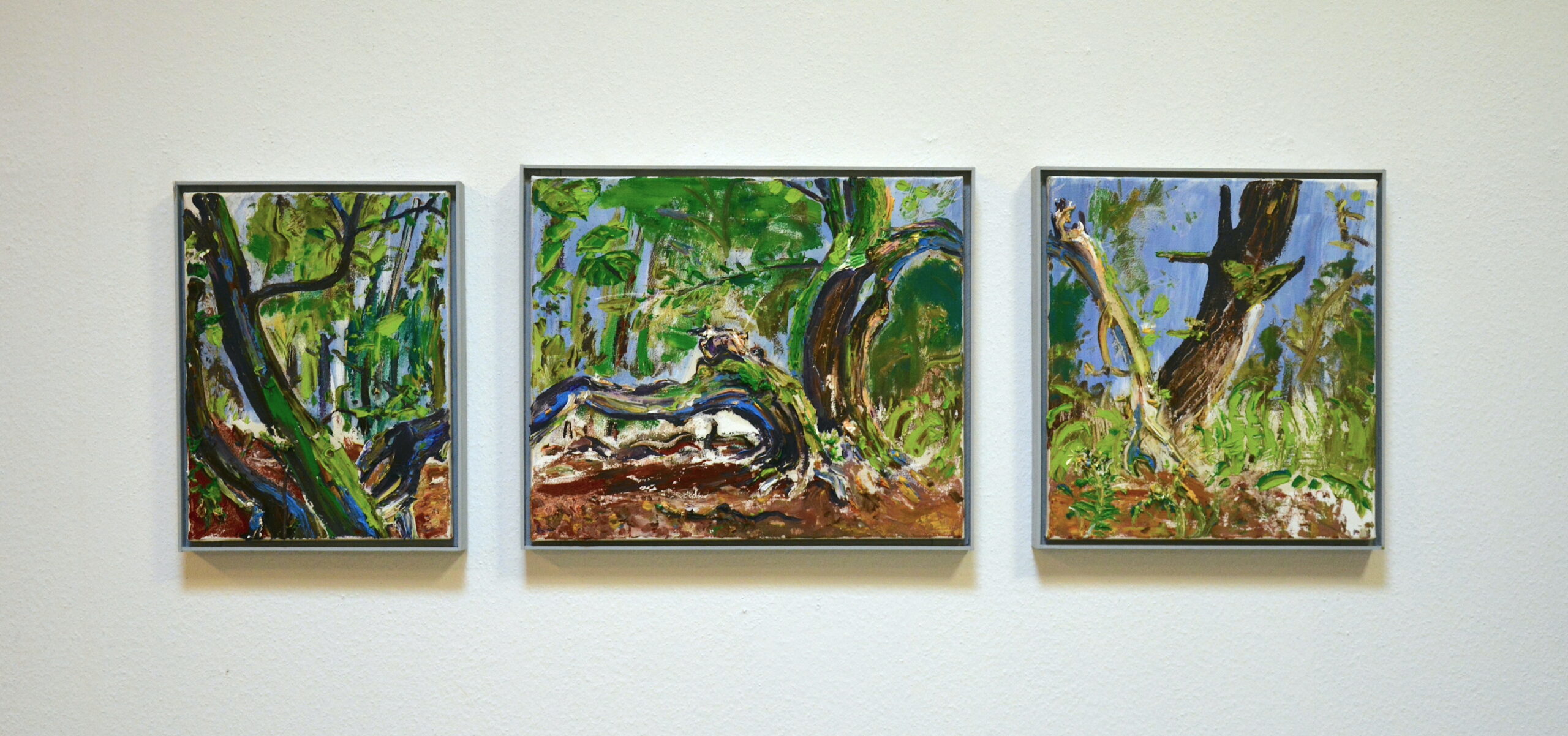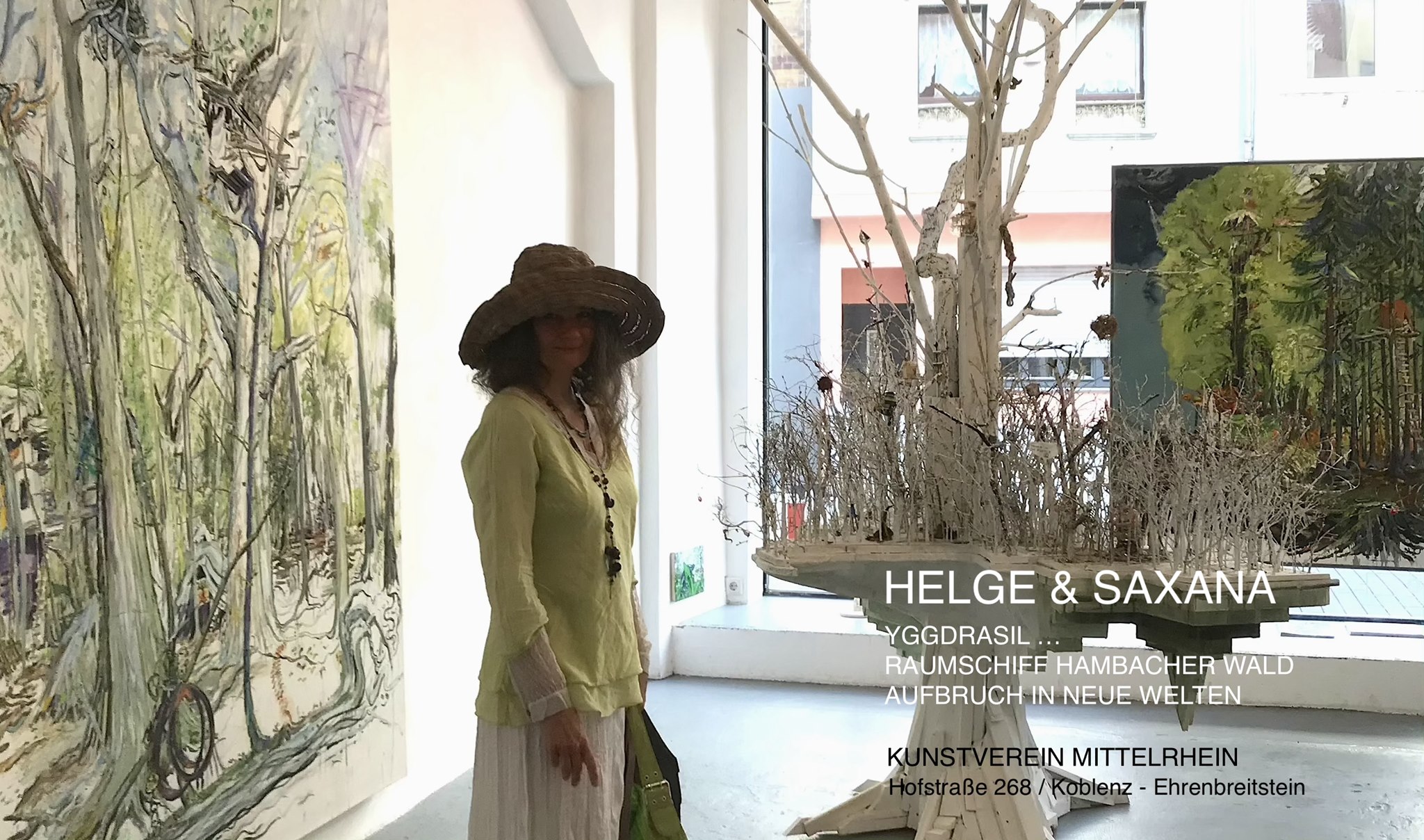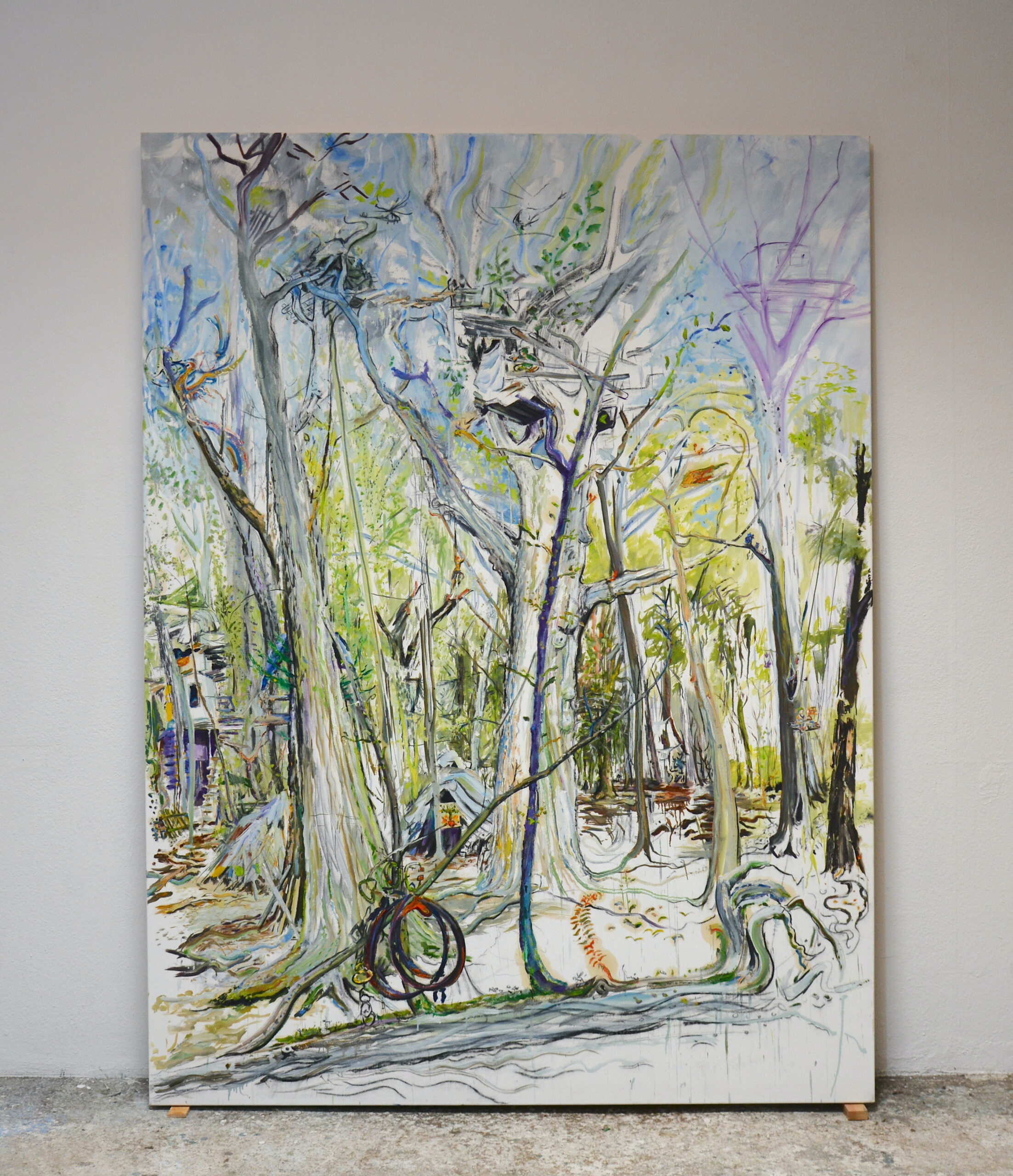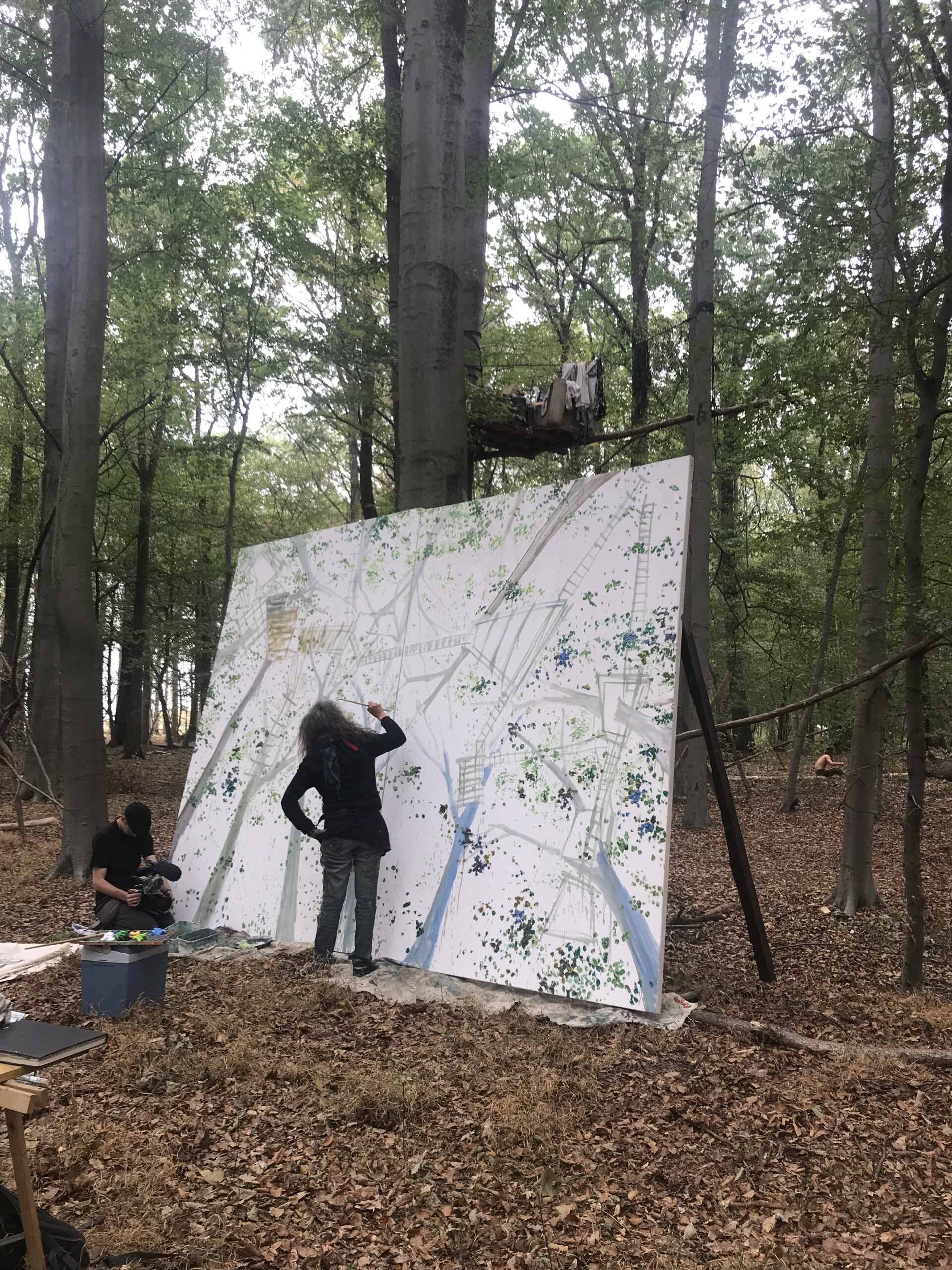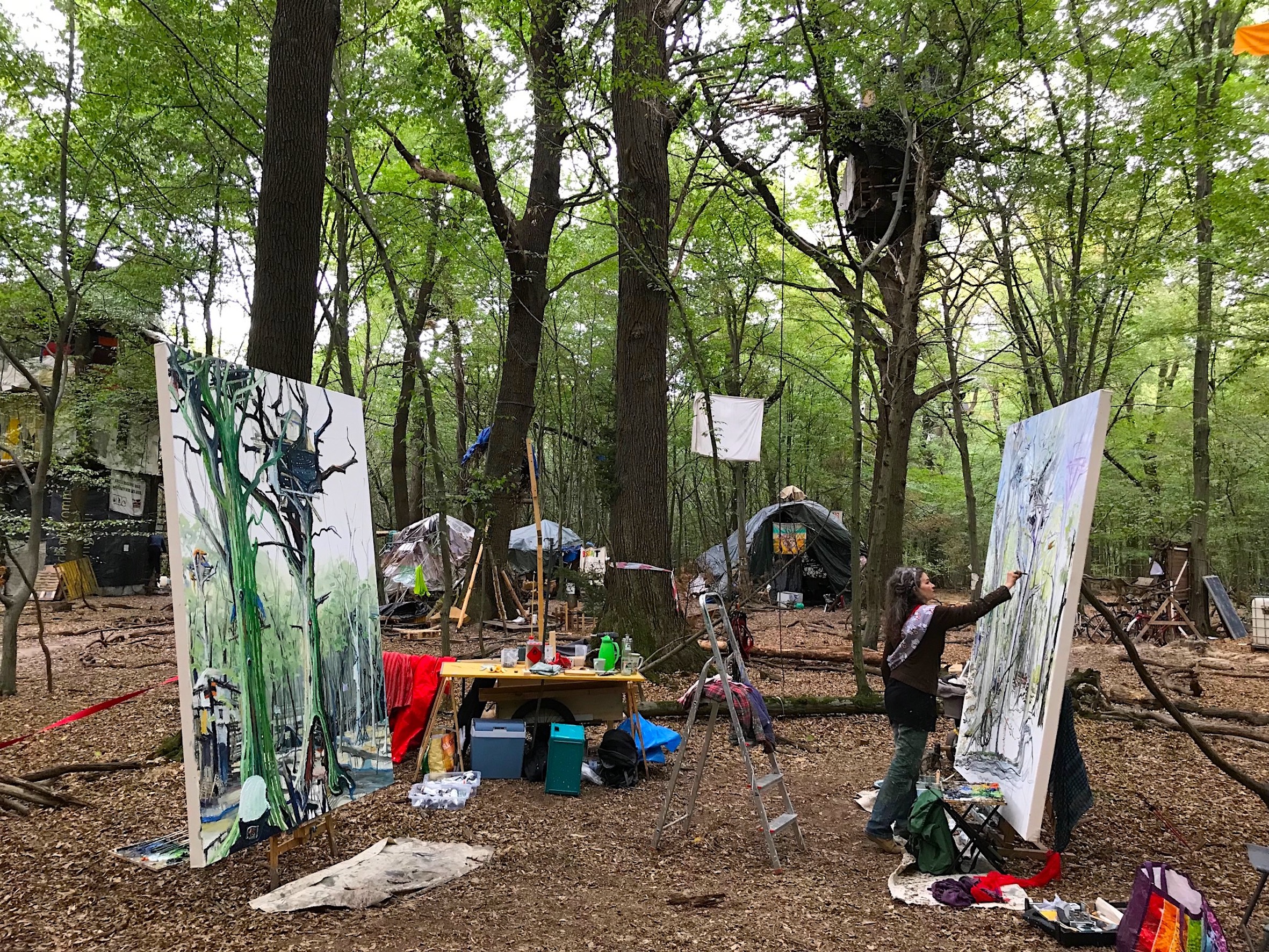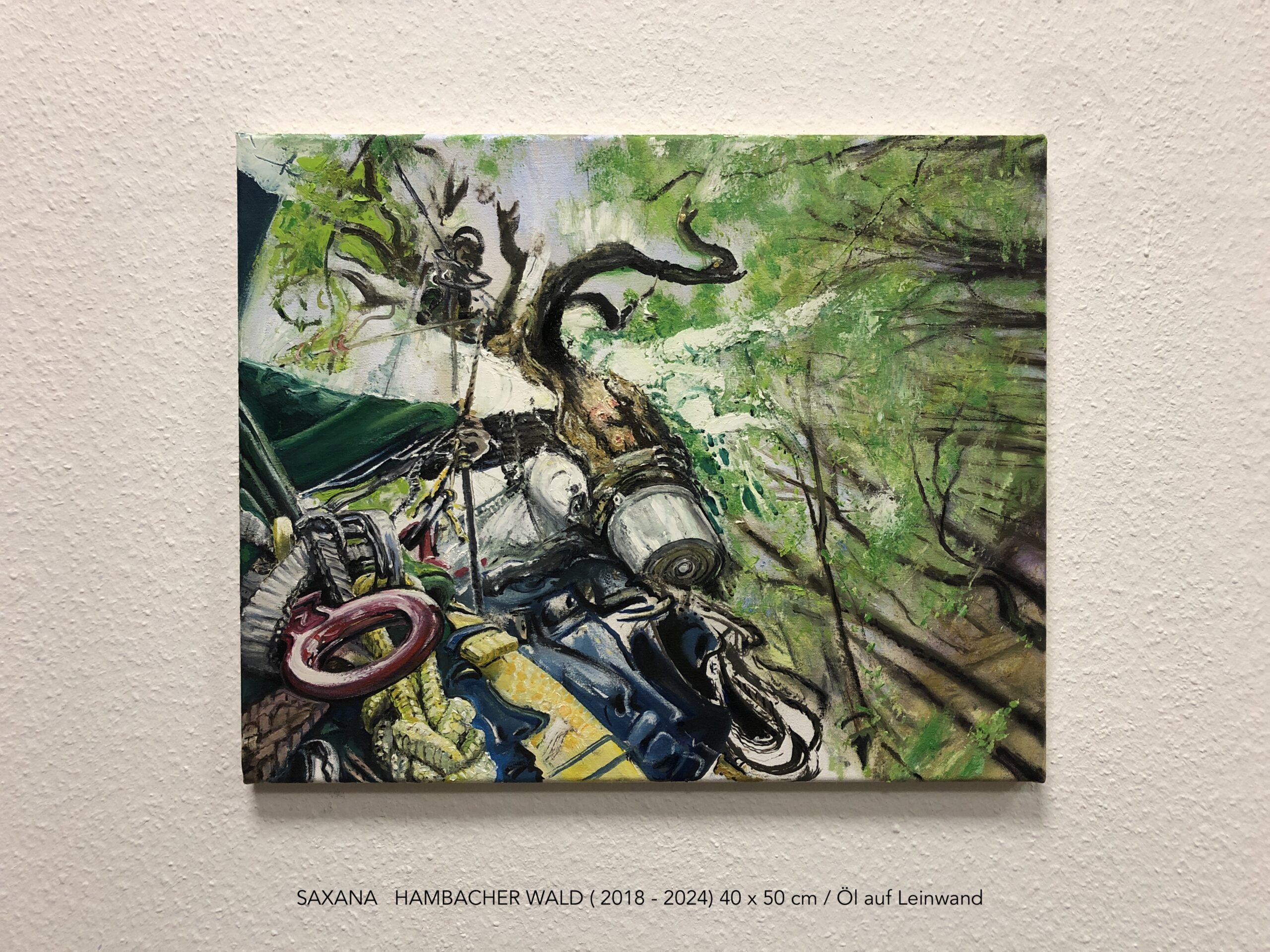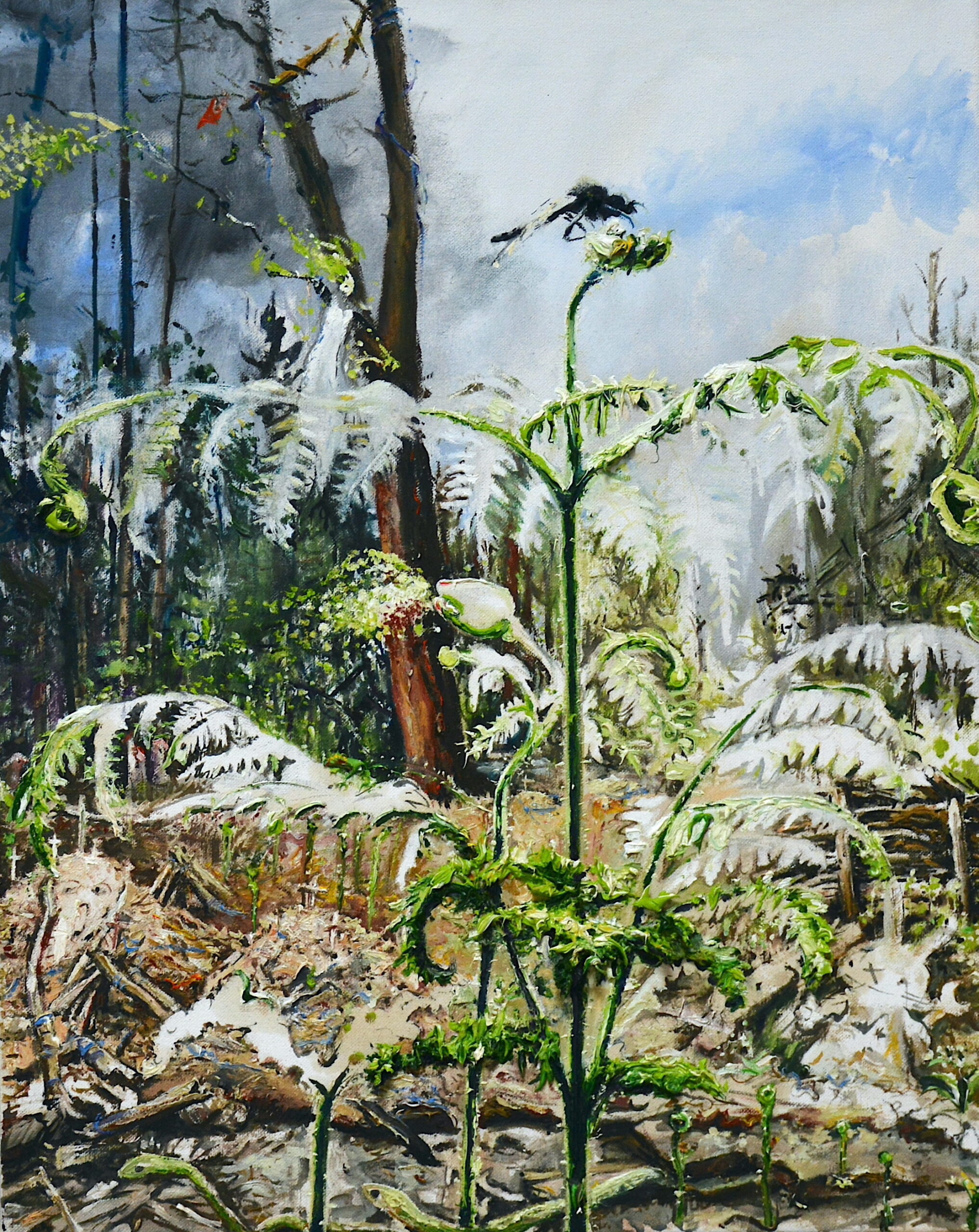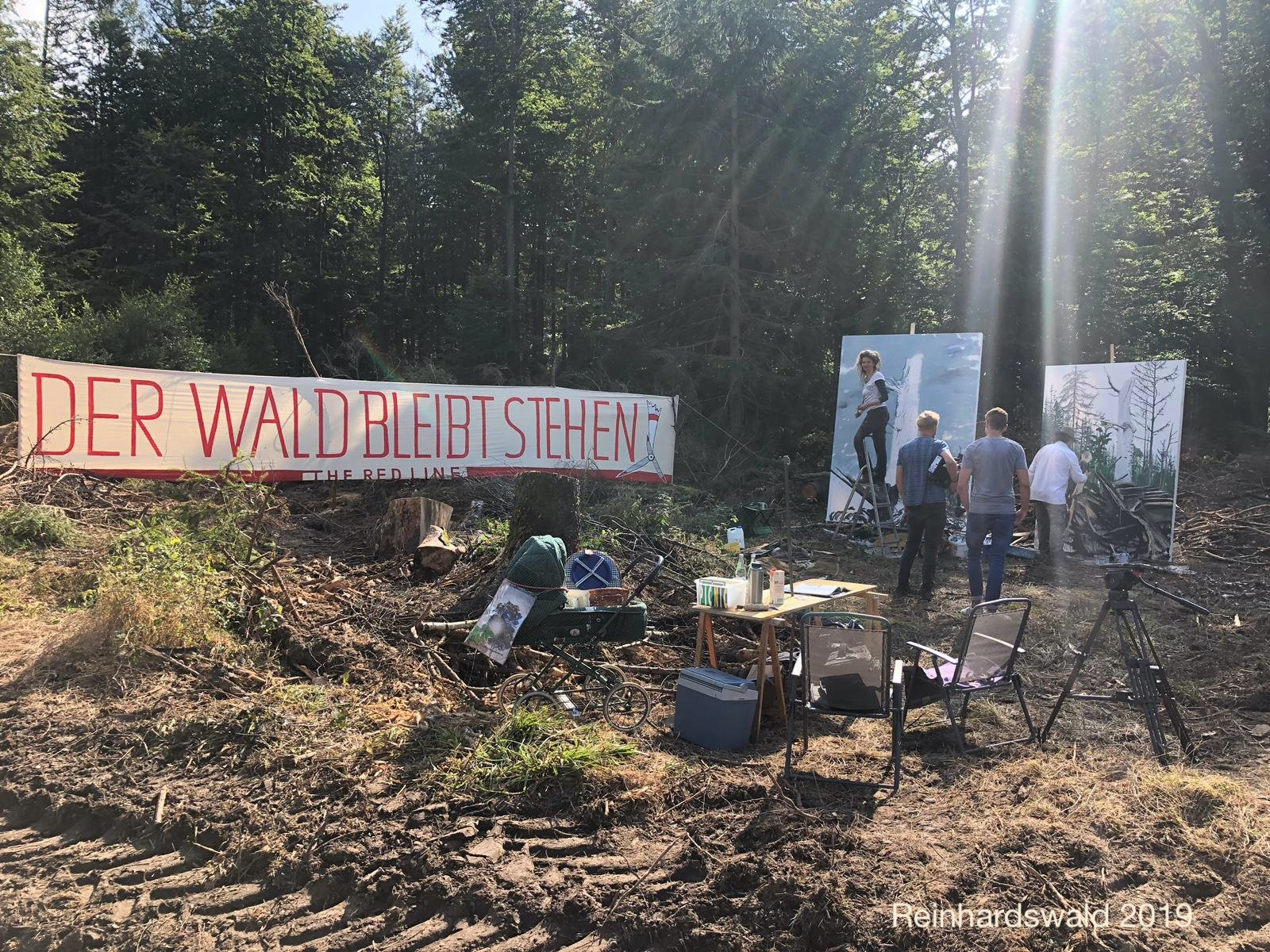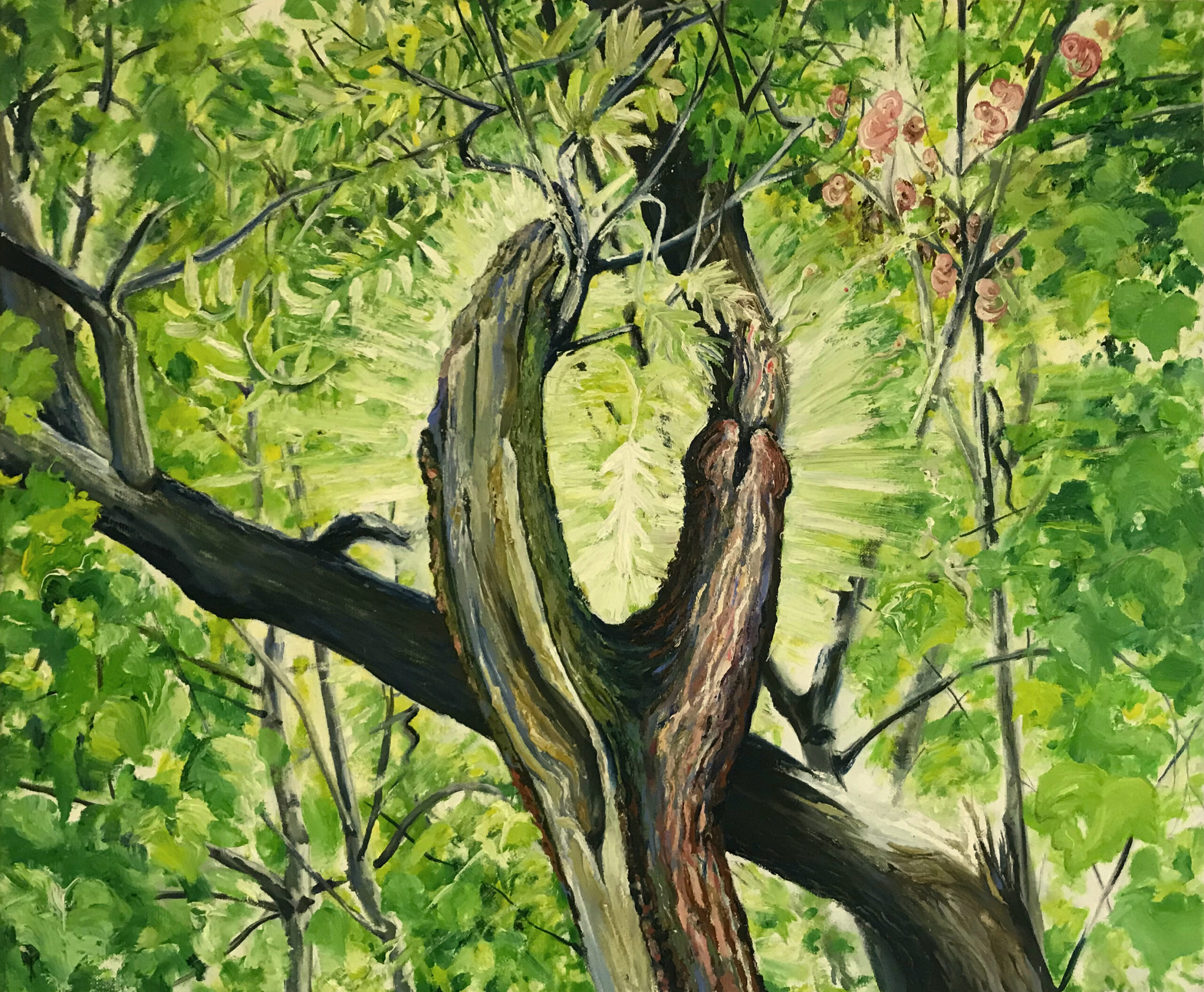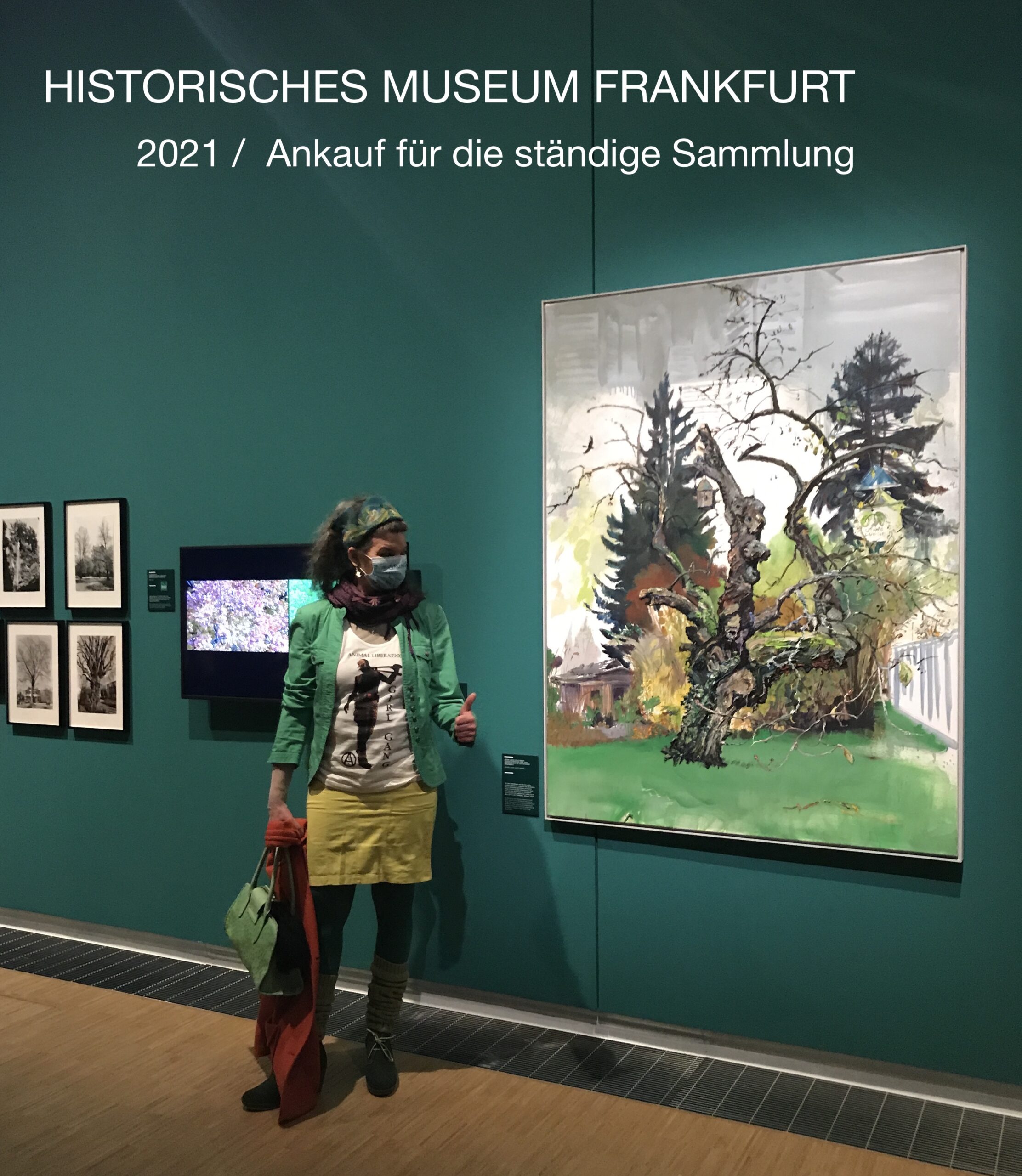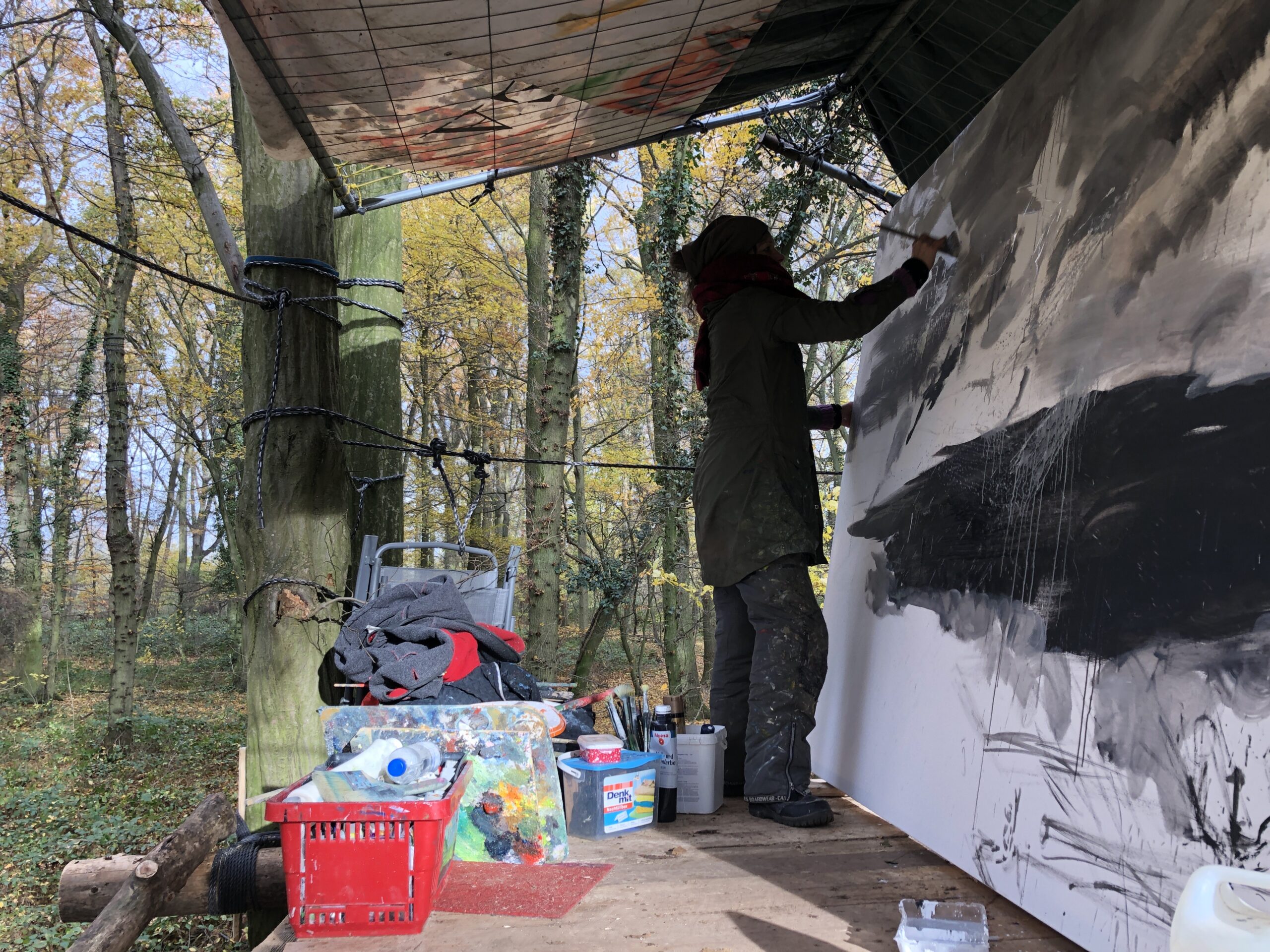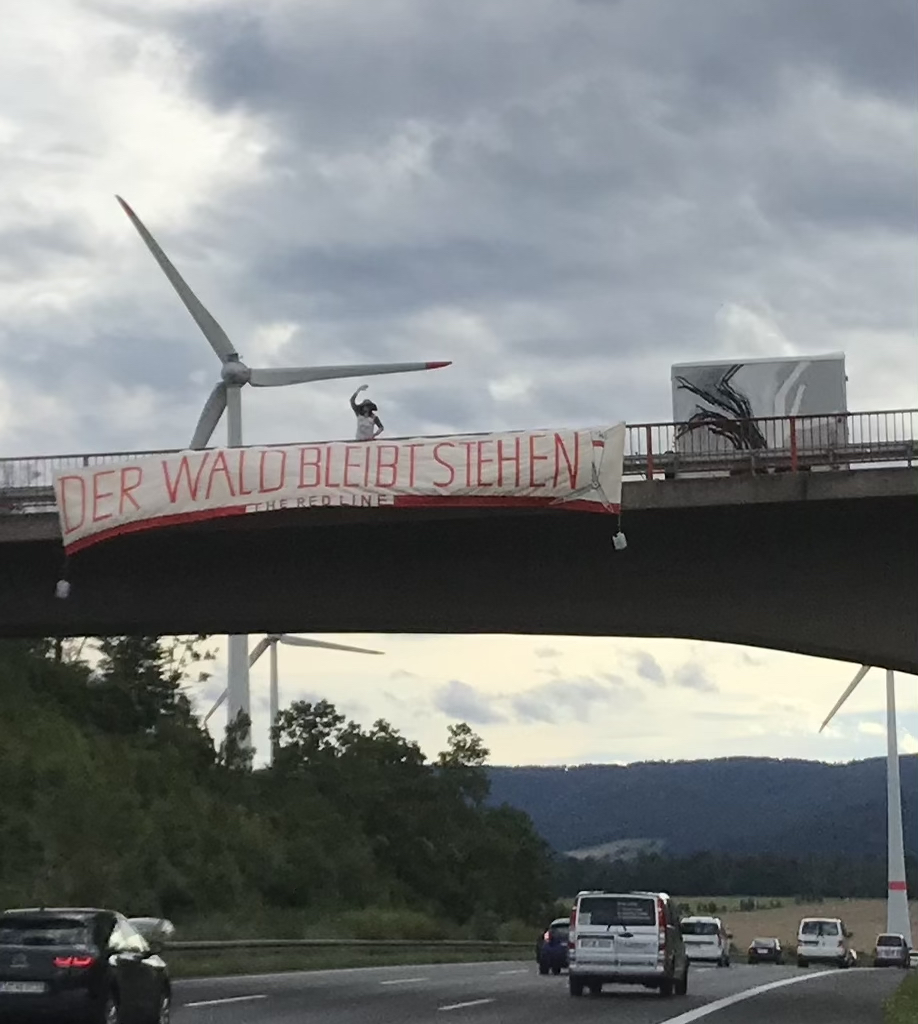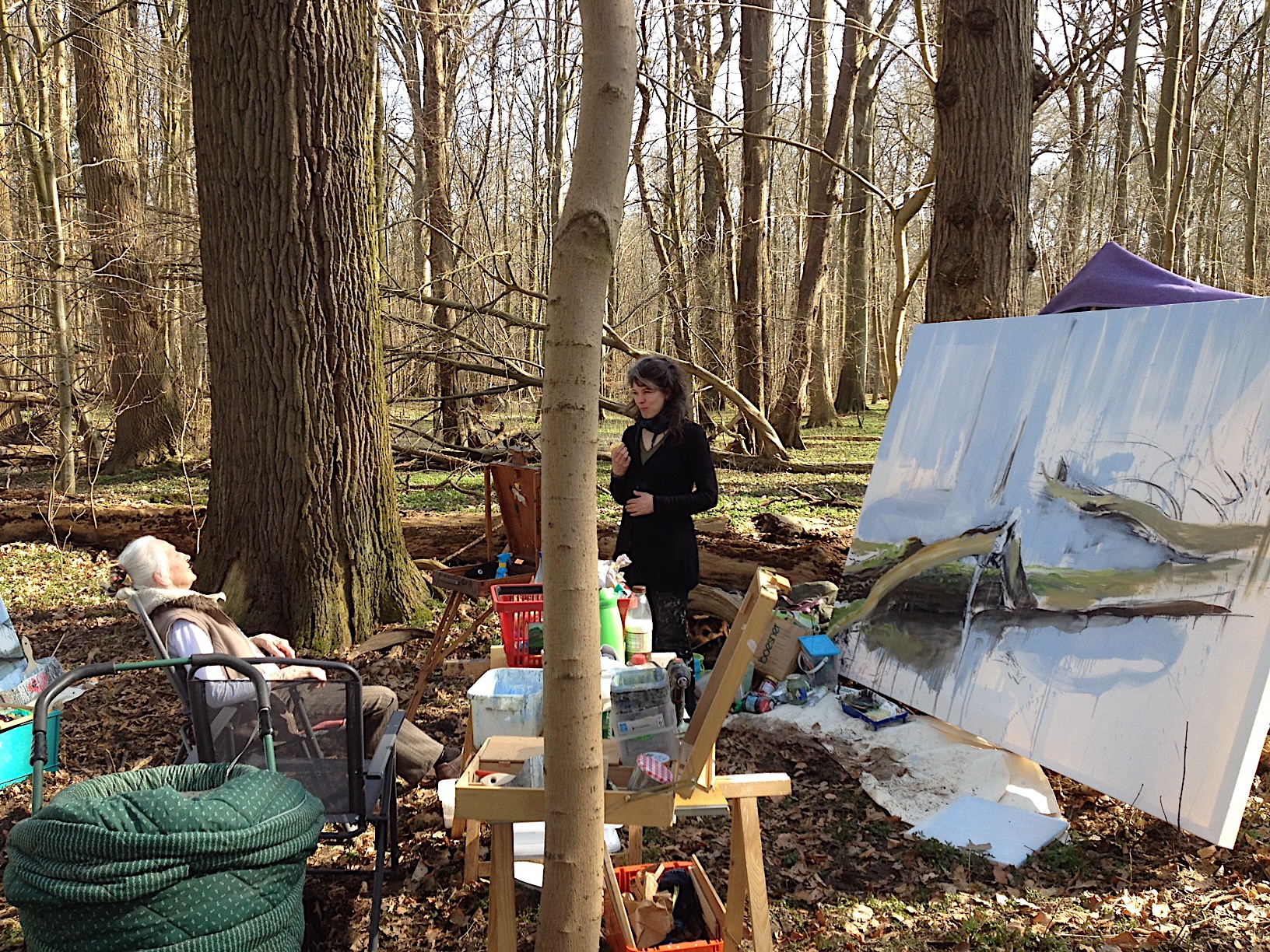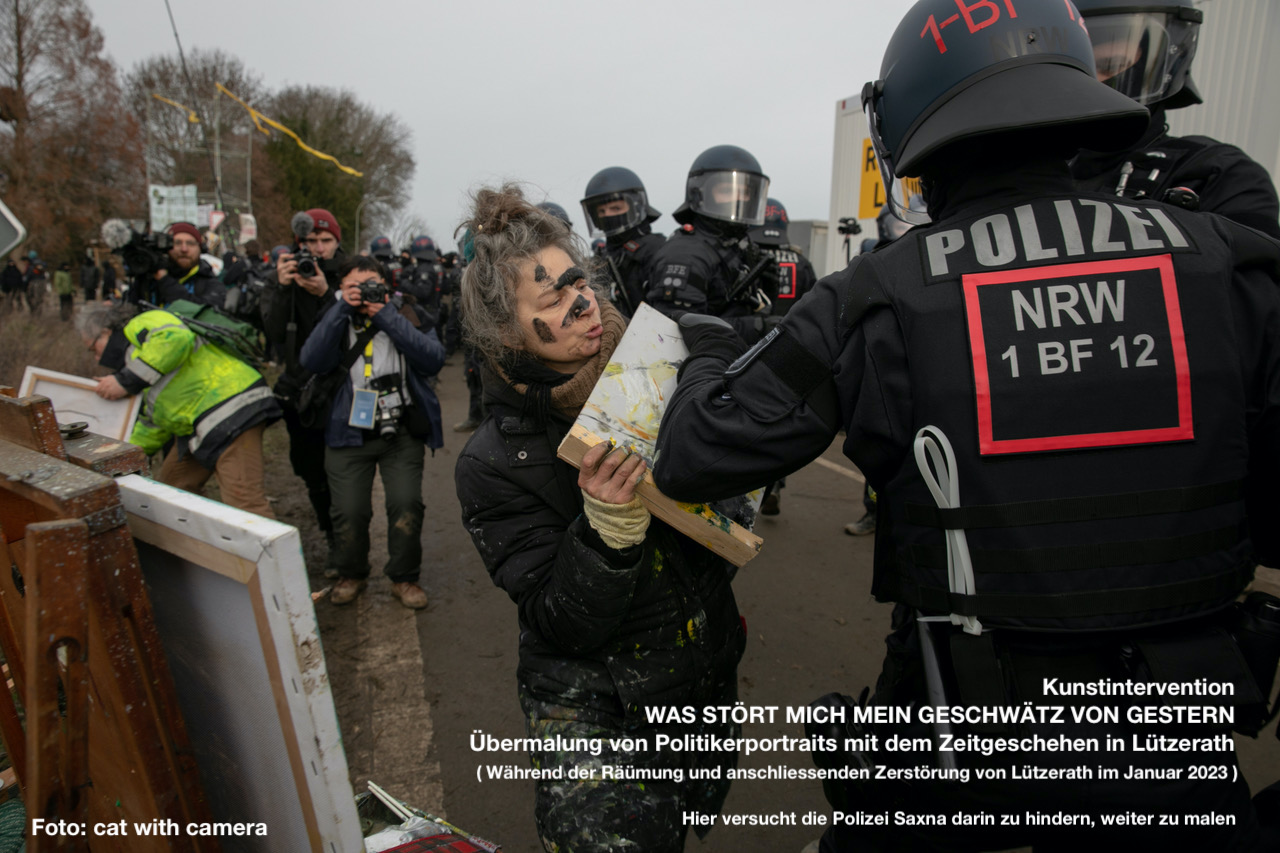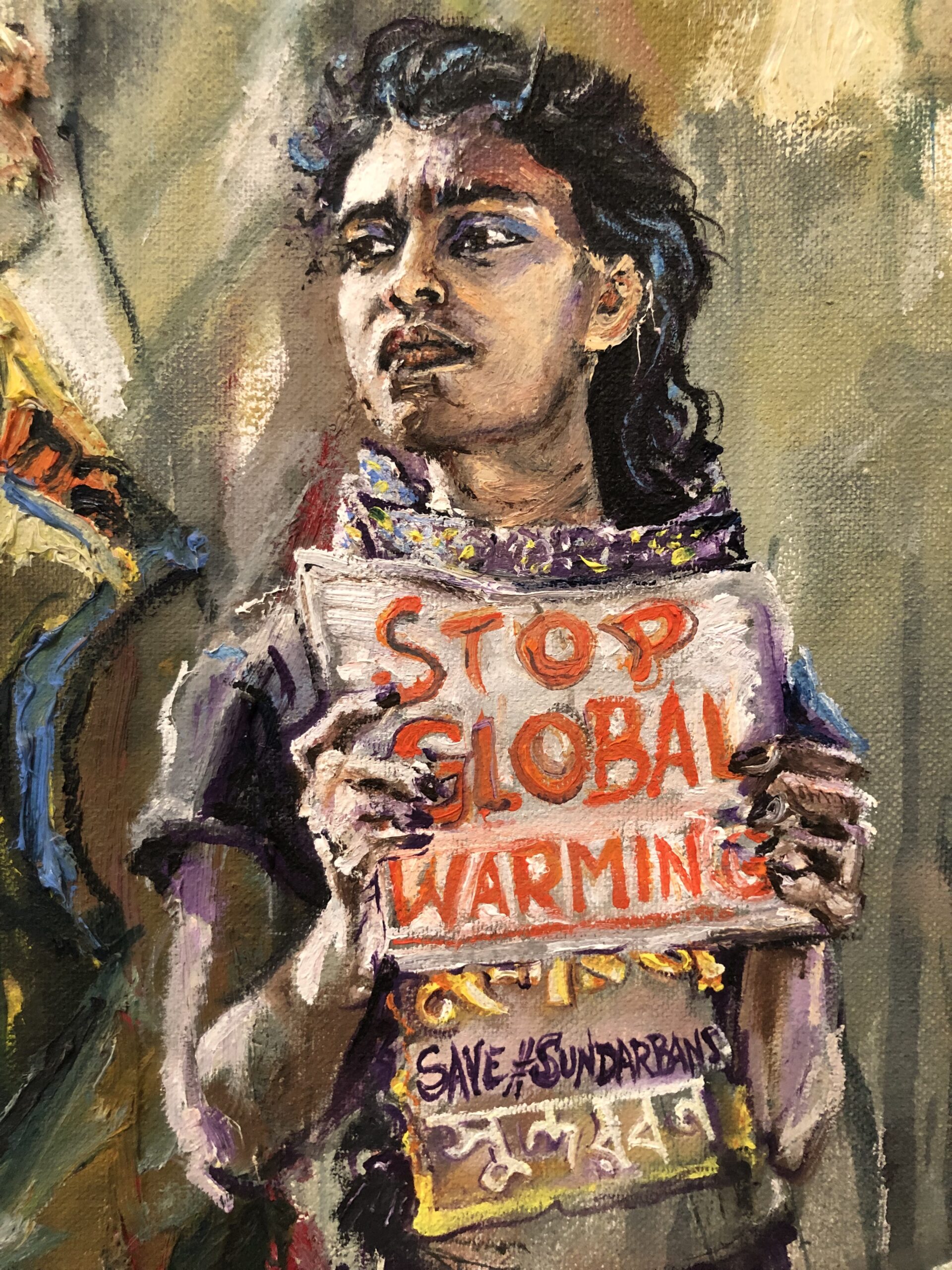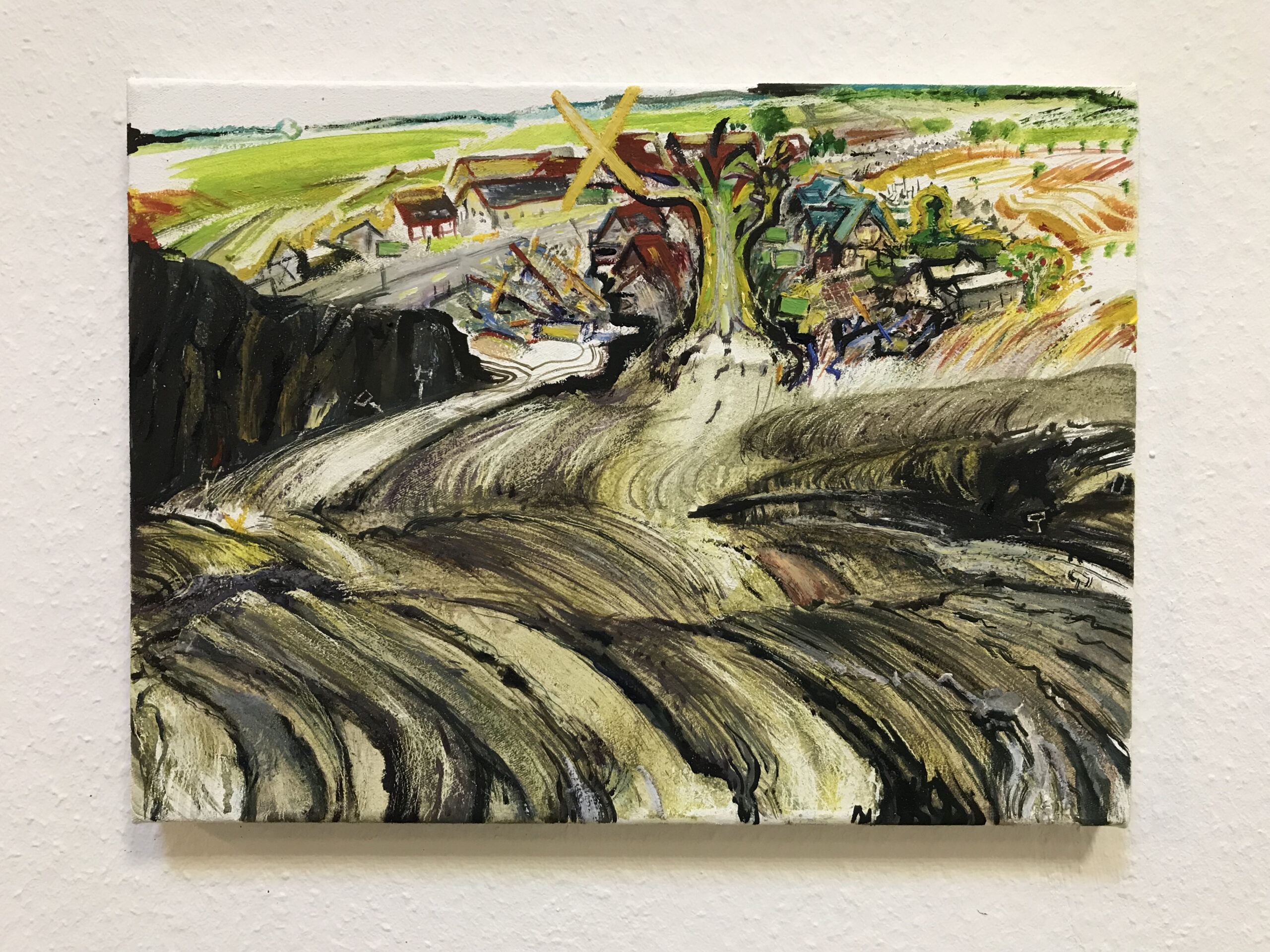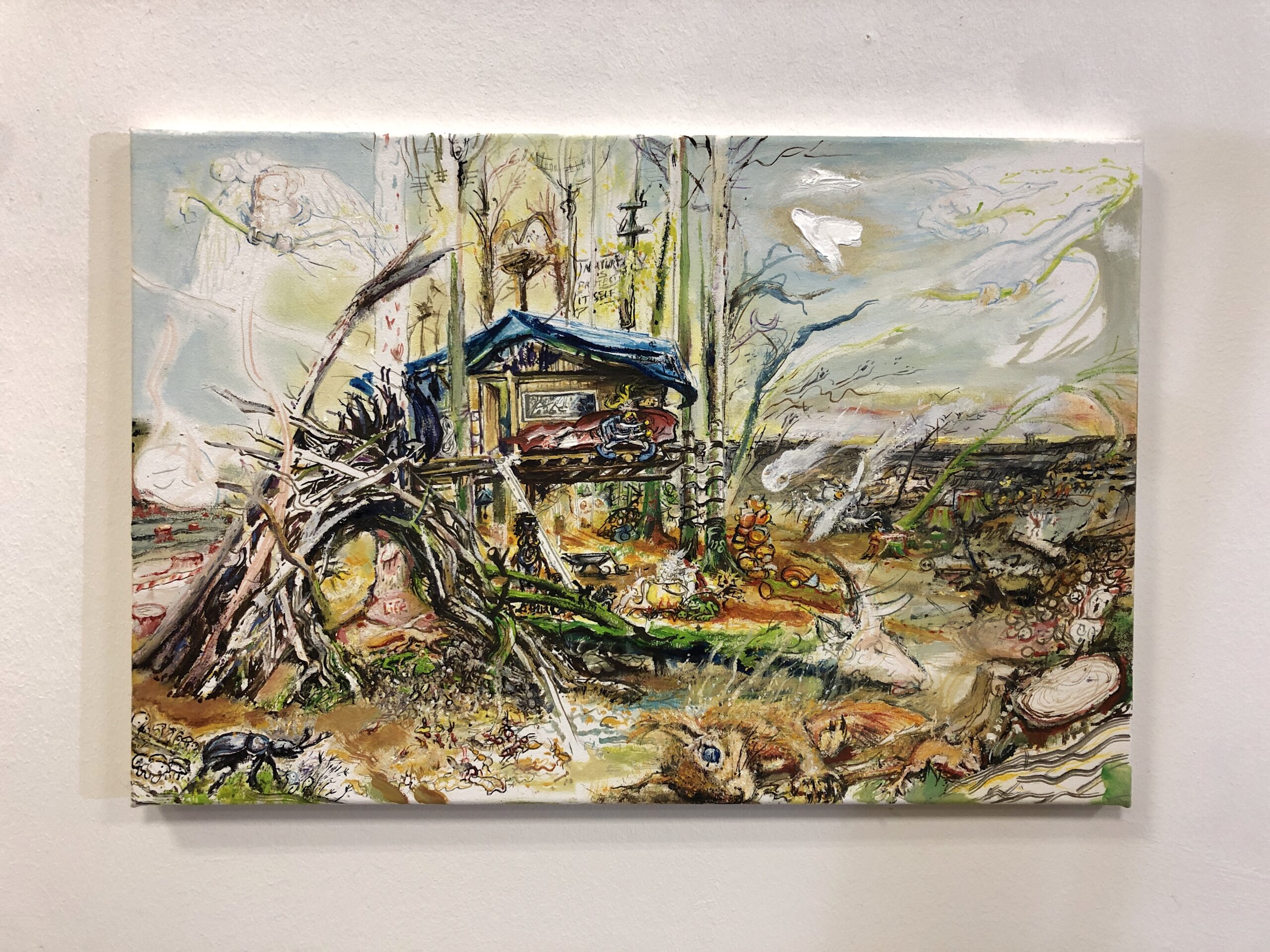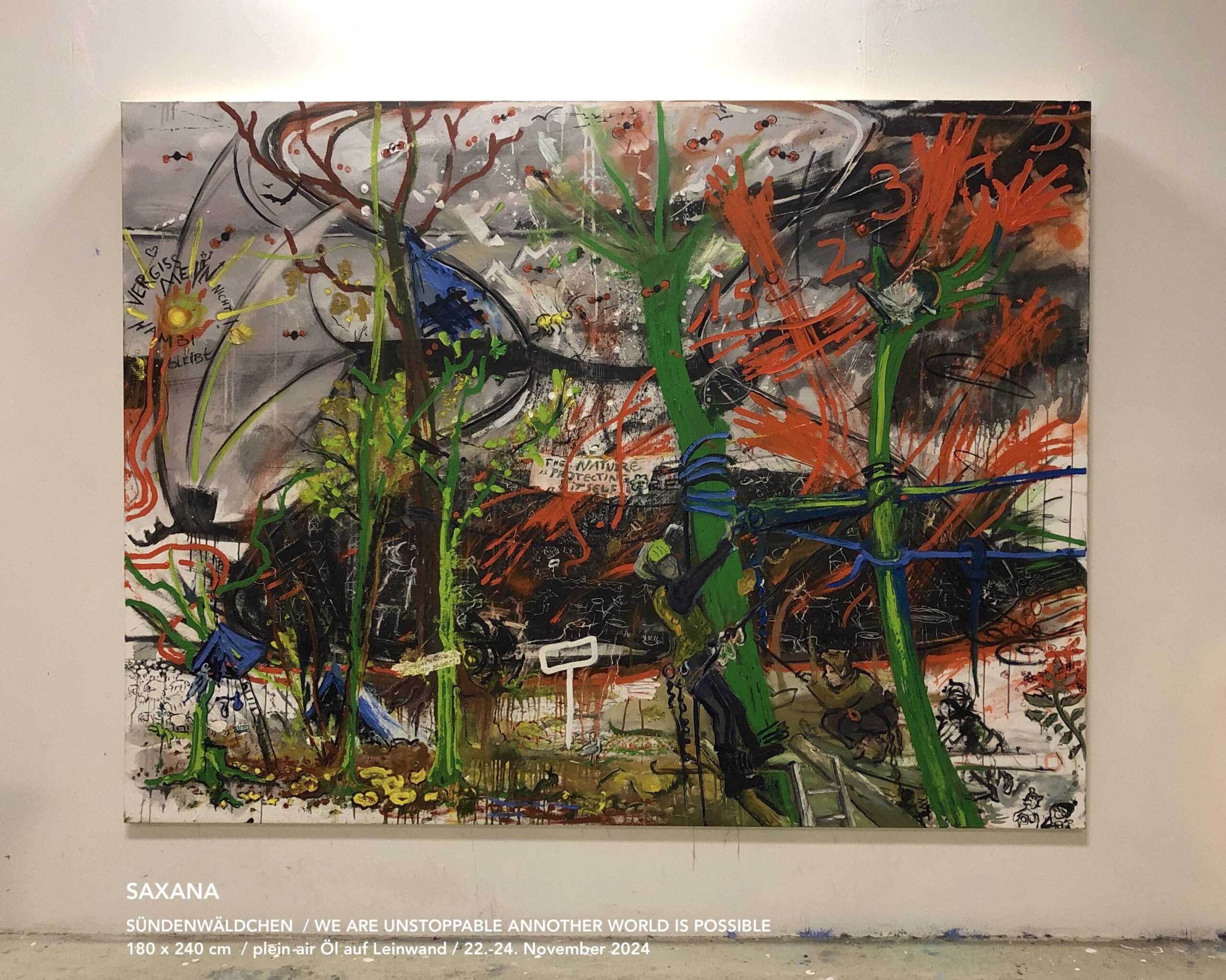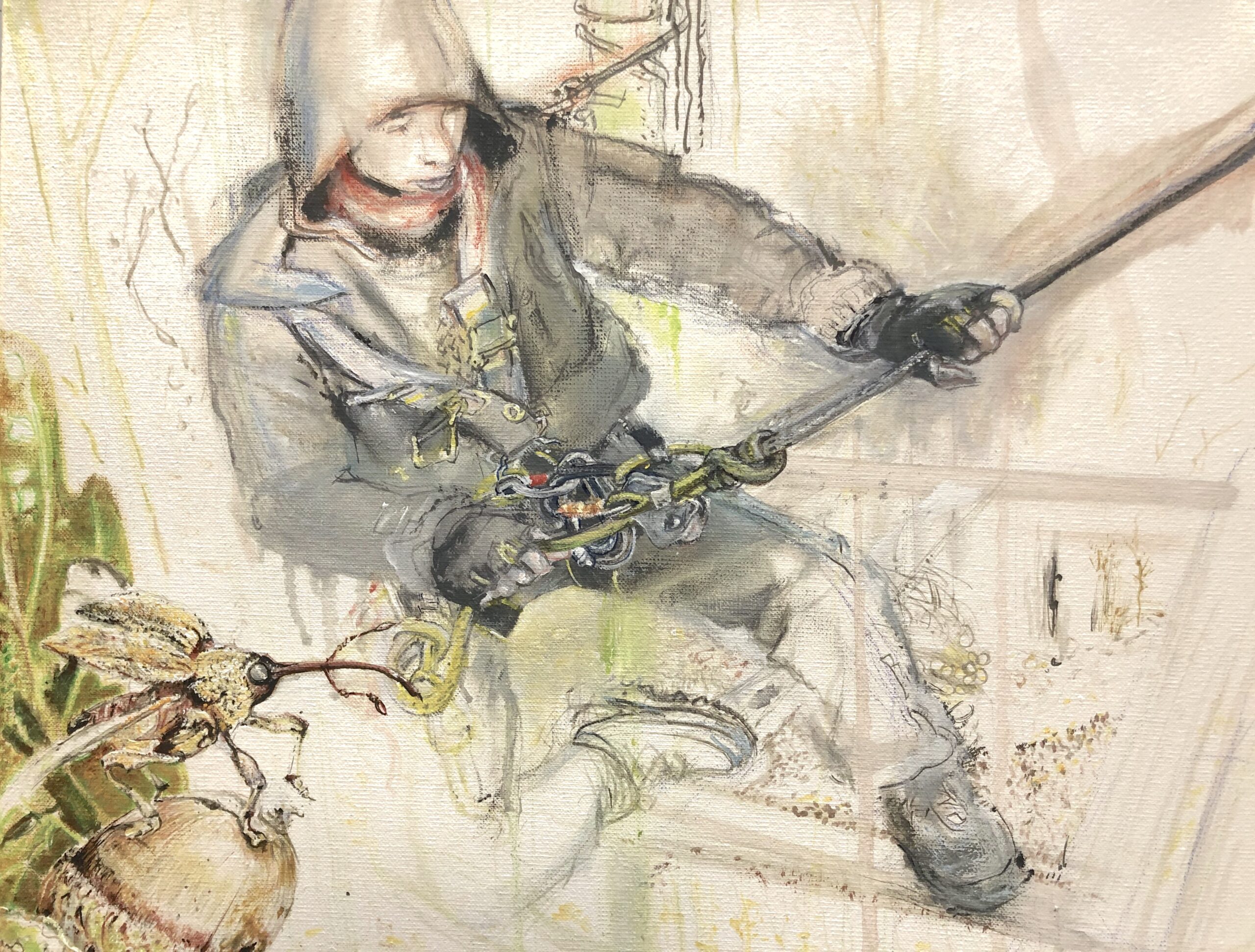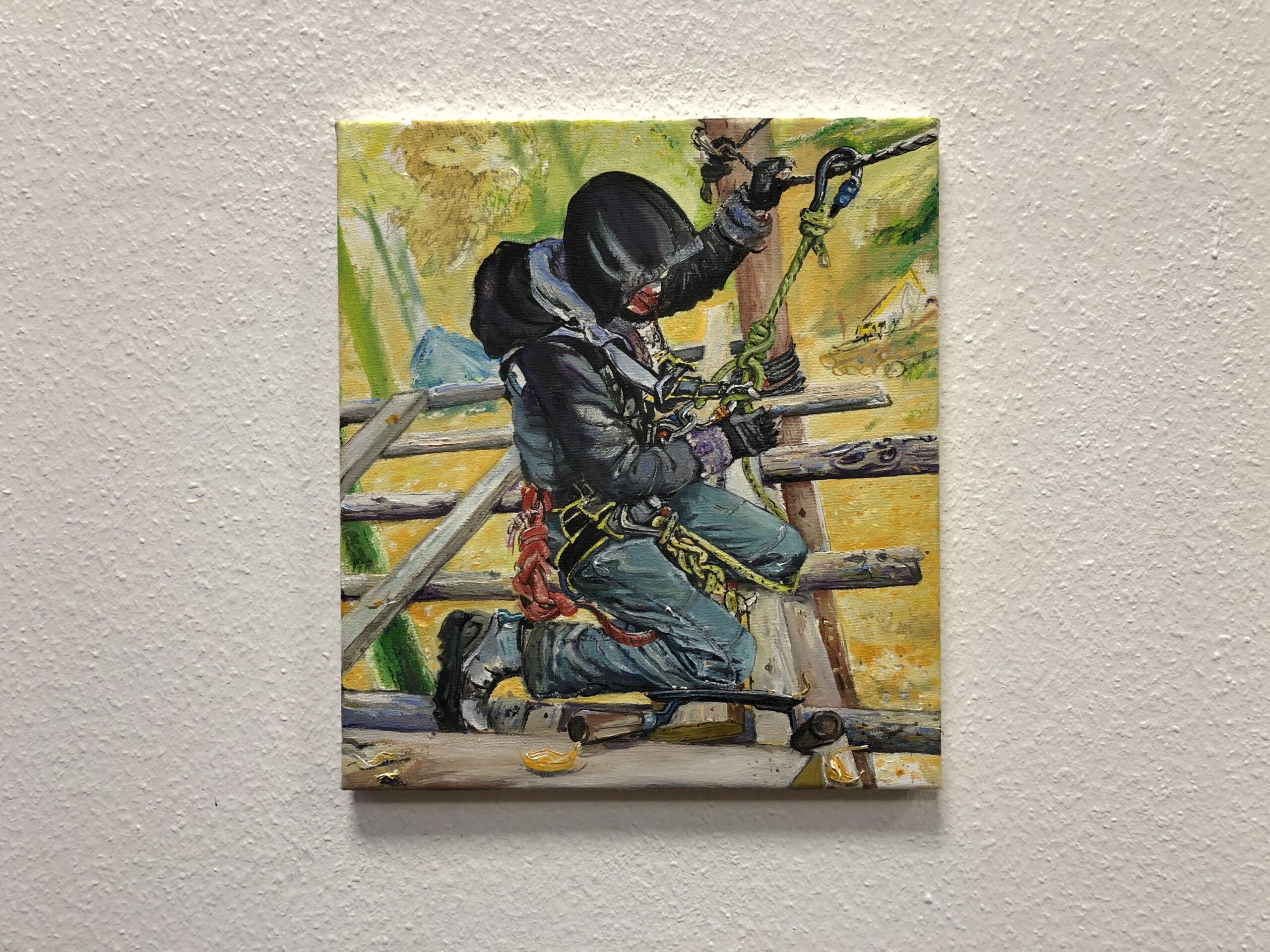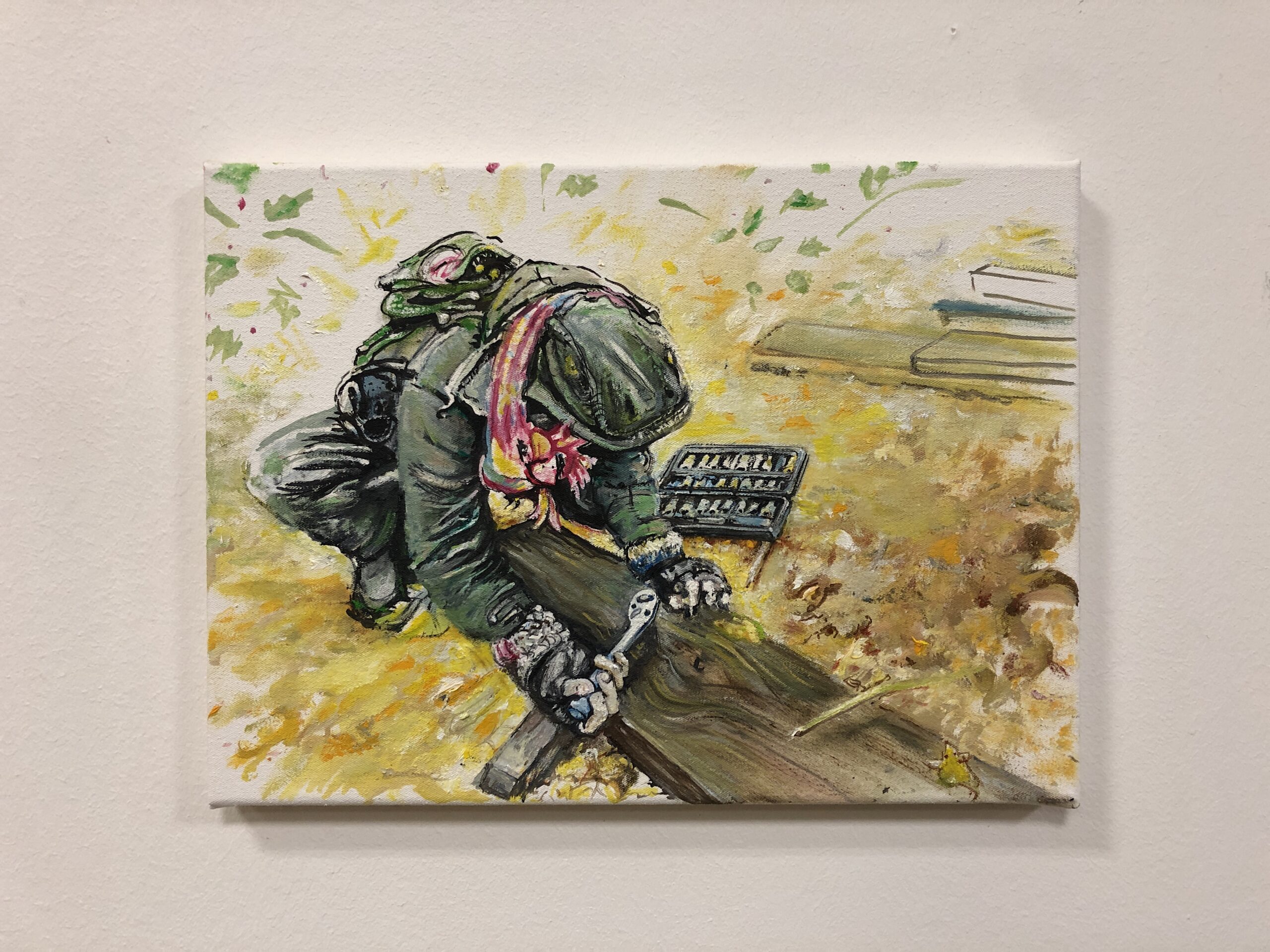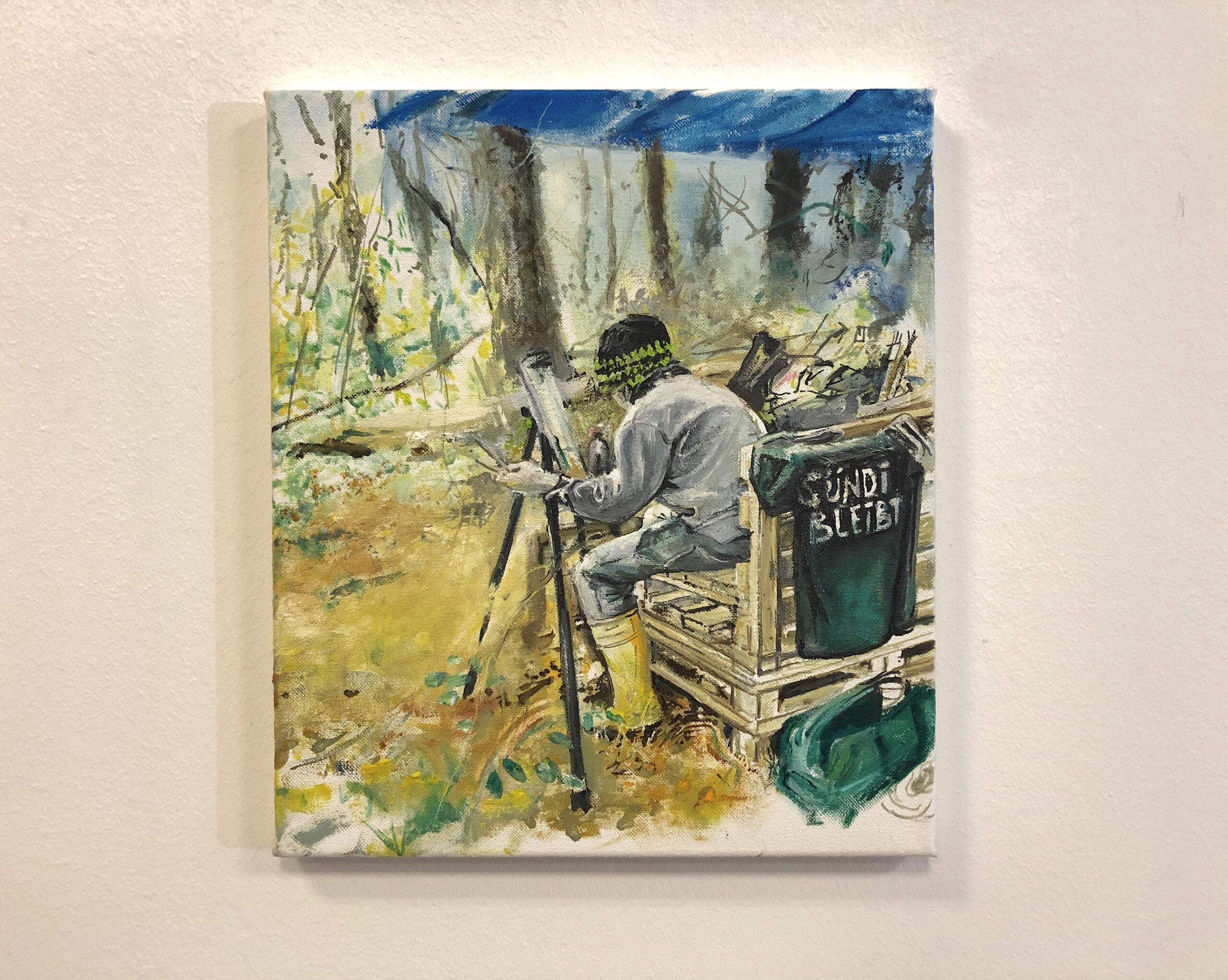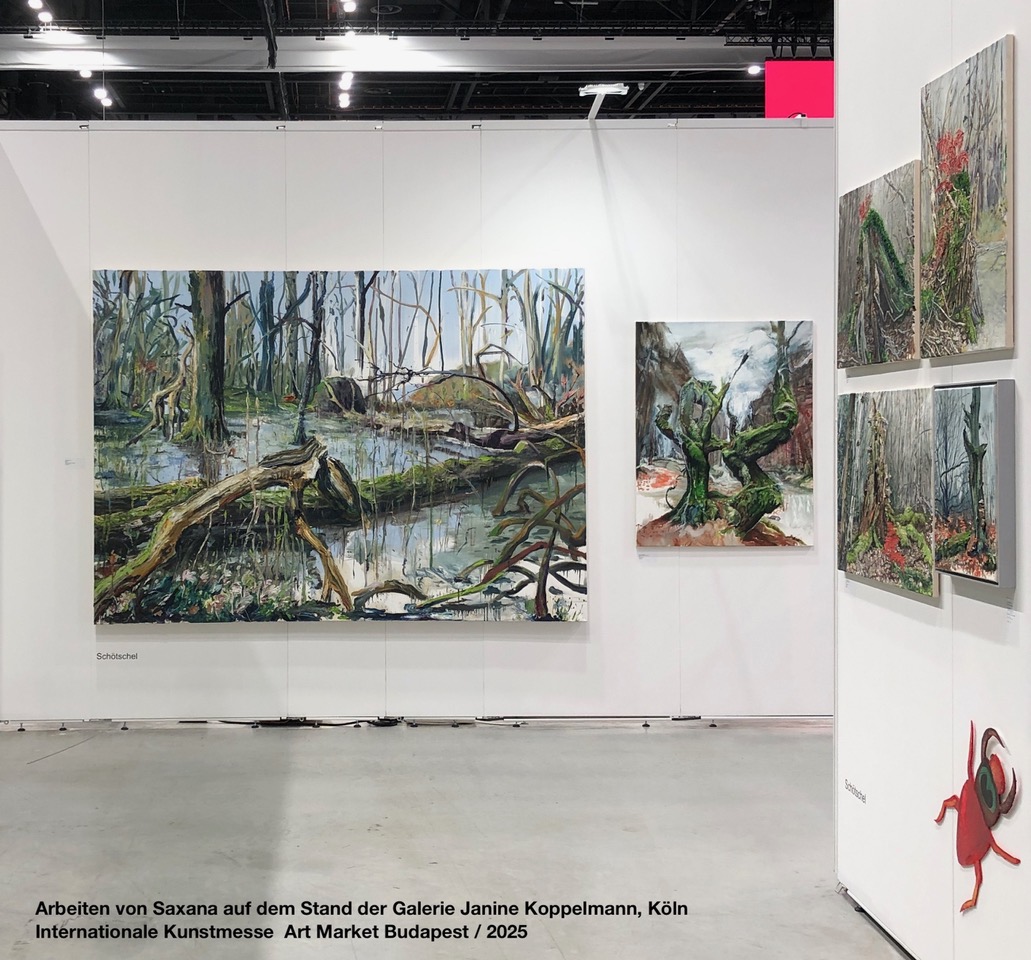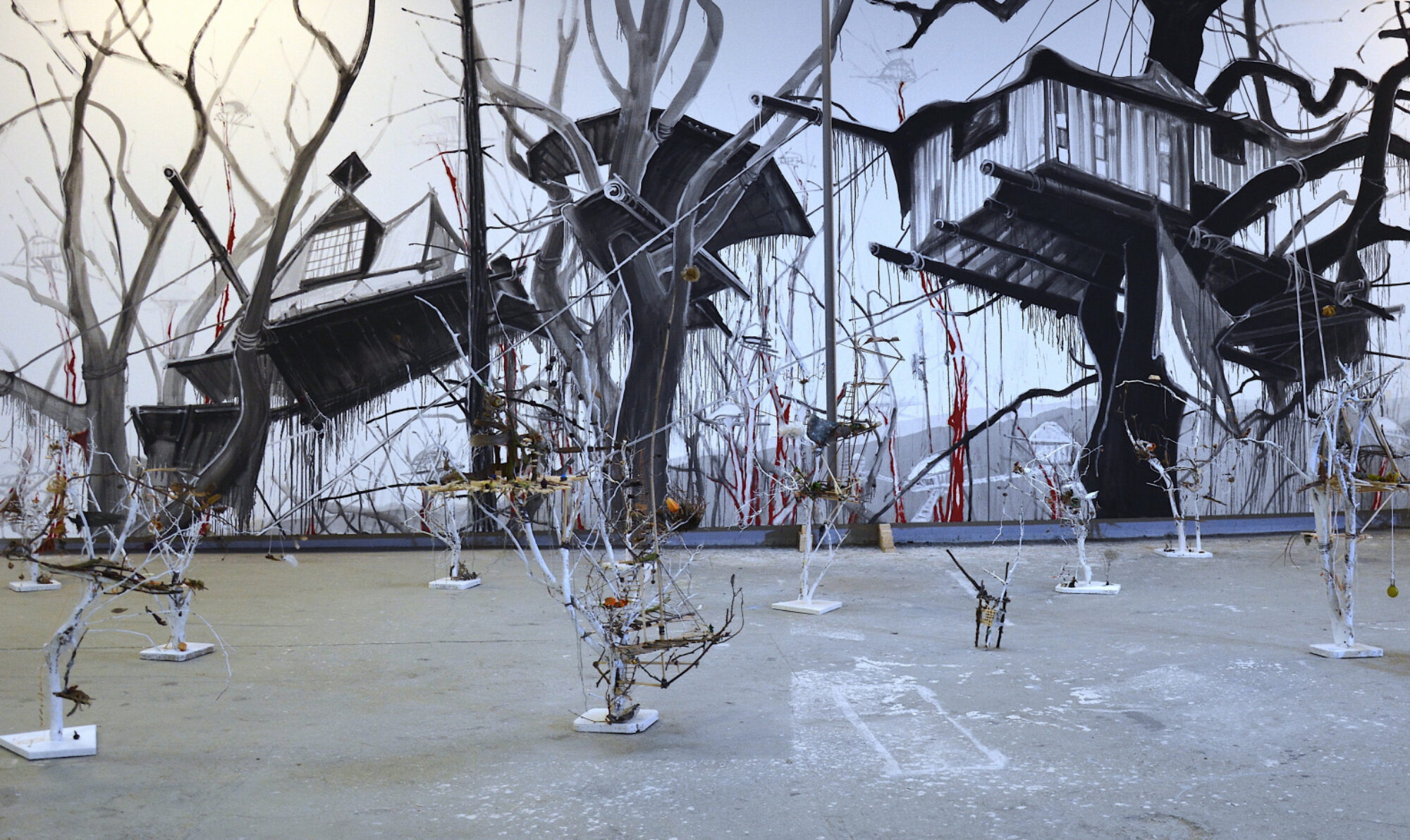
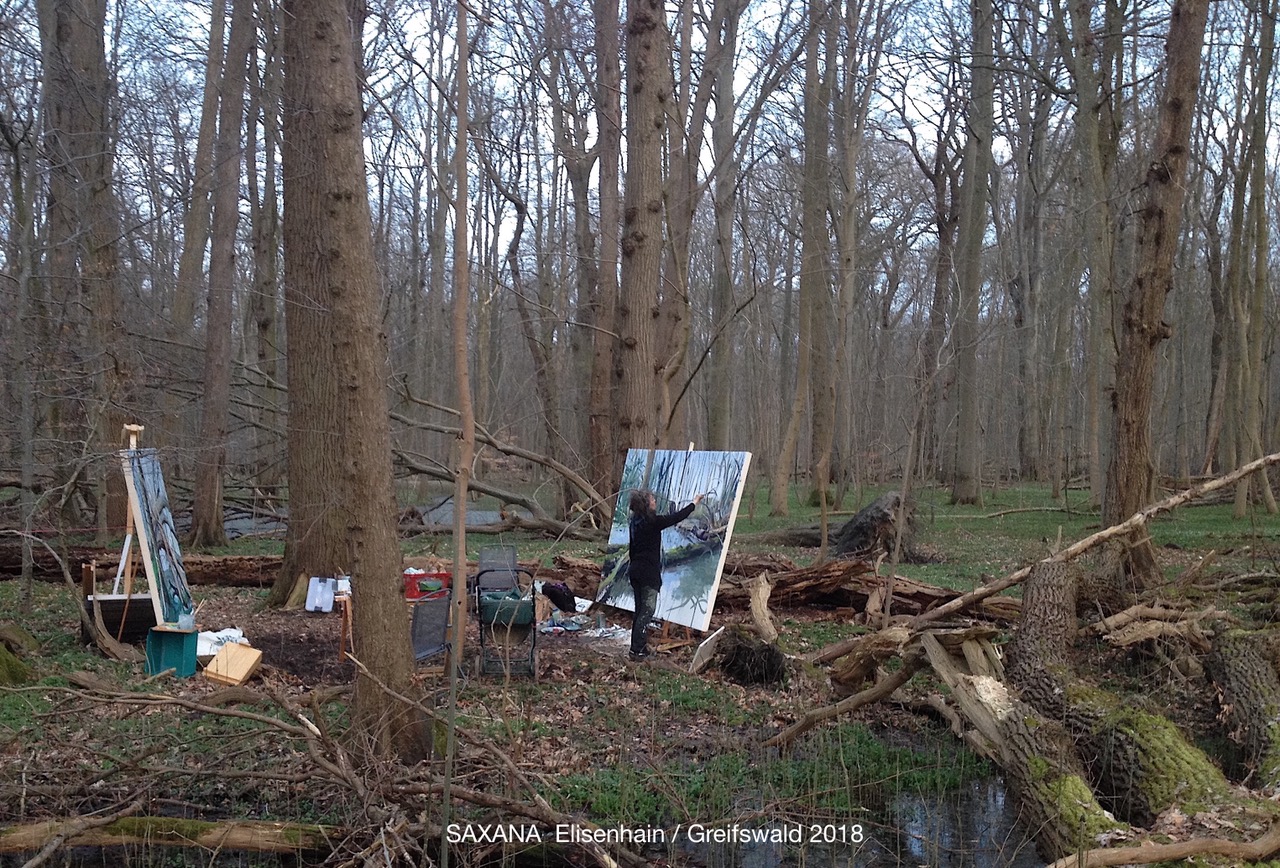
Many years have seen the emergence of a complex, interconnected pictorial universe spanning multiple bodies of work. Saxana creates her works outdoors—in forests, and, in another facet of her artistic practice, at key sites of the climate justice movement, including the Hambach Forest (since 2018), Lützerath, the Dannenröder Forest, and many others.
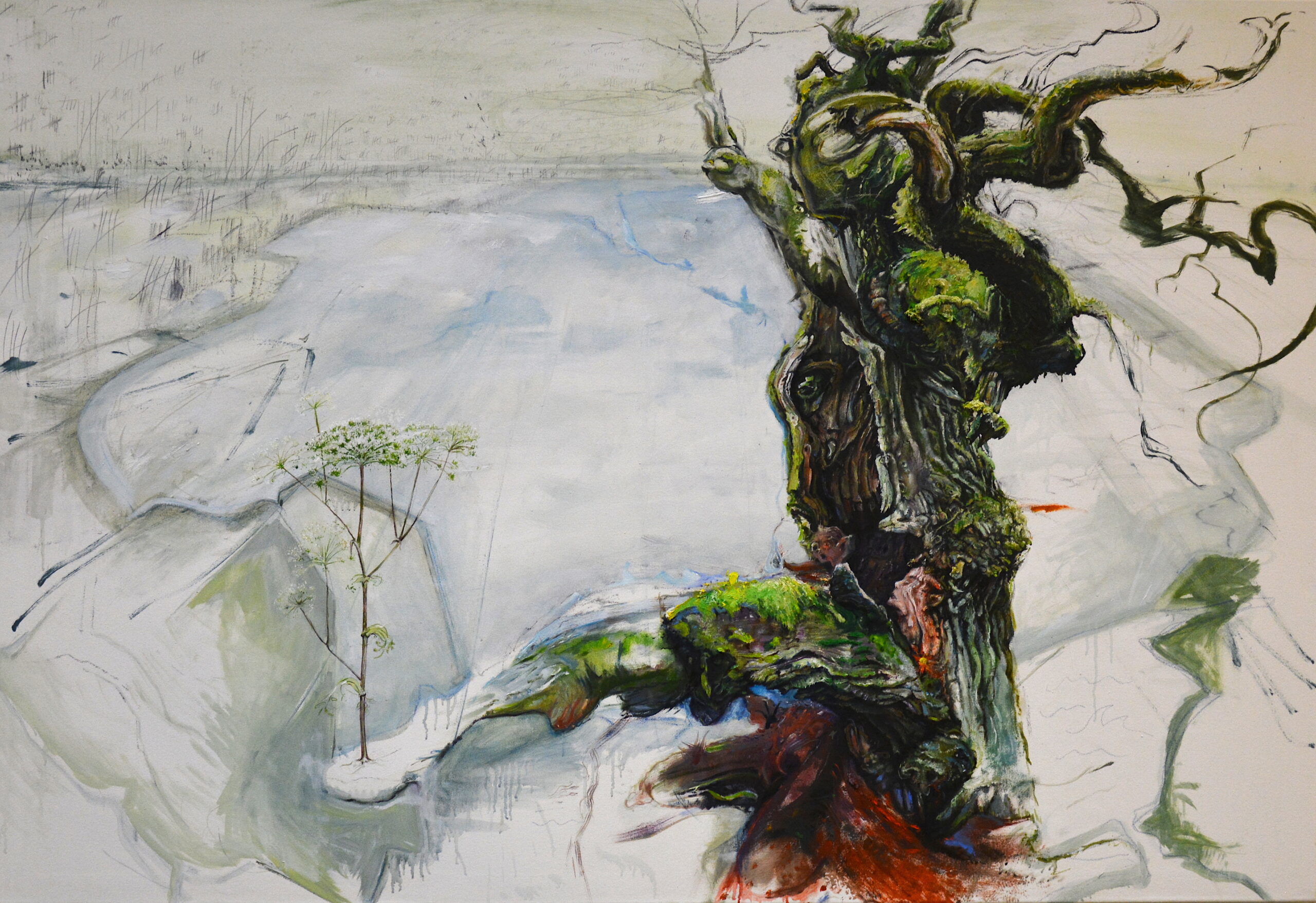
In her Leipzig studio, Saxana develops works that demand time, contemplation, and sustained artistic concentration. Her paintings evolve through a meticulous process in which a wide range of references is thoughtfully interwoven. Complex concepts drawn from science and history, discoveries in botany and zoology, observations of the cosmos and the celestial sphere, as well as reflections on the hidden ecosystems of the deep sea, are carefully composed into multilayered visual narratives. These diverse fields of knowledge do not function merely as illustrations but become integral elements of an autonomous pictorial language.
A significant current within contemporary art is that of Individual Mythology, a term describing artistic practices in which personal systems of meaning are transformed into universal visual narratives. Artists such as Giuseppe Penone, and likewise Saxana, construct physical and pictorial spaces charged with symbolic objects, traces of memory, and autobiographical references. These carefully orchestrated constellations of signs transcend the purely personal, inviting viewers to enter complex worlds in which memory, nature, science, and imagination converge. In Saxana’s work, symbols become carriers of meaning, revealing an individual worldview while opening a poetic space for reflection on the relationship between humanity and the natural world.
Born in Düsseldorf in 1966, Saxana lives a life shaped by an unwavering commitment to both artistic practice and activism. Her work is grounded in a profound sense of responsibility, embracing forms of creative action that extend beyond the self and seek to effect meaningful change—both in everyday life and within broader social and ecological contexts.
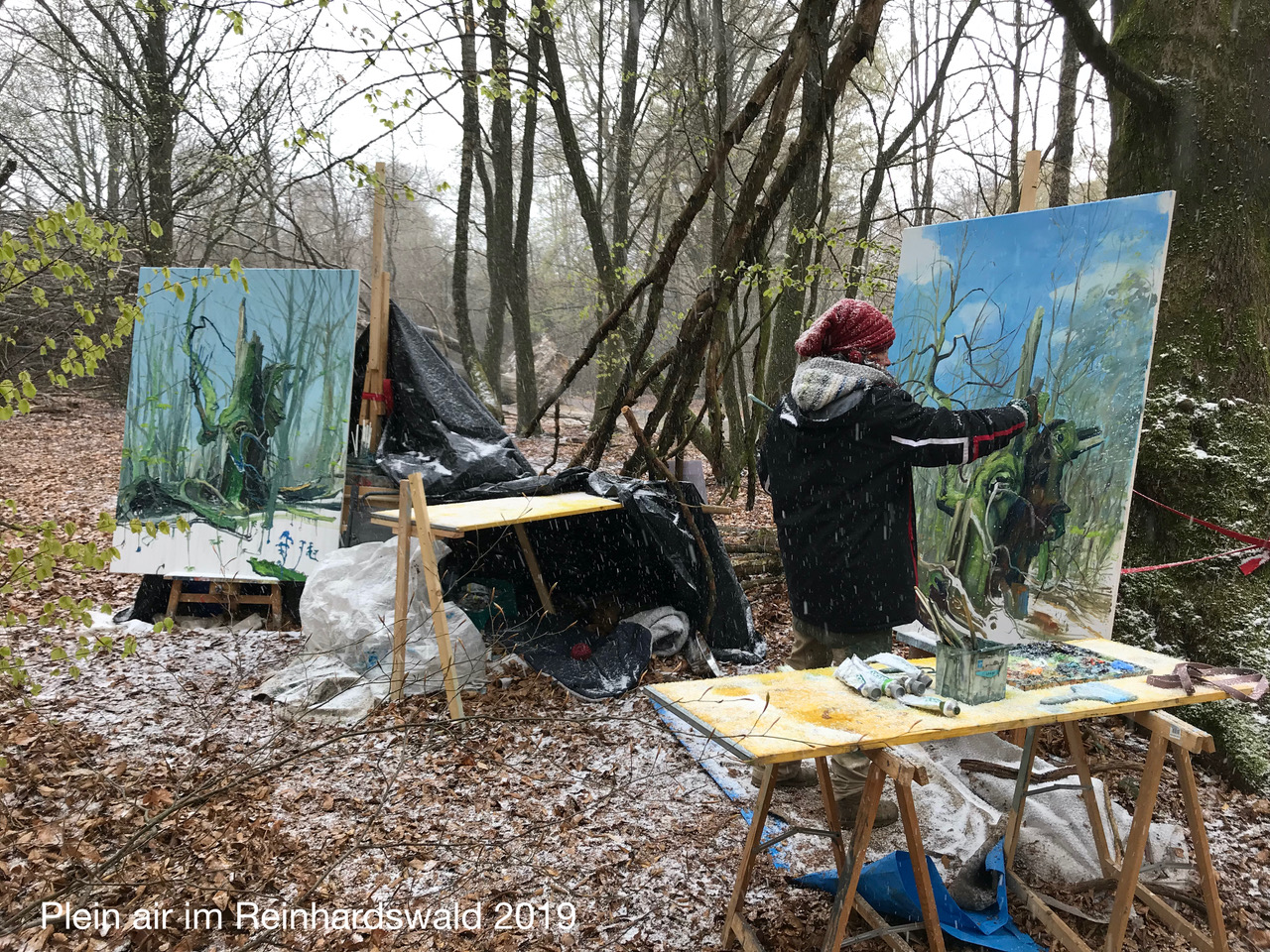
“My studio is outdoors …”—this brief statement, taken from a conversation with the artist, is deeply revealing of her artistic practice. In an era shaped by digital acceleration, and at a time when it has become increasingly evident that humanity must once again understand itself as an integral part of nature, the practice of plein air painting assumes an almost revolutionary significance.
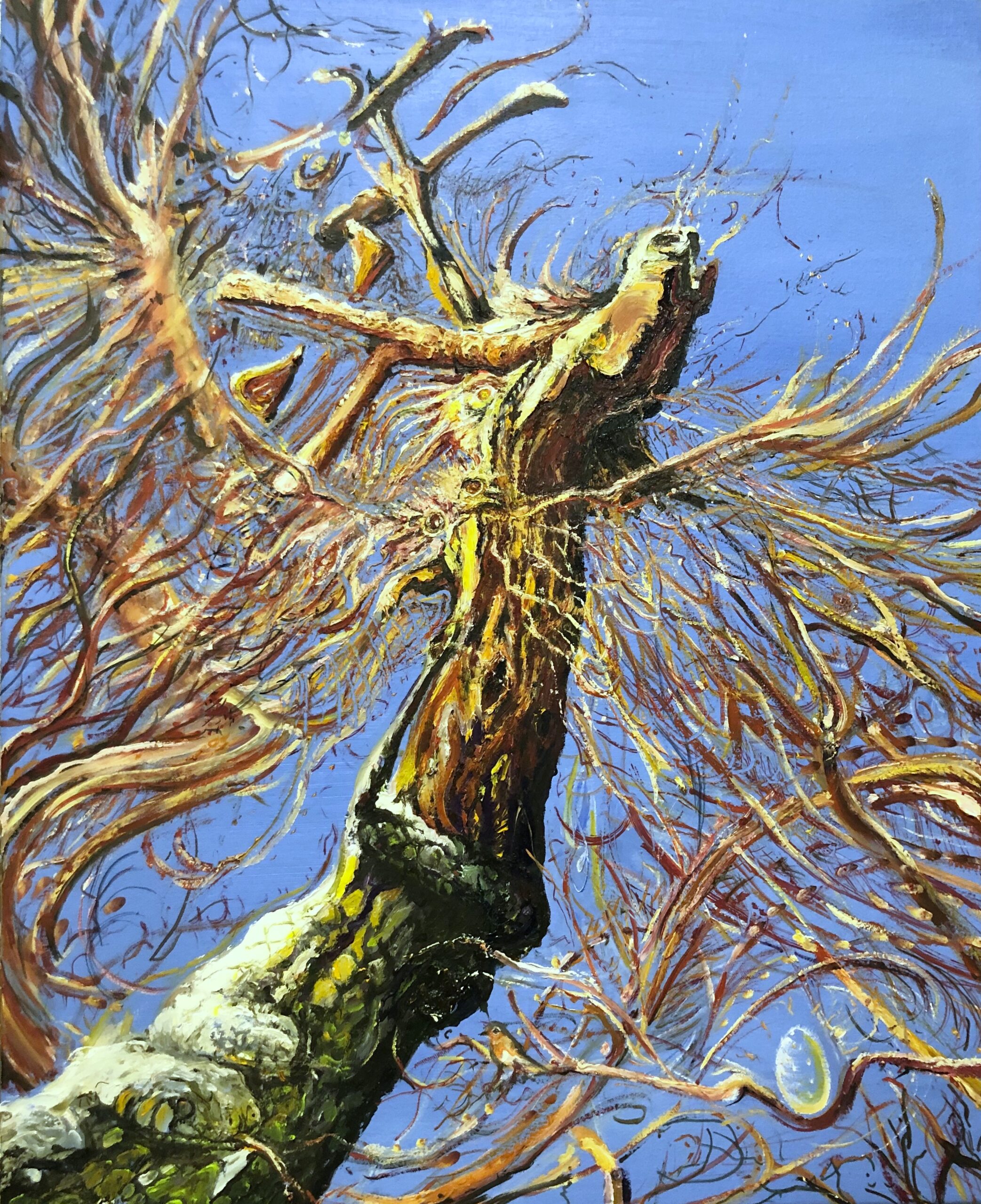
Although countless hours are devoted to the studio, the days spent painting in forests are the true highlights of the year. Working under an open sky—whether deep blue or veiled in mist, in freezing cold or oppressive heat, amid snowfall or strong winds—demands a profound commitment to being fully present in the moment, regardless of external conditions.
Rather than resisting these forces, Saxana welcomes them. The traces left by weather, climate, and the elements are intended to remain visible within the work. They become witnesses to the circumstances of its creation, integral components of the painting itself, and are granted a permanent home within its surface.
Viewed from the perspective of the “adult world,” the joyful immersion in one’s own immediate universe is often dismissed as naïve. Yet it is precisely this meticulous, wholehearted way of being—the quality we readily admire in children and quietly lament losing in adulthood—that has never diminished in Saxana’s artistic vision.
This enduring capacity enables her to create images of remarkable honesty and authenticity. Her paintings remind us of a faculty many of us have forgotten: the ability to perceive the world with the openness, wonder, and clarity of a child. In doing so, they invite us to reconnect with a way of seeing that precedes convention and expectation.
Her painting is untouched by academic orthodoxy or the conventions of the art market. It remains immediate, uncompromising, and profoundly genuine.
Excerpt from:
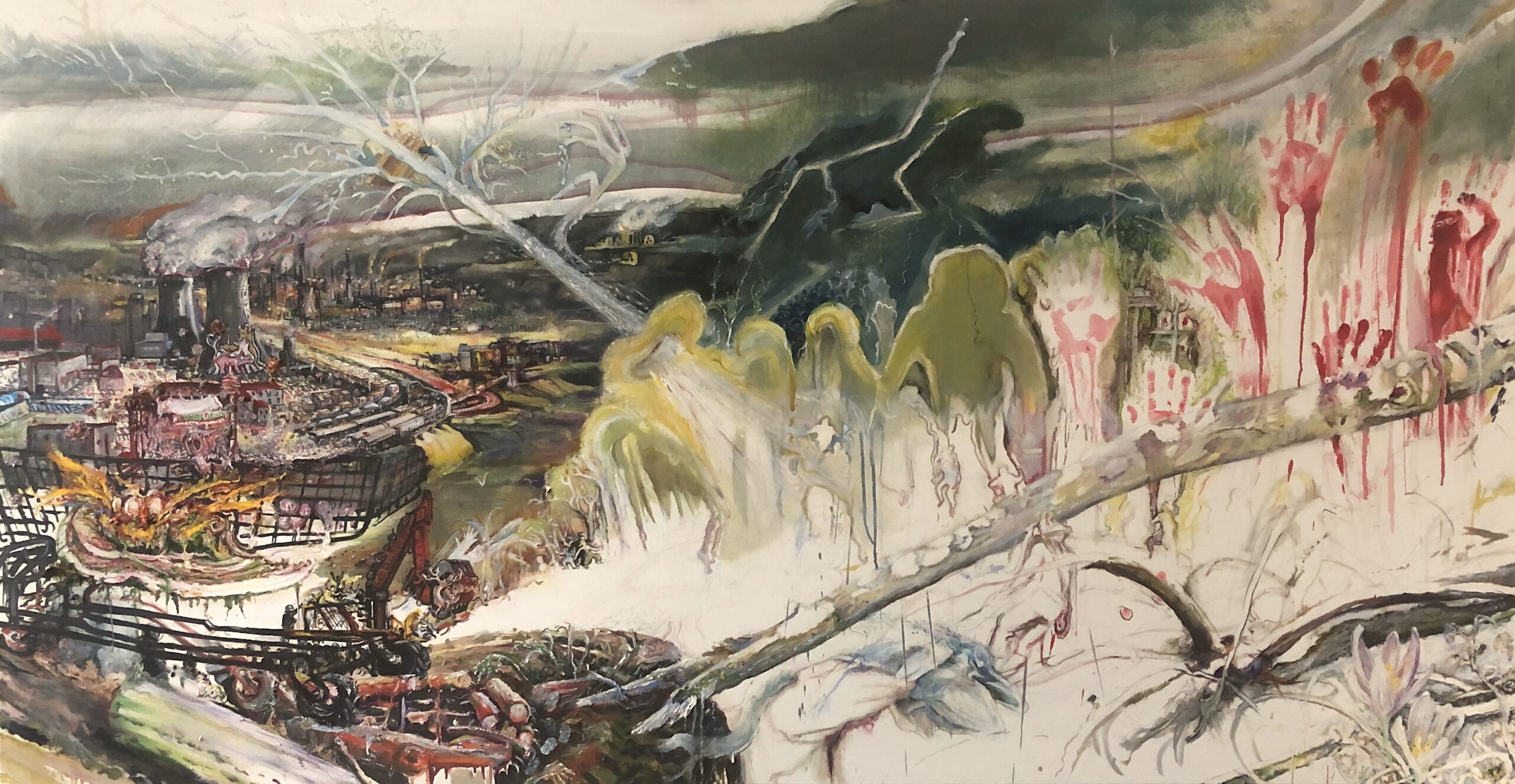
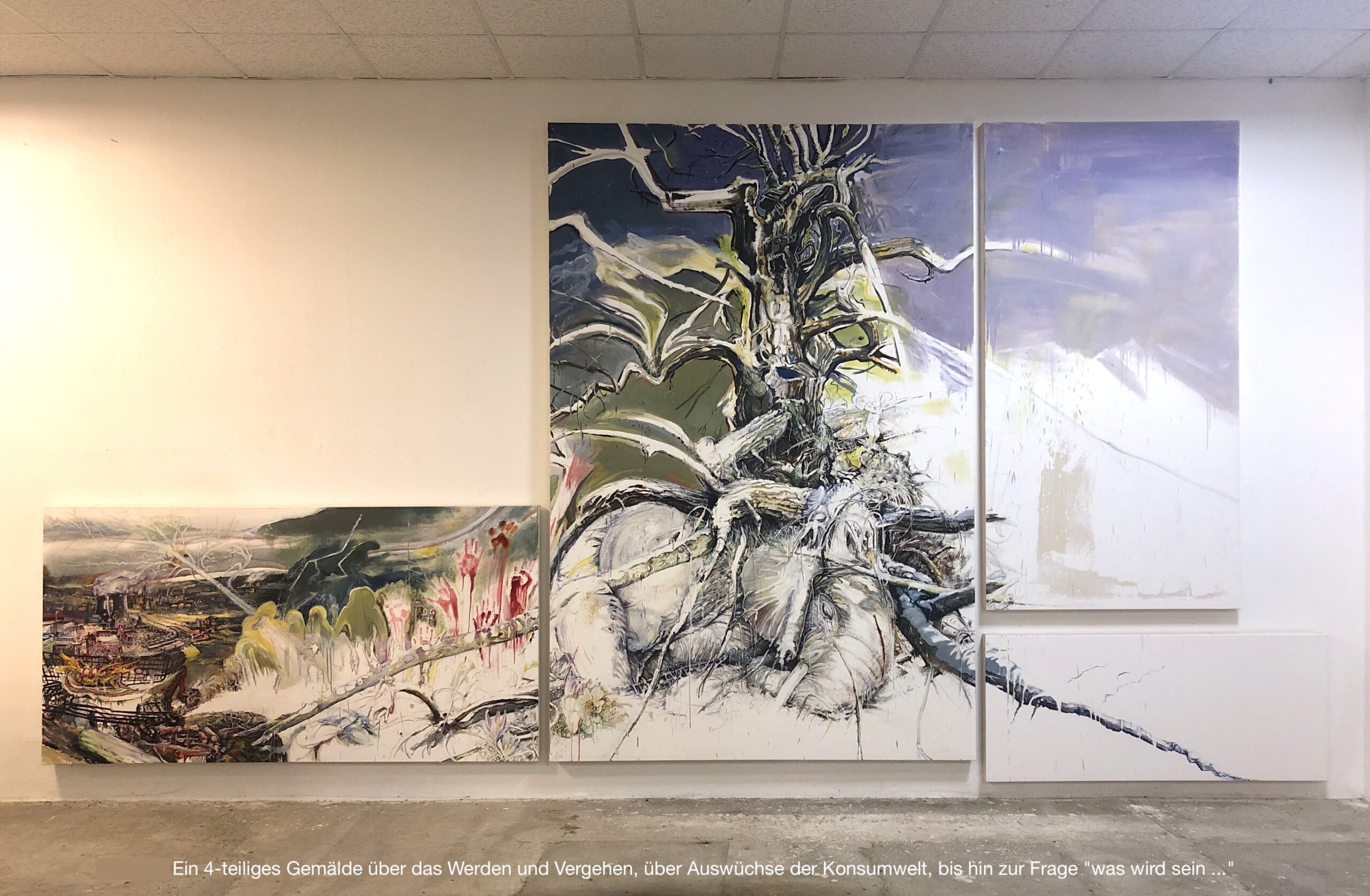
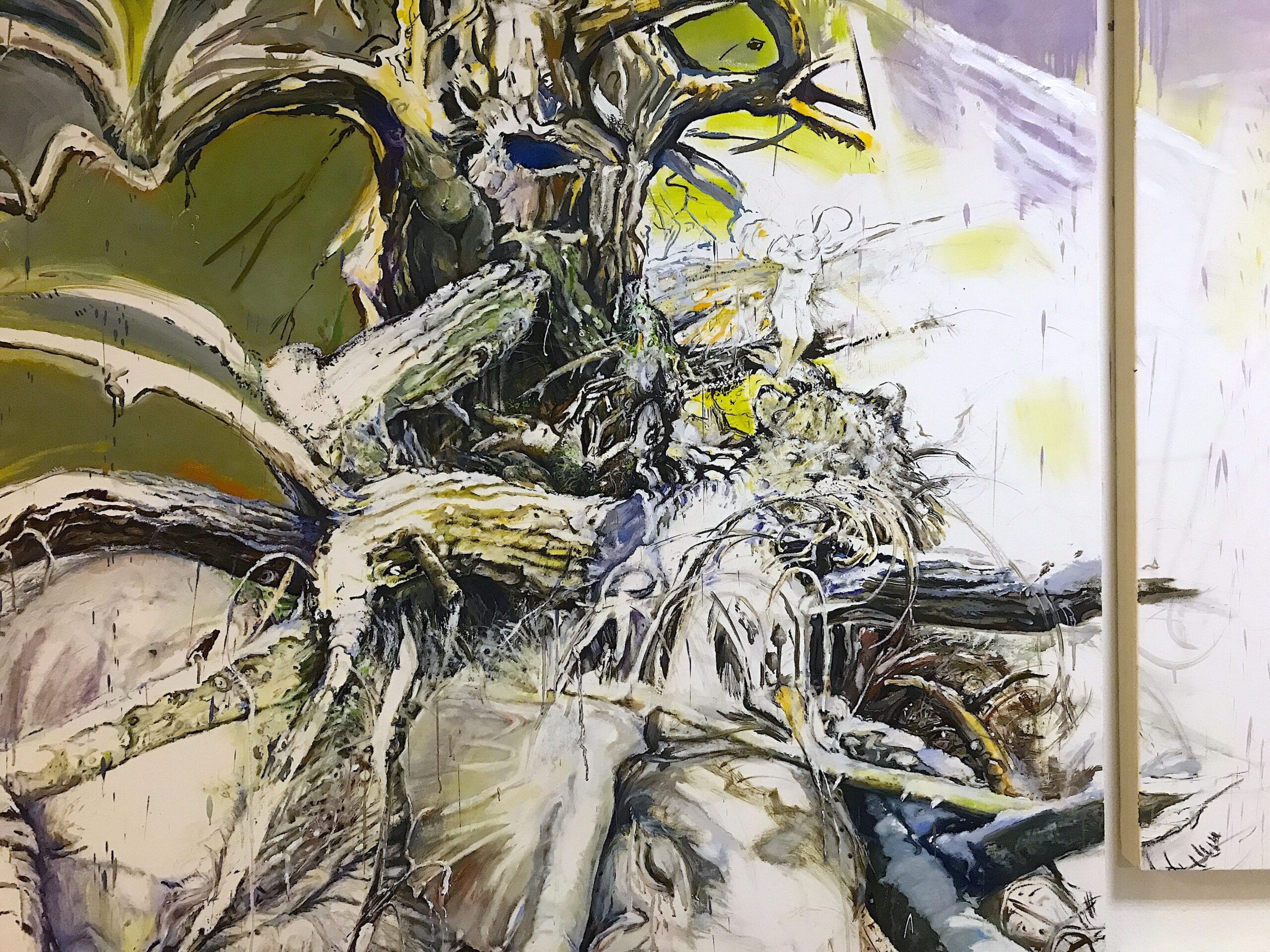
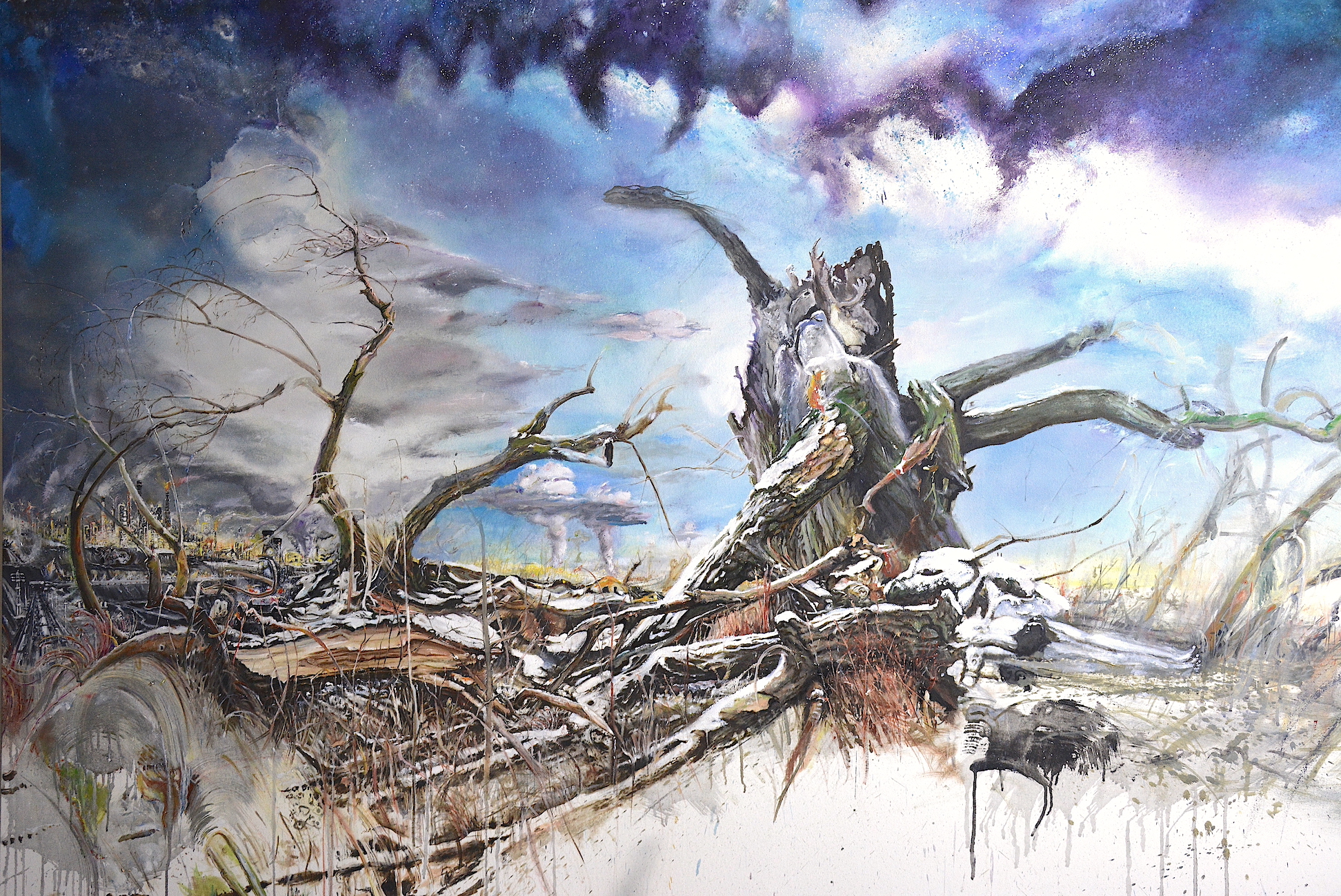
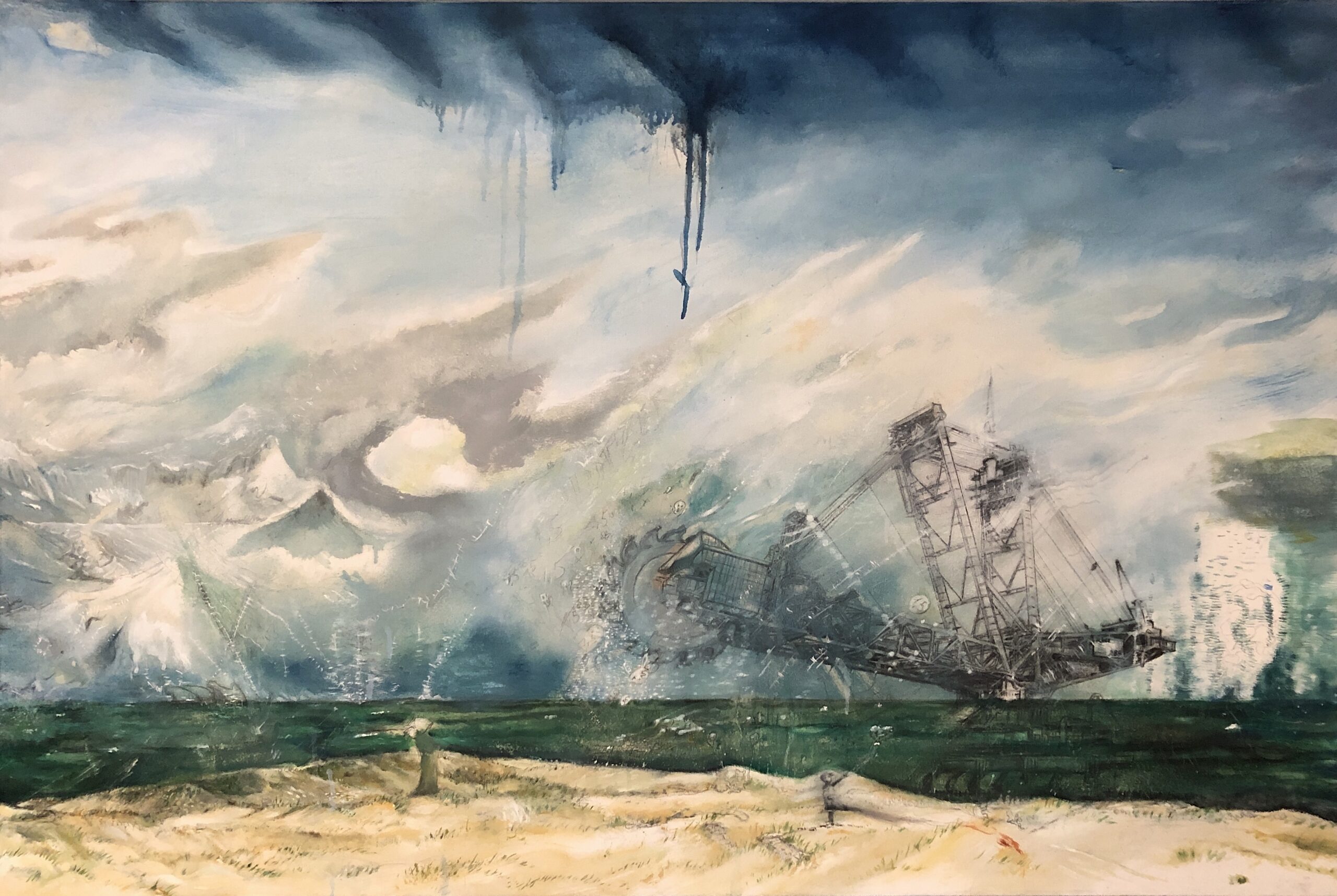
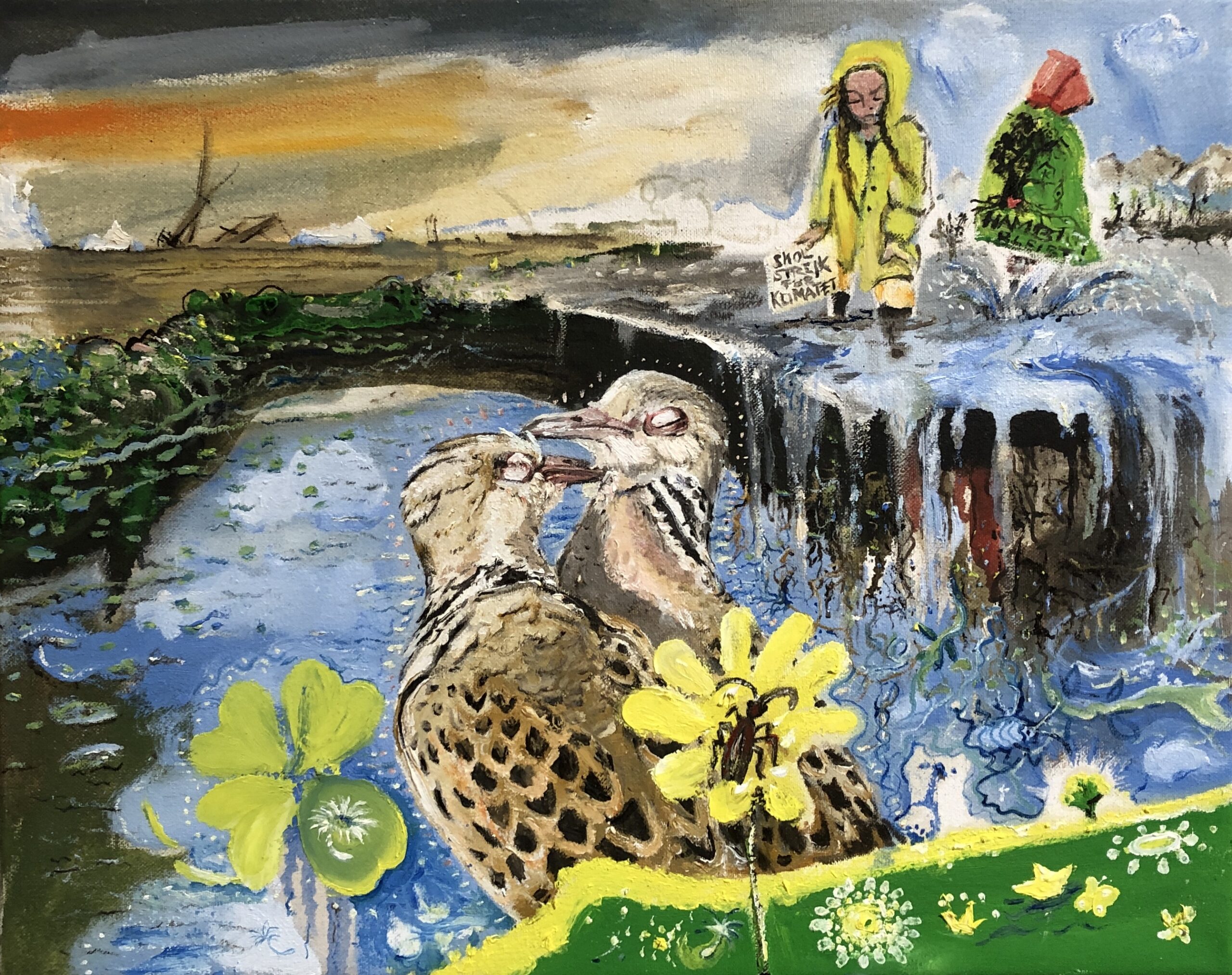
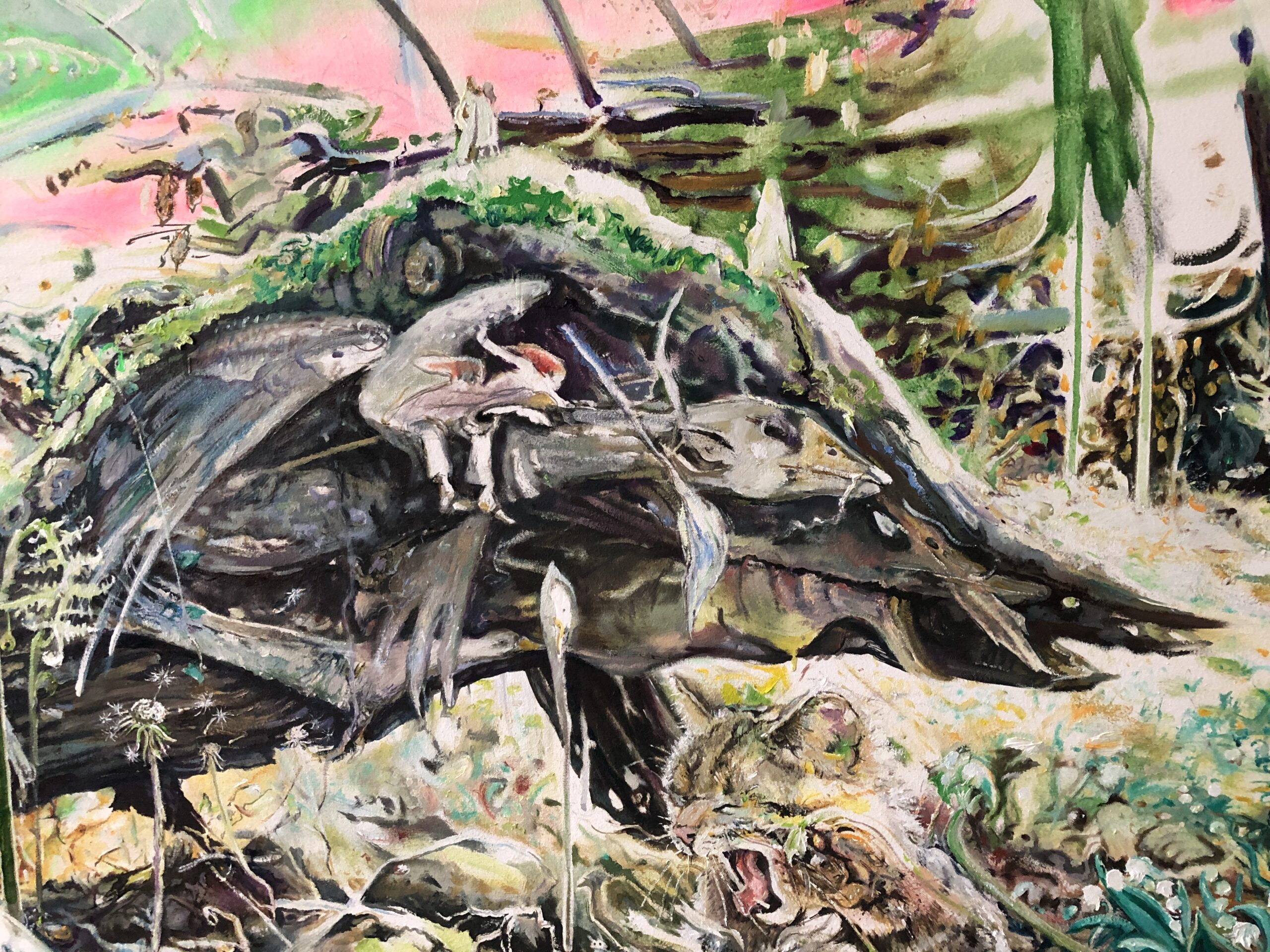
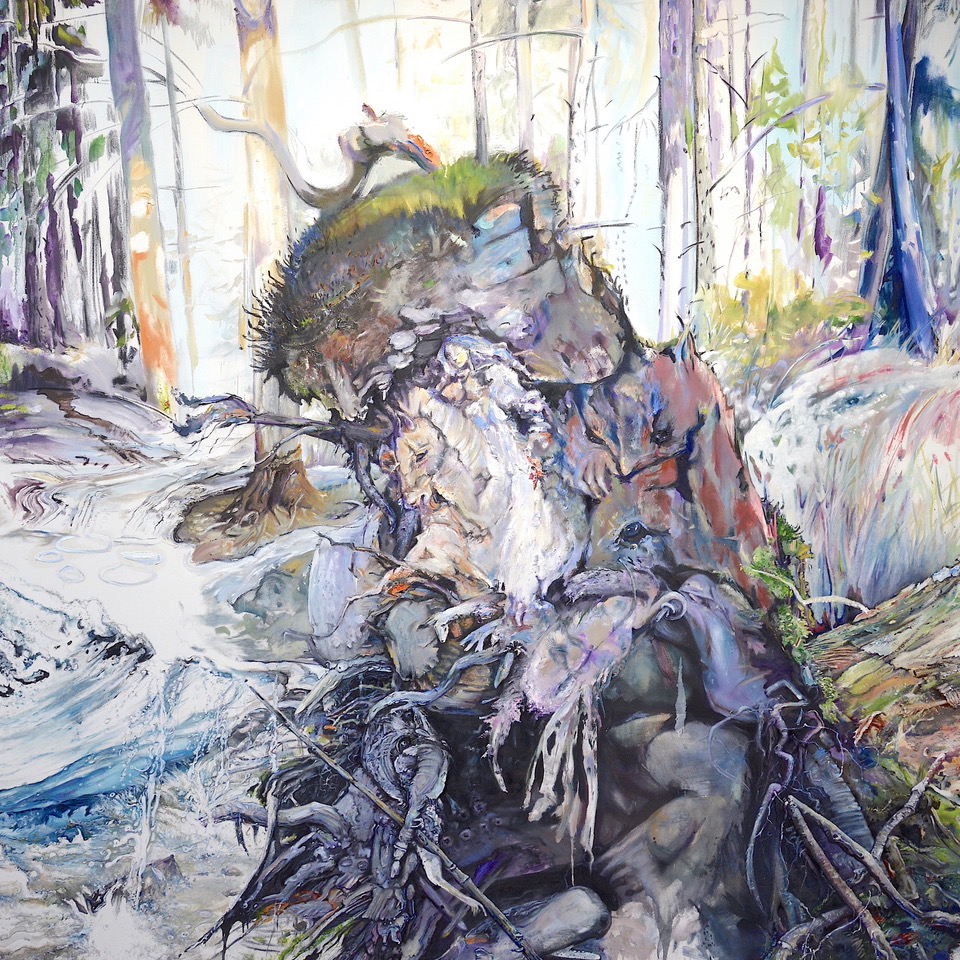
Die Tiere sagen, die Gletscher schmelzen … / 250 x 230 cm / Öl a.Lw. / 2020
Saxana studied at the Werkkunstschule in Cologne during the early 1990s, a period in which painting had already explored virtually every formal and conceptual possibility known to art history. At that time, Cologne’s exhibition scene offered little room for any form of figurative painting, as conceptual and non-representational practices largely dominated the contemporary discourse.
Yet for artists who experience painting as the necessary outlet for an inner impulse—a cry seeking to become an image, a condition familiar to many emerging artists—finding both the time and the right environment in which such a language can develop is essential.
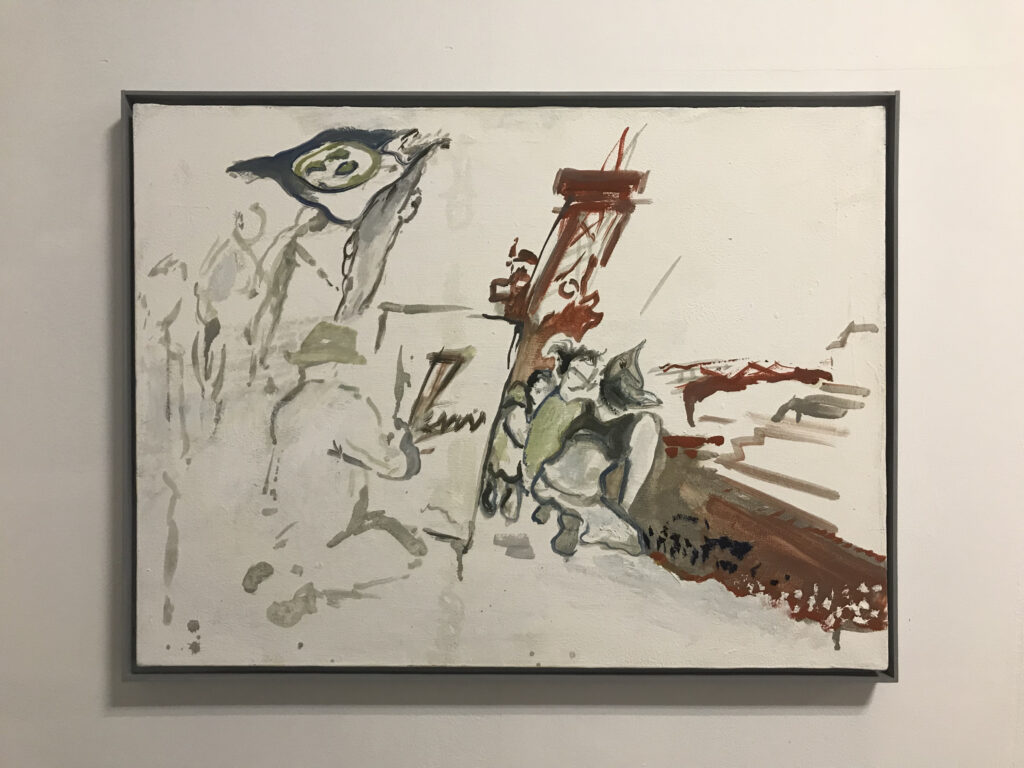
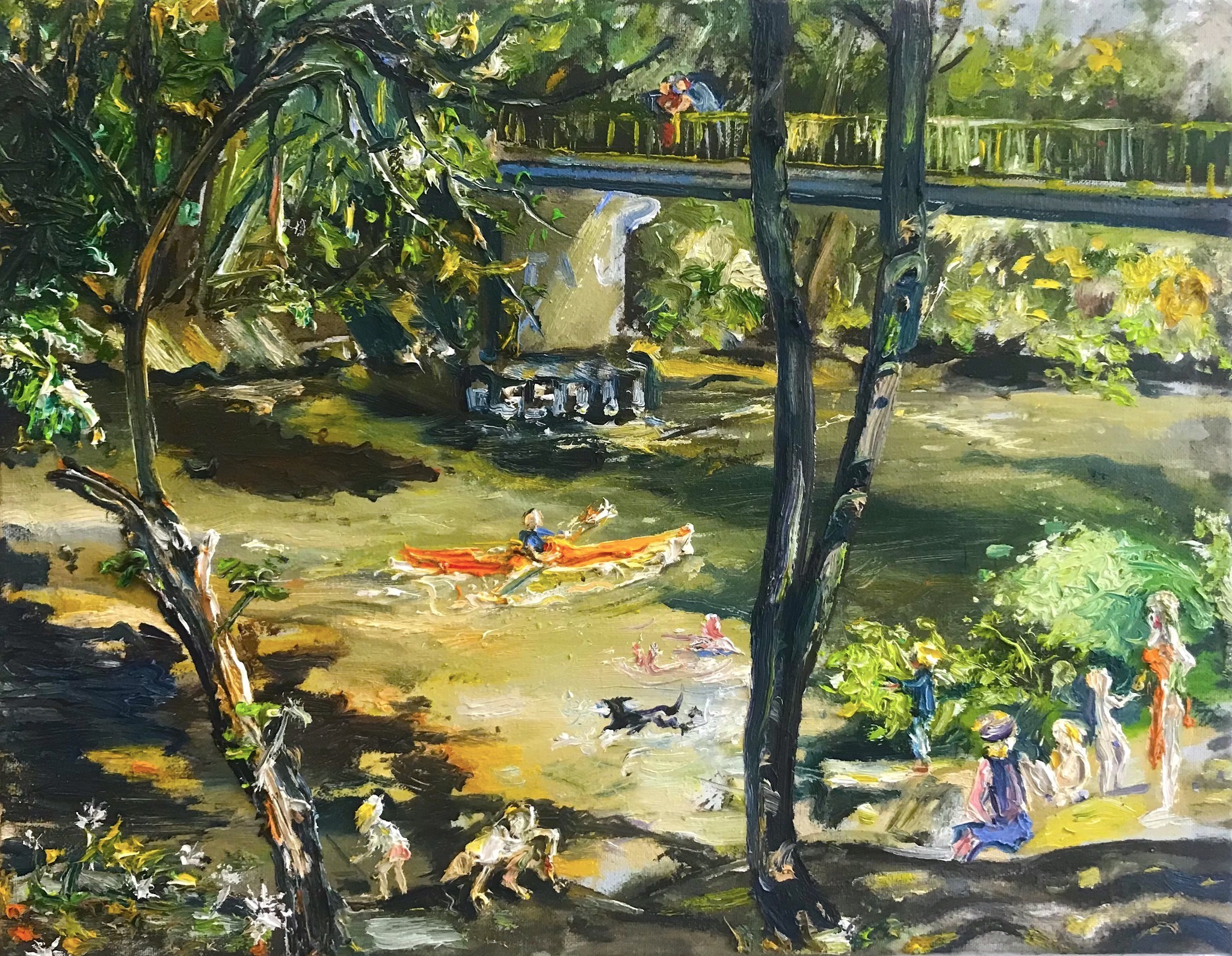
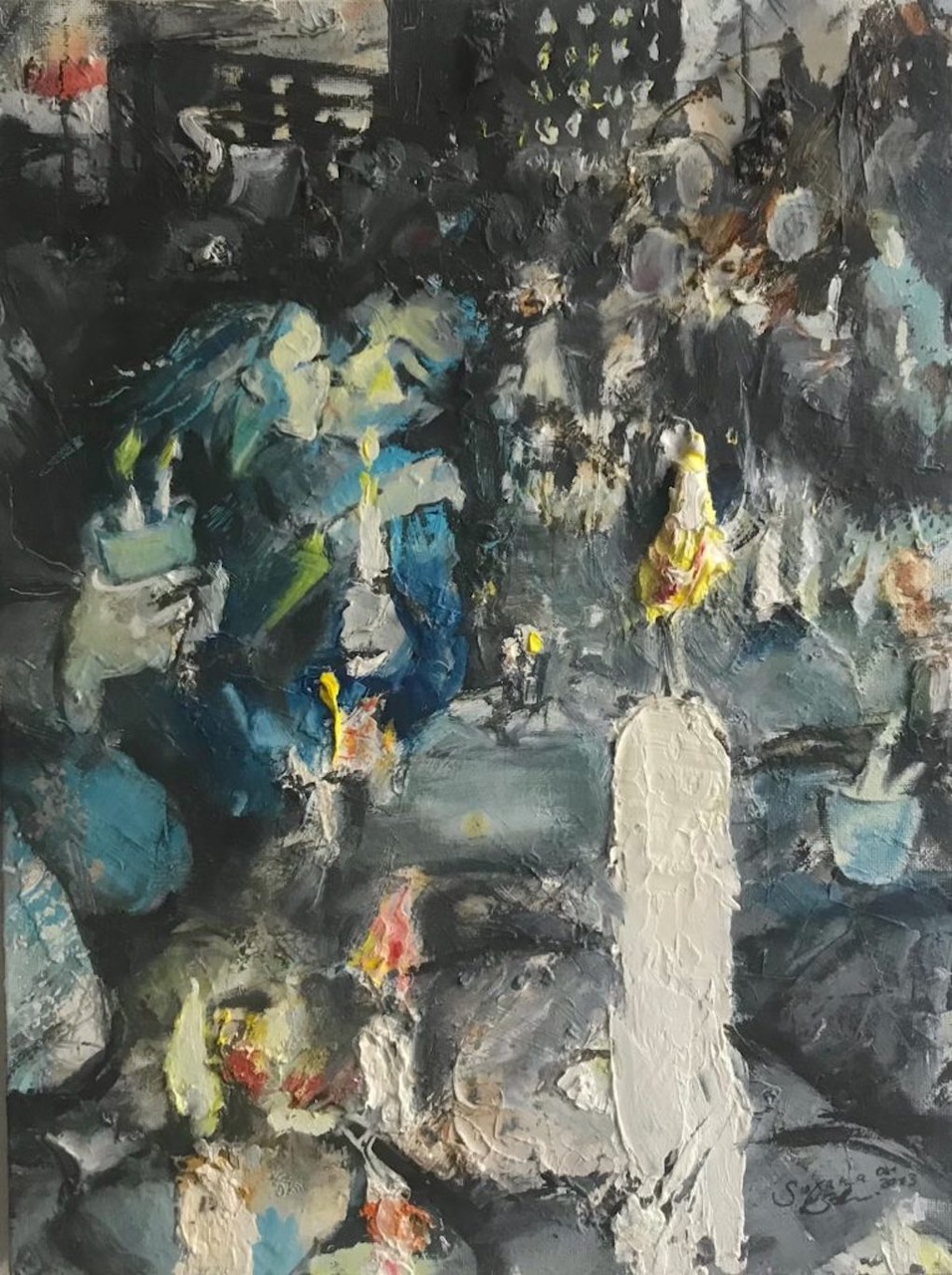
After living and working in various places, Saxana discovered Leipzig in 2012 and chose to settle there, drawn by one of Europe’s most vibrant centres of contemporary figurative painting. Among the works that emerged during this period is the following small yet profoundly evocative painting.
Lichtfest – Leipzig / ca. 45 x 33 cm / Öl auf Kartonage / 2014
The fundamental social question—How do we want to live, and what kind of society do we wish to create?—has remained a constant thread throughout Saxana’s artistic practice.
In 2013, Saxana Nicole Schötschel met Helge Hommes in Leipzig. Since 2017, they have worked together as the artist duo HELGE & SAXANA, combining their individual artistic approaches in a shared practice shaped by ecological awareness, social responsibility, and political engagement.
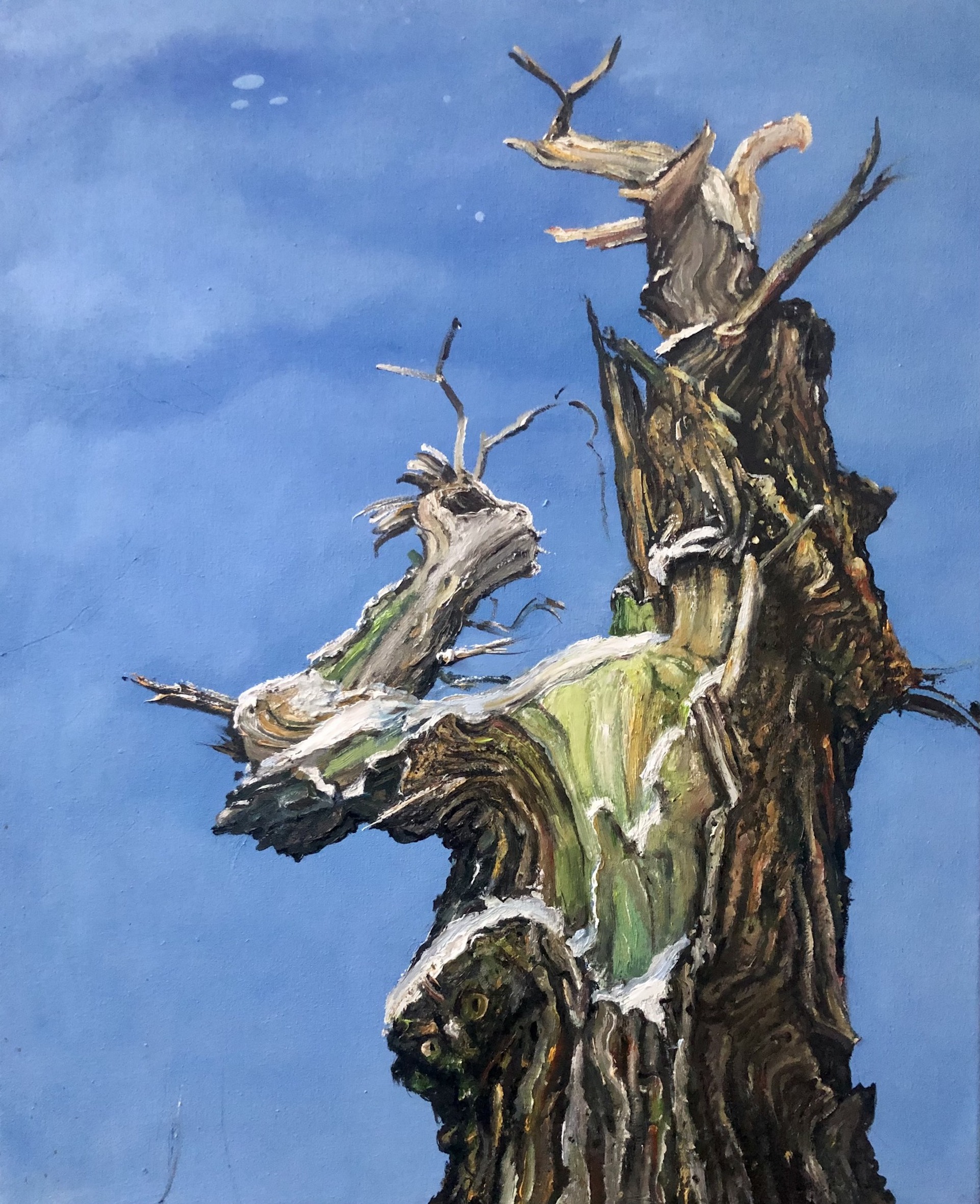
Saxana’s painting The Cry of the Tree (1987) stands as an early artistic statement. The trees are still crying—most audibly in the Hambach Forest between 2012 and 2018, and again in 2024 and 2025 in the eastern section of the forest and in the area known as Sündenwäldchen. Their work understands these places not merely as landscapes, but as symbols of an ongoing struggle over humanity’s relationship with nature.
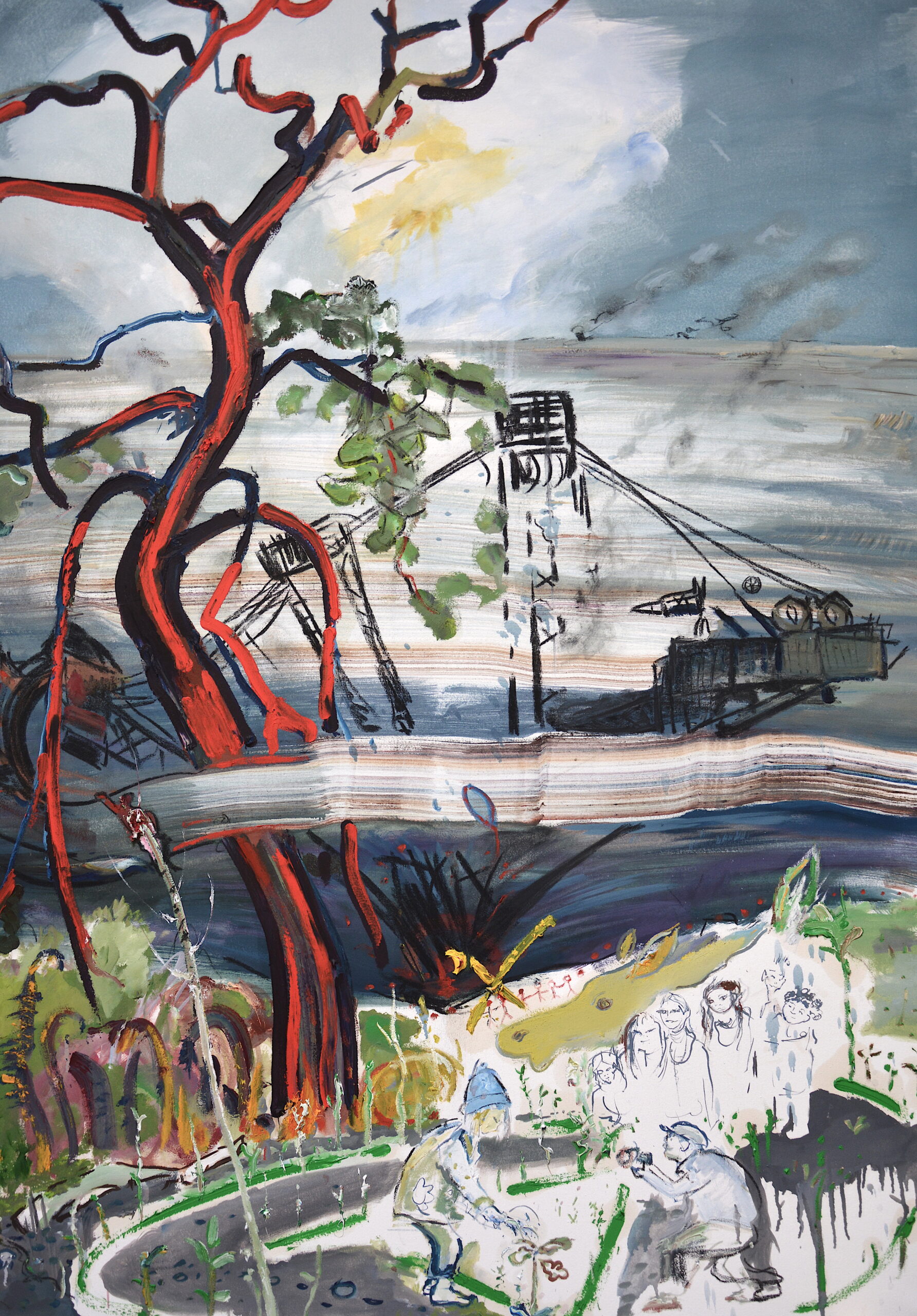
Since 2018, artistic interventions created directly within sites of resistance alongside the climate justice movement have become a major strand of Saxana’s oeuvre, complementing her other bodies of work. Increasingly, these different artistic trajectories have converged in a long-term conceptual project dedicated to the Hambach Forest. Through a multilayered body of paintings, Saxana seeks to create a lasting tribute to this remaining fragment of ancient woodland—a unique painterly testimony to a place preserved through the determination of a diverse civil society. That struggle, however, also claimed human lives.
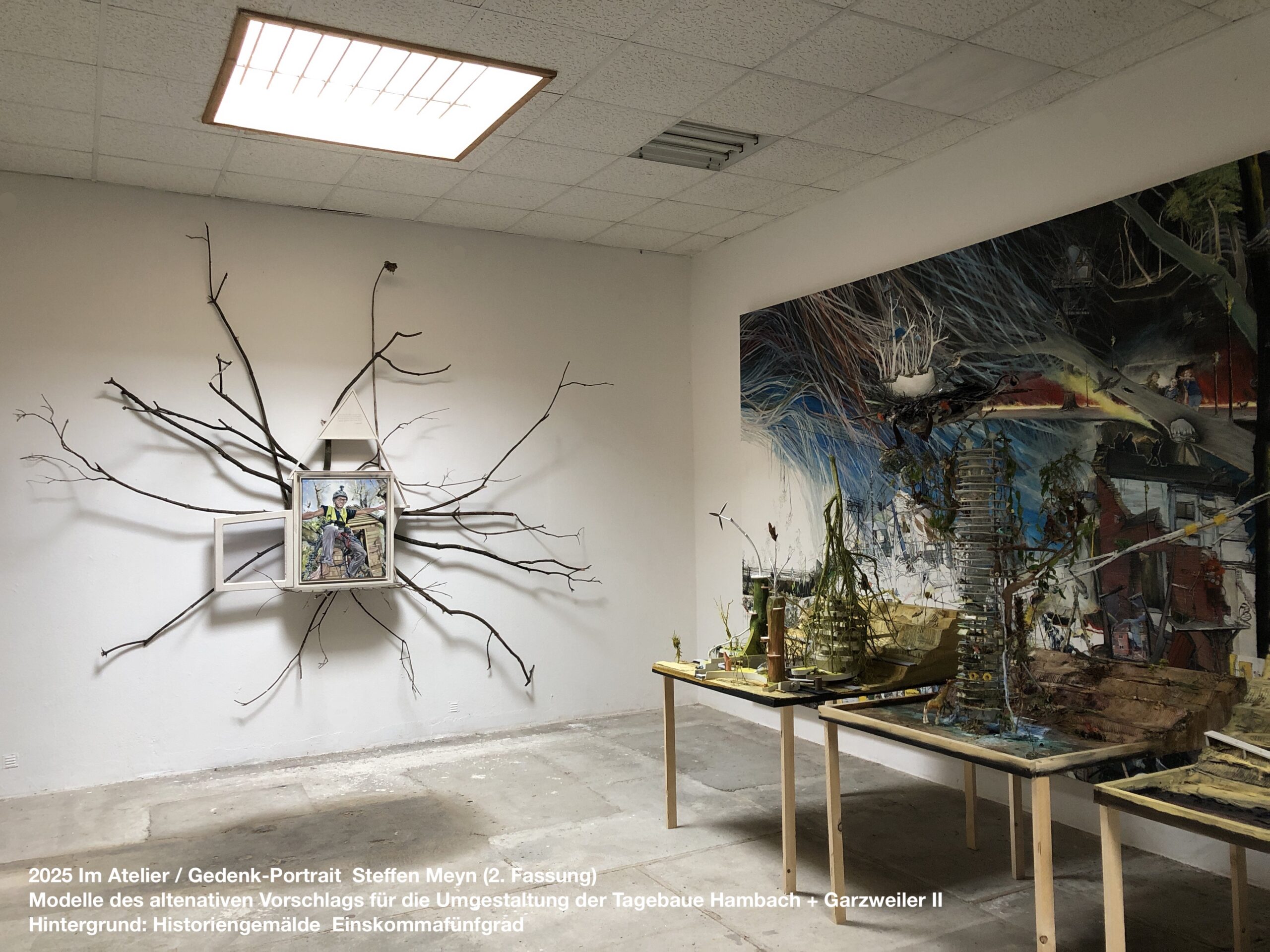
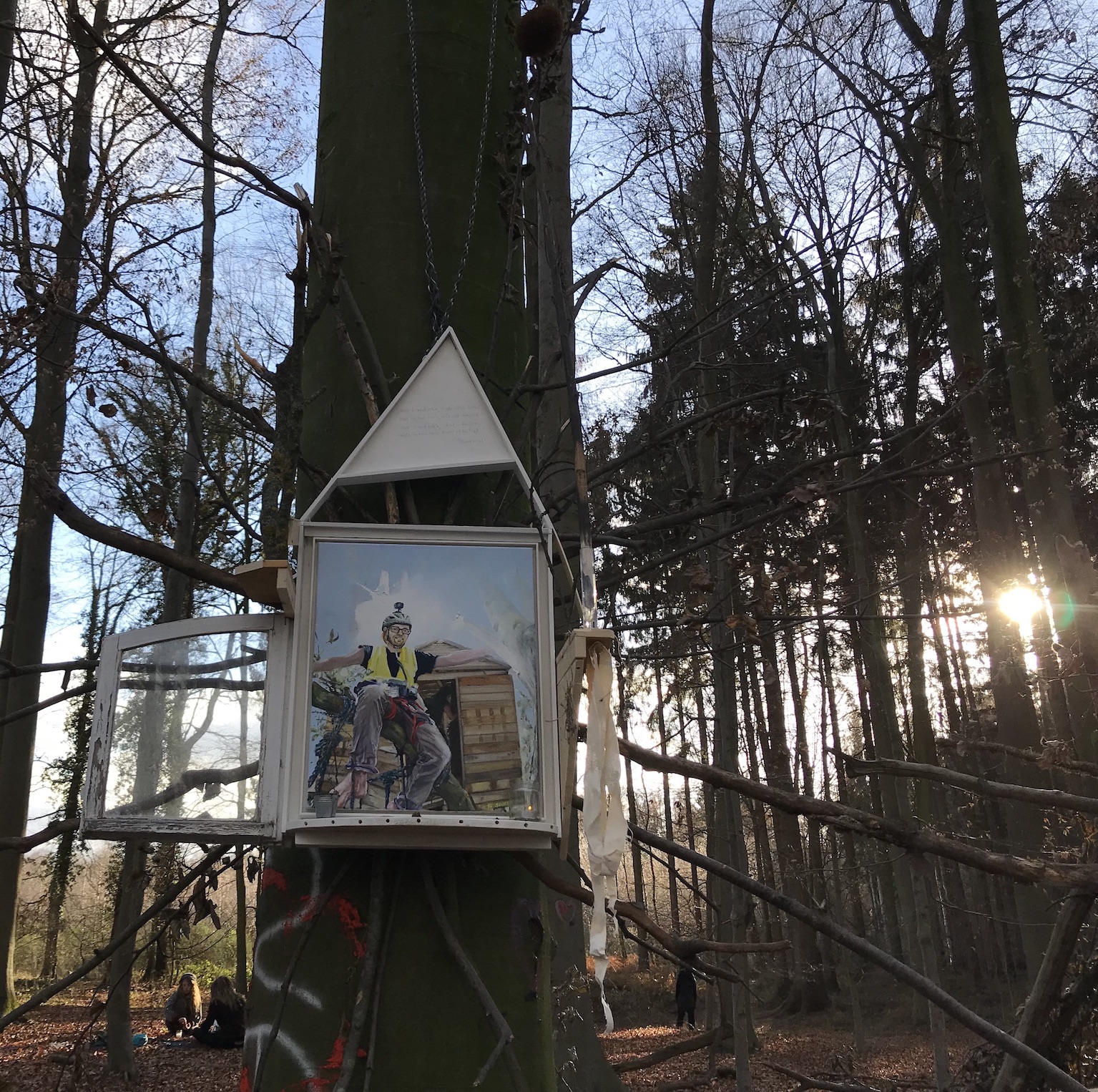
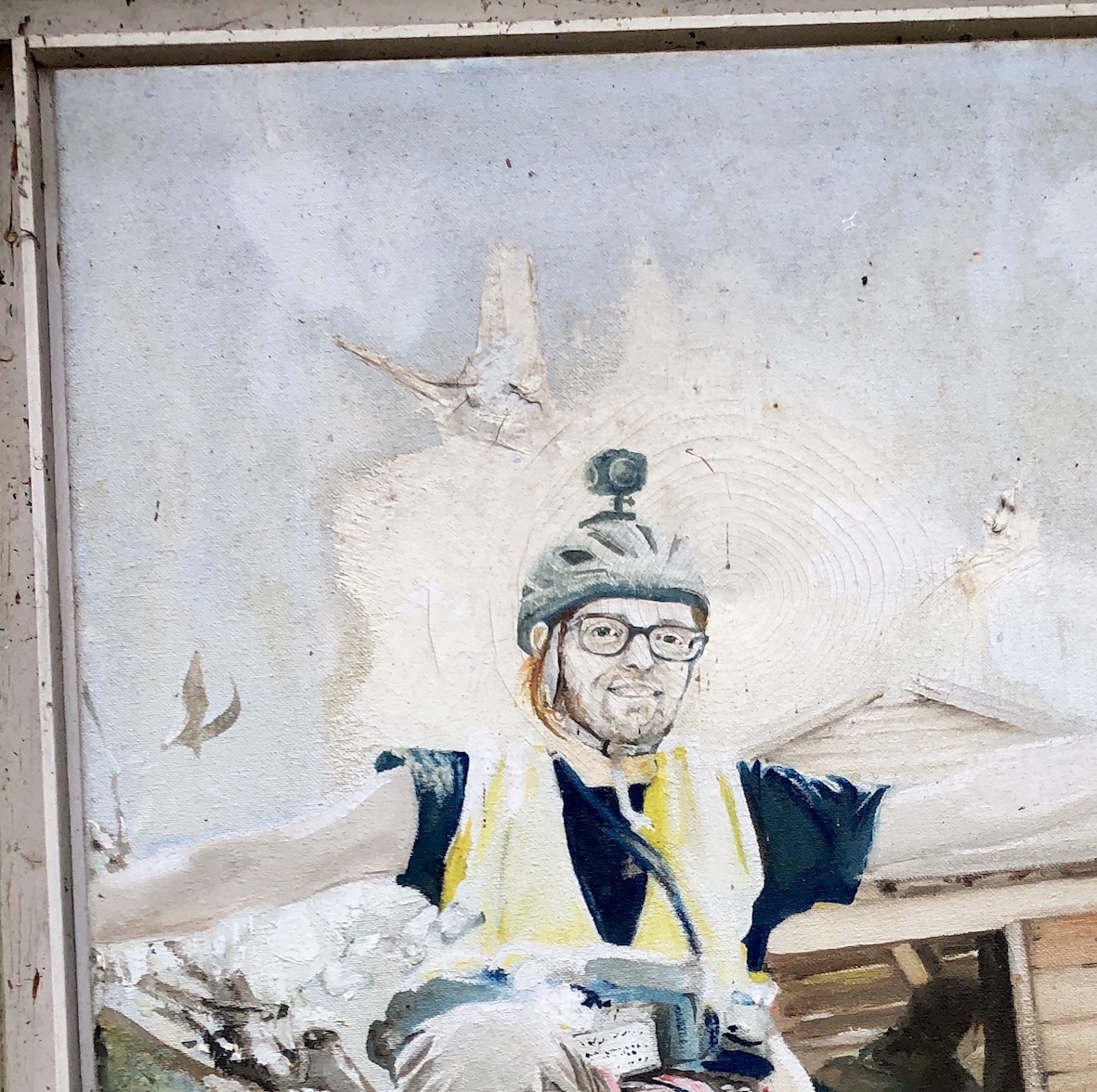
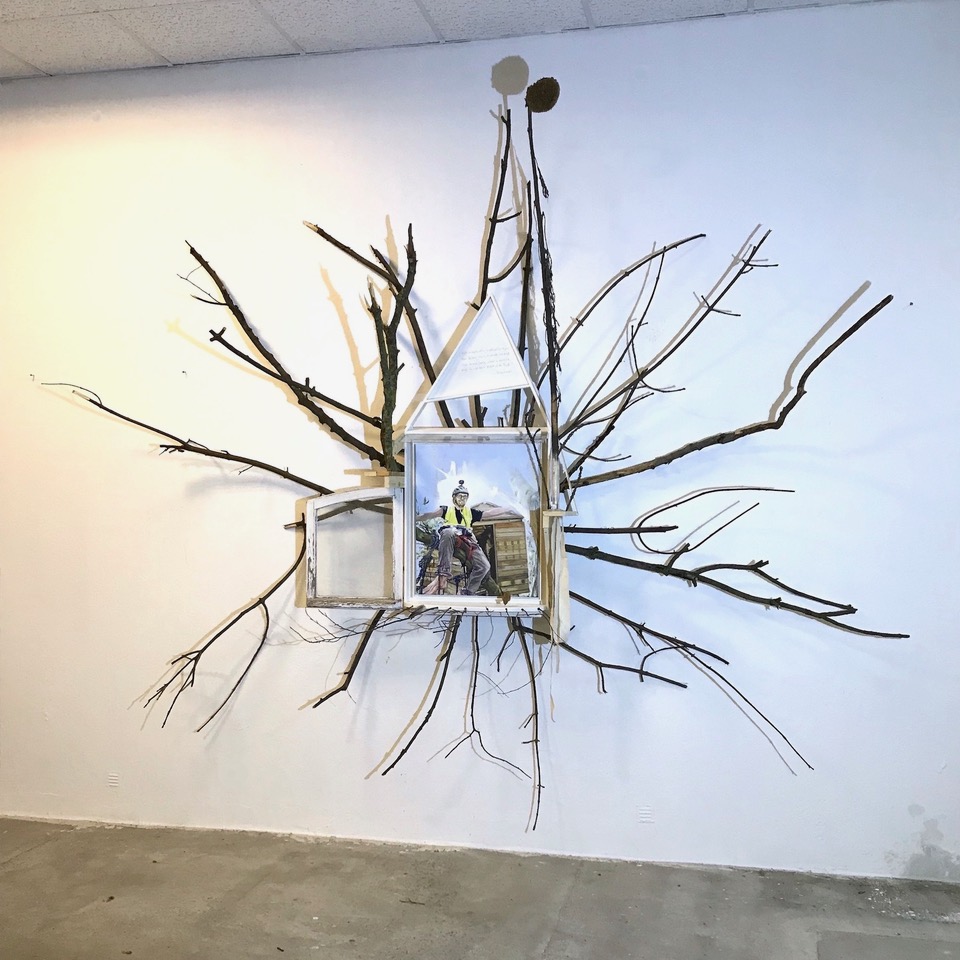
One of the most significant works within this context is the memorial portrait of Steffen Meyn, who died in the Hambach Forest in 2018 while documenting the protests. Saxana painted the portrait, and together the artists installed it at the exact location where Meyn lost his life. The memorial remained in the forest until 2025, when it was replaced by a second portrait painted by Saxana, while the original was carefully preserved for the future.
The artists hope that a museum in North Rhine-Westphalia will recognise the historical and artistic significance of this powerful document of contemporary history preserved in paint. To date, however, no institution has accepted the work into its collection. Among the responses was the decision by the Haus der Geschichte in Bonn to decline the artists’ offer to donate the memorial, leaving this important artistic witness to recent history without a public institutional home.
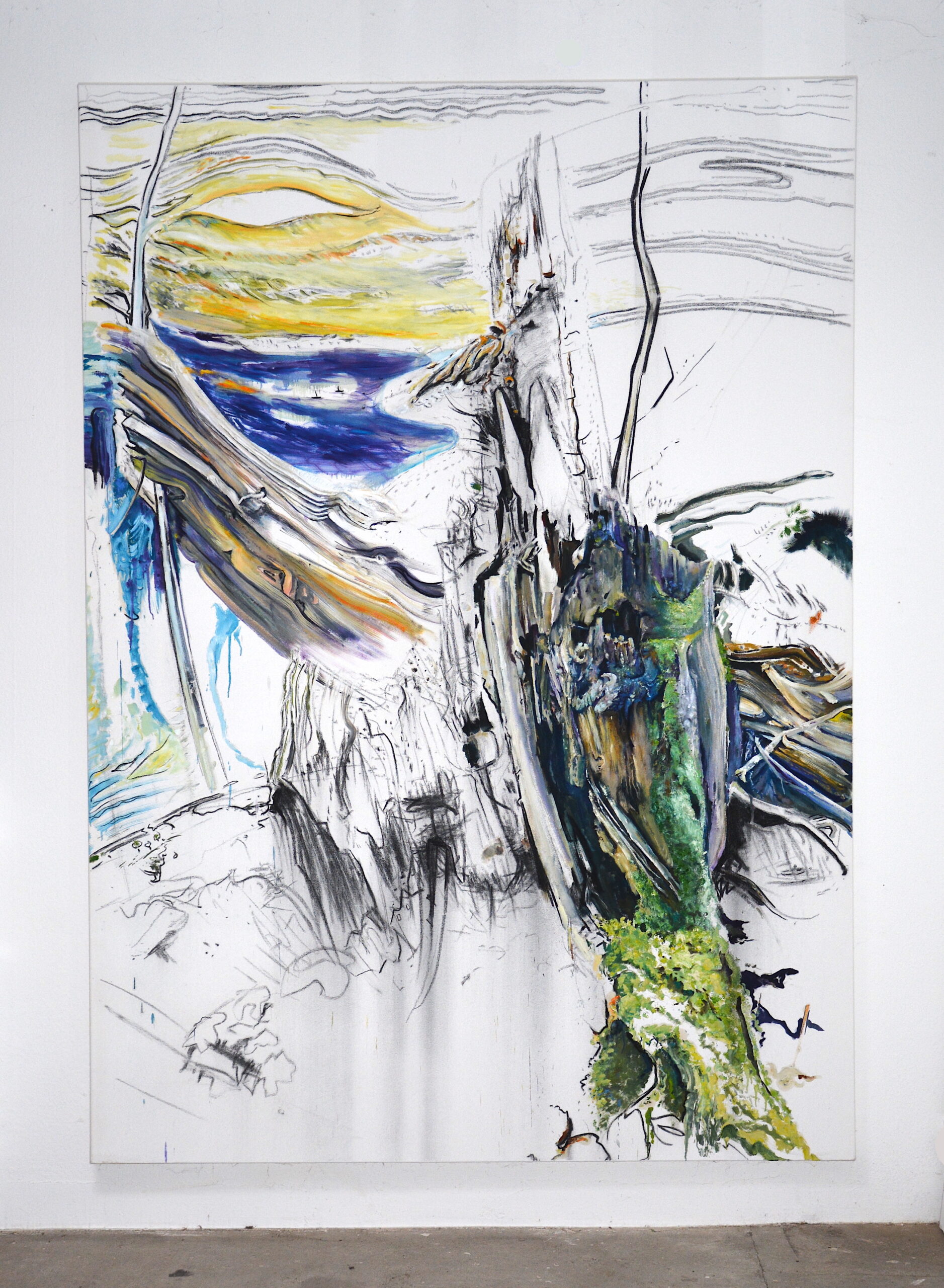
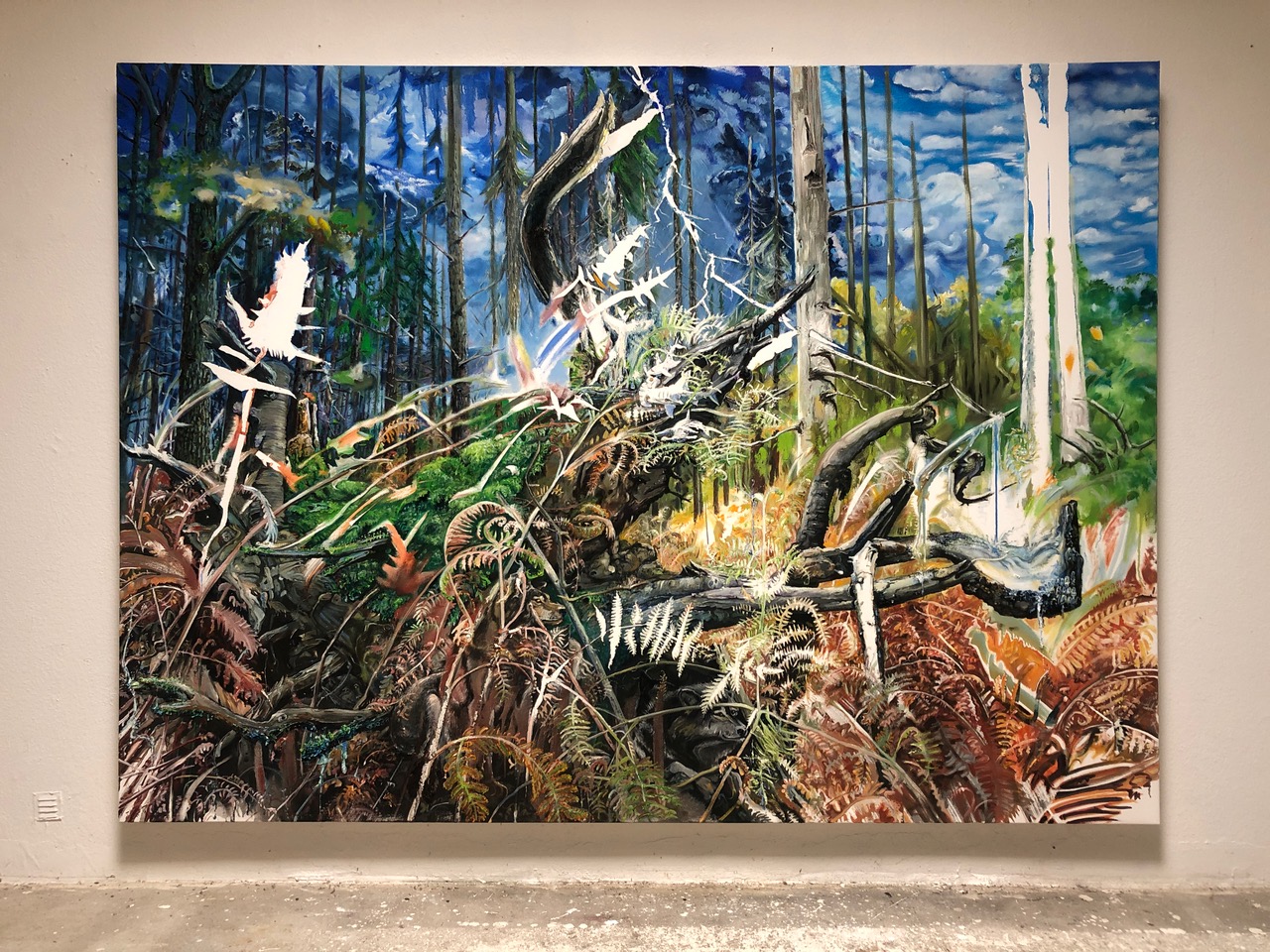
Recent works such as EMERALD VEIN, GRASPING THE SKY’S GIFT (190 × 260 cm) and JUST NATURE reveal the remarkable complexity of Saxana’s artistic vision.
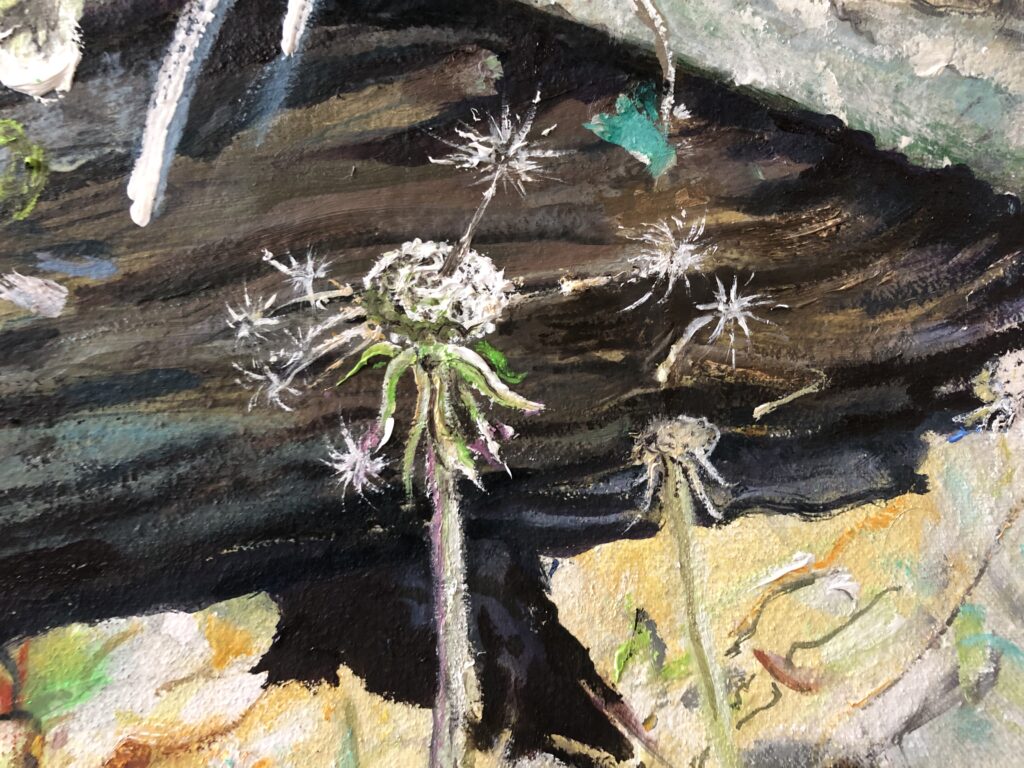
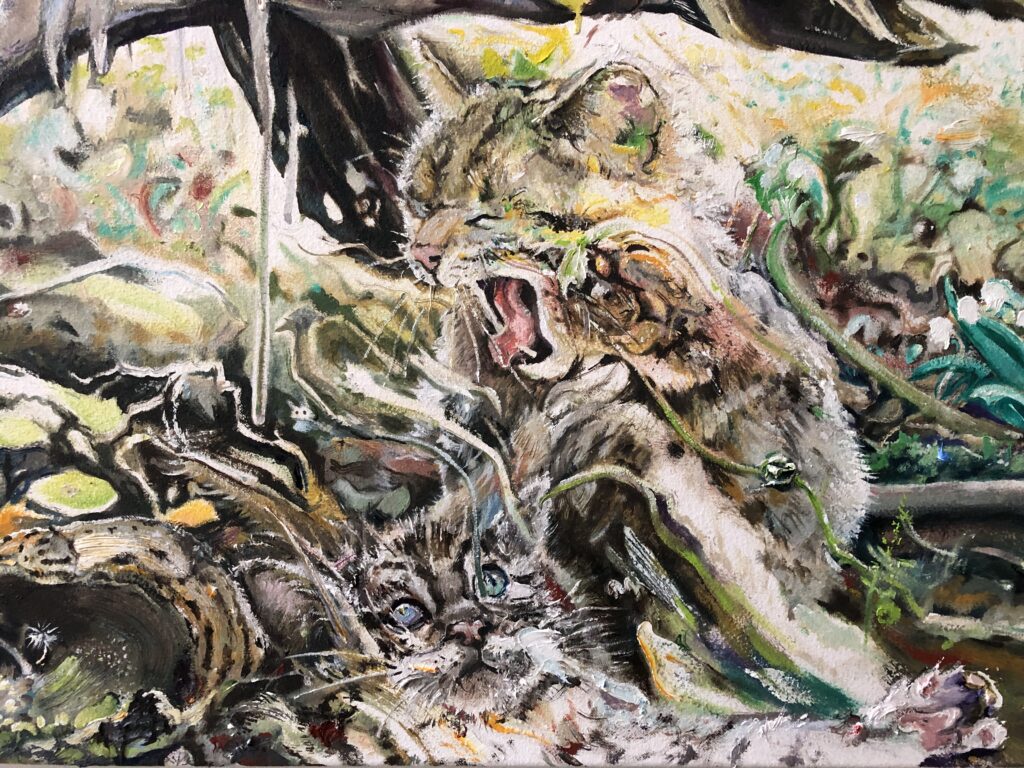
Their richness of detail and layered symbolism call for something increasingly rare in contemporary life: time, patience, and sustained attention. Rather than yielding themselves at first glance, these paintings invite slow contemplation. For those willing to make this investment—to look closely, to engage, and to understand—they offer an experience of profound visual and intellectual reward.
The true power of these works unfolds gradually, revealing itself only through the depth of sustained viewing. It is within this immersive encounter that the full poetic, emotional, and conceptual resonance of Saxana’s painting becomes apparent.
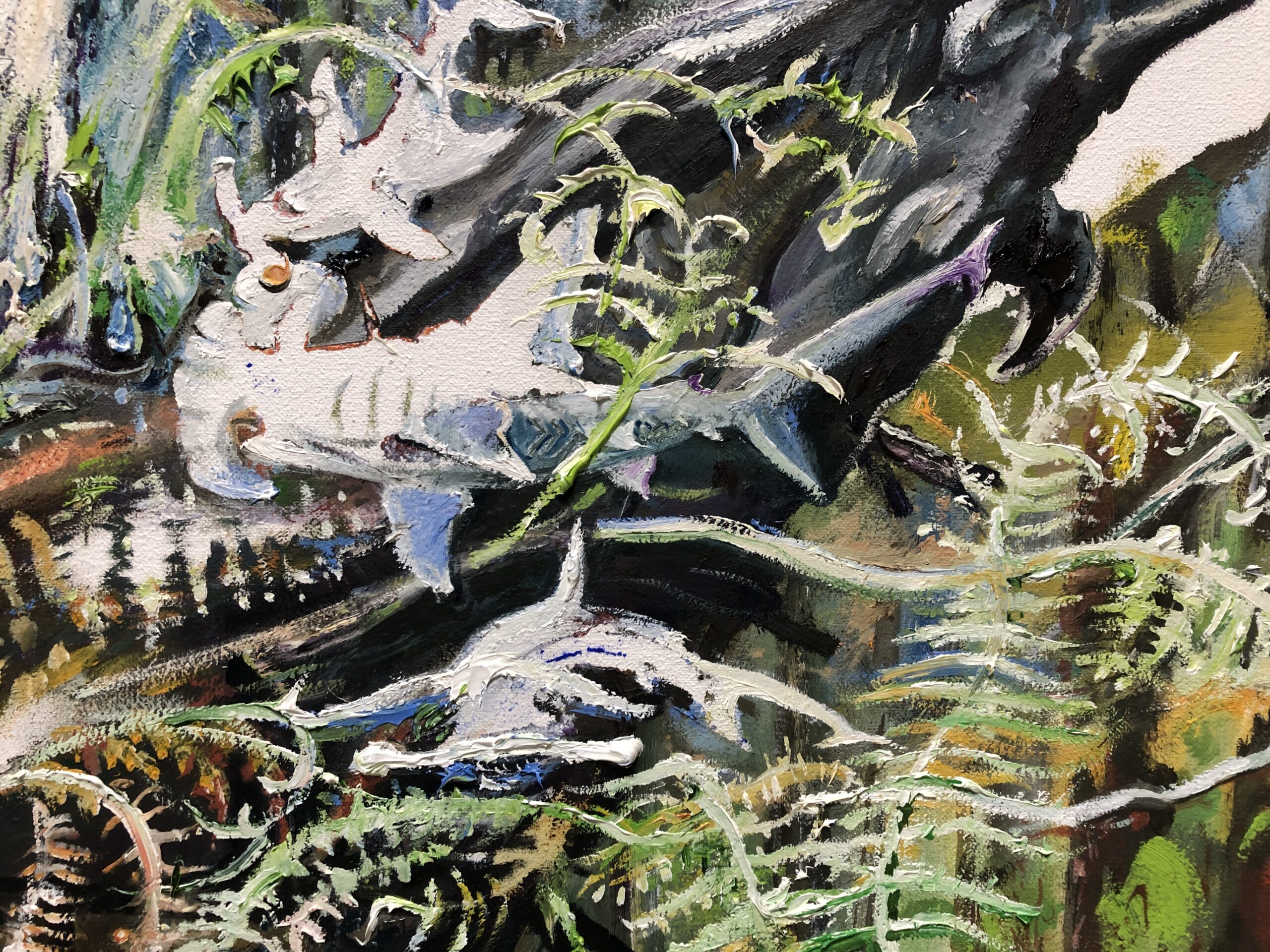
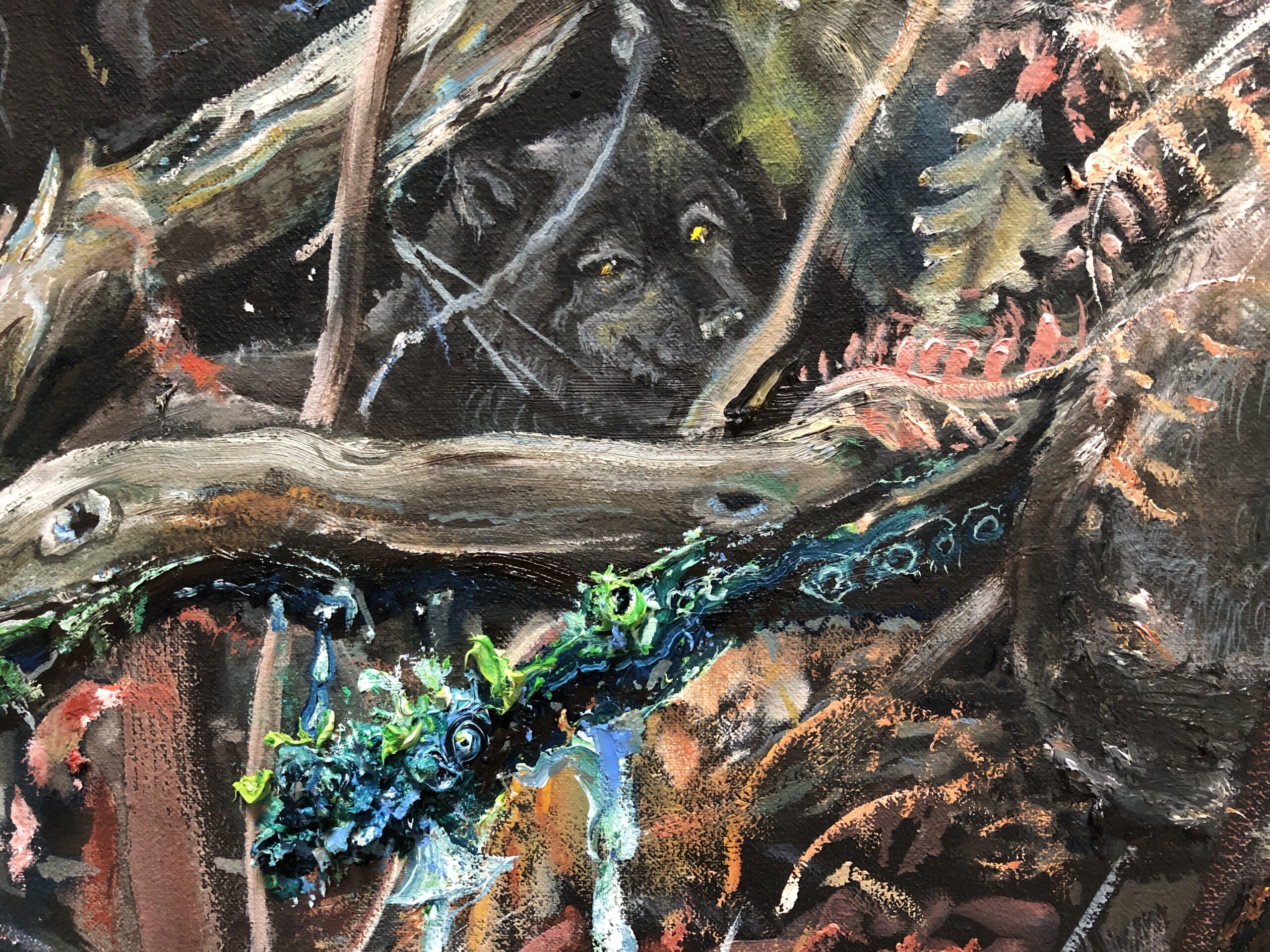
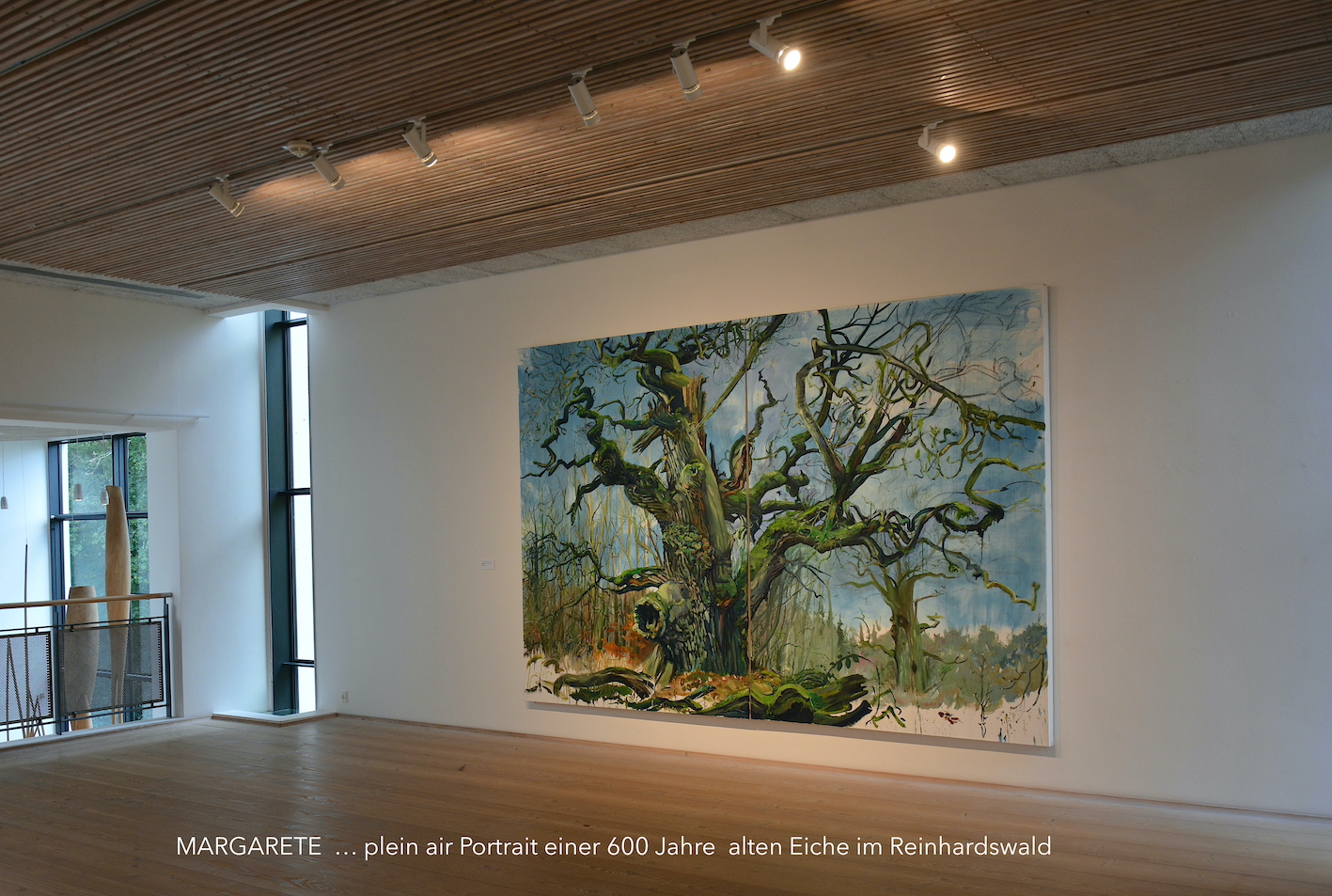
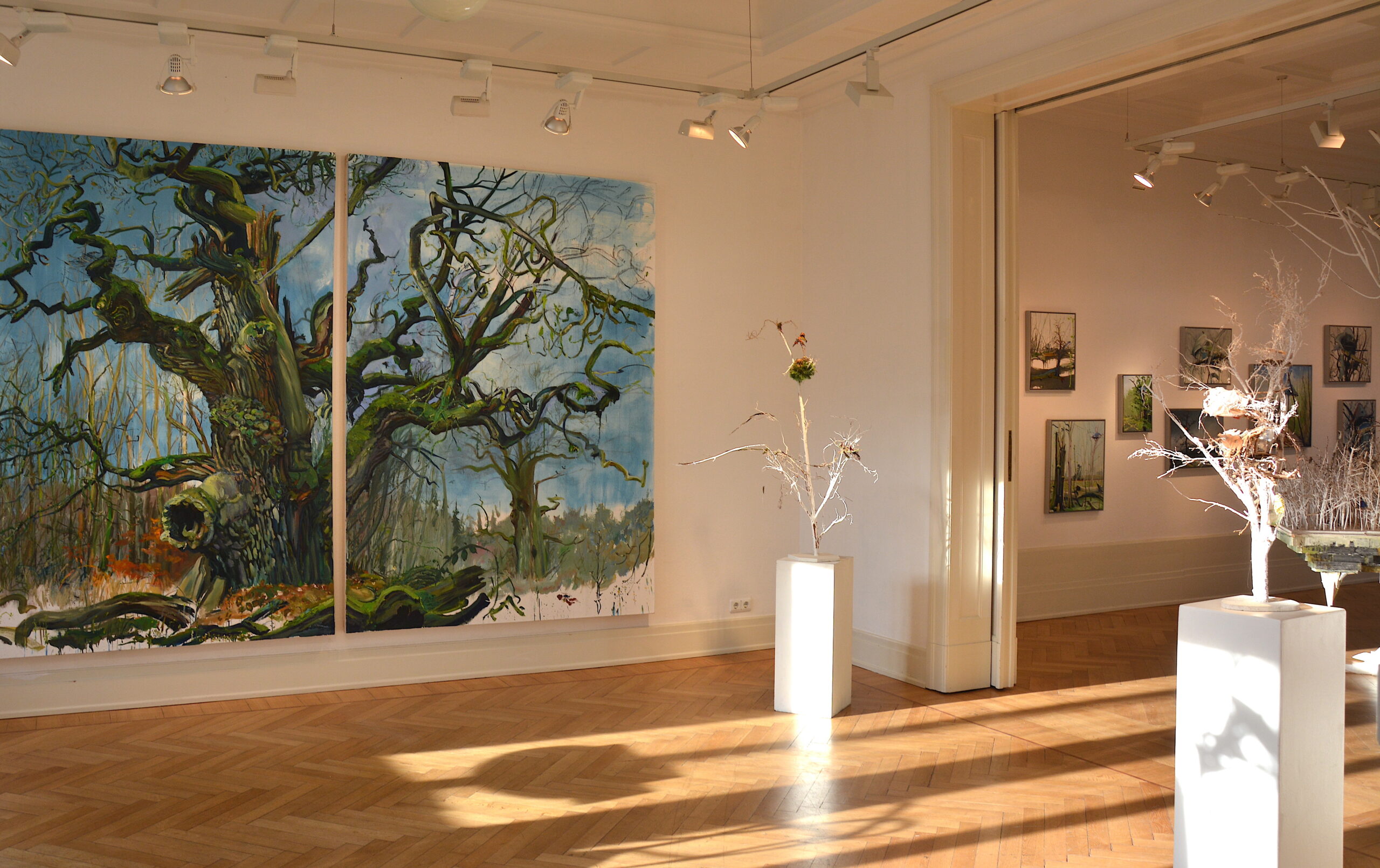
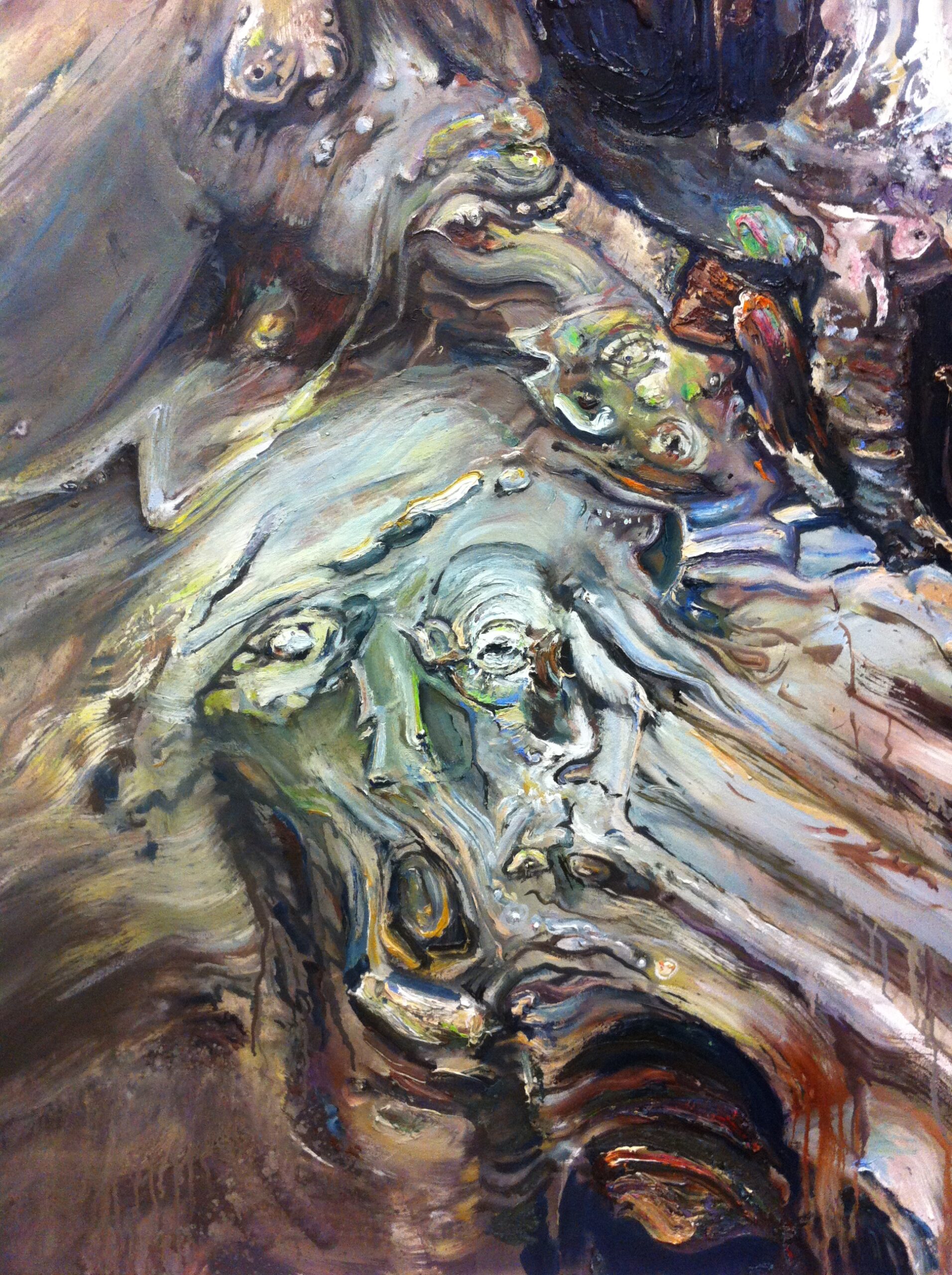
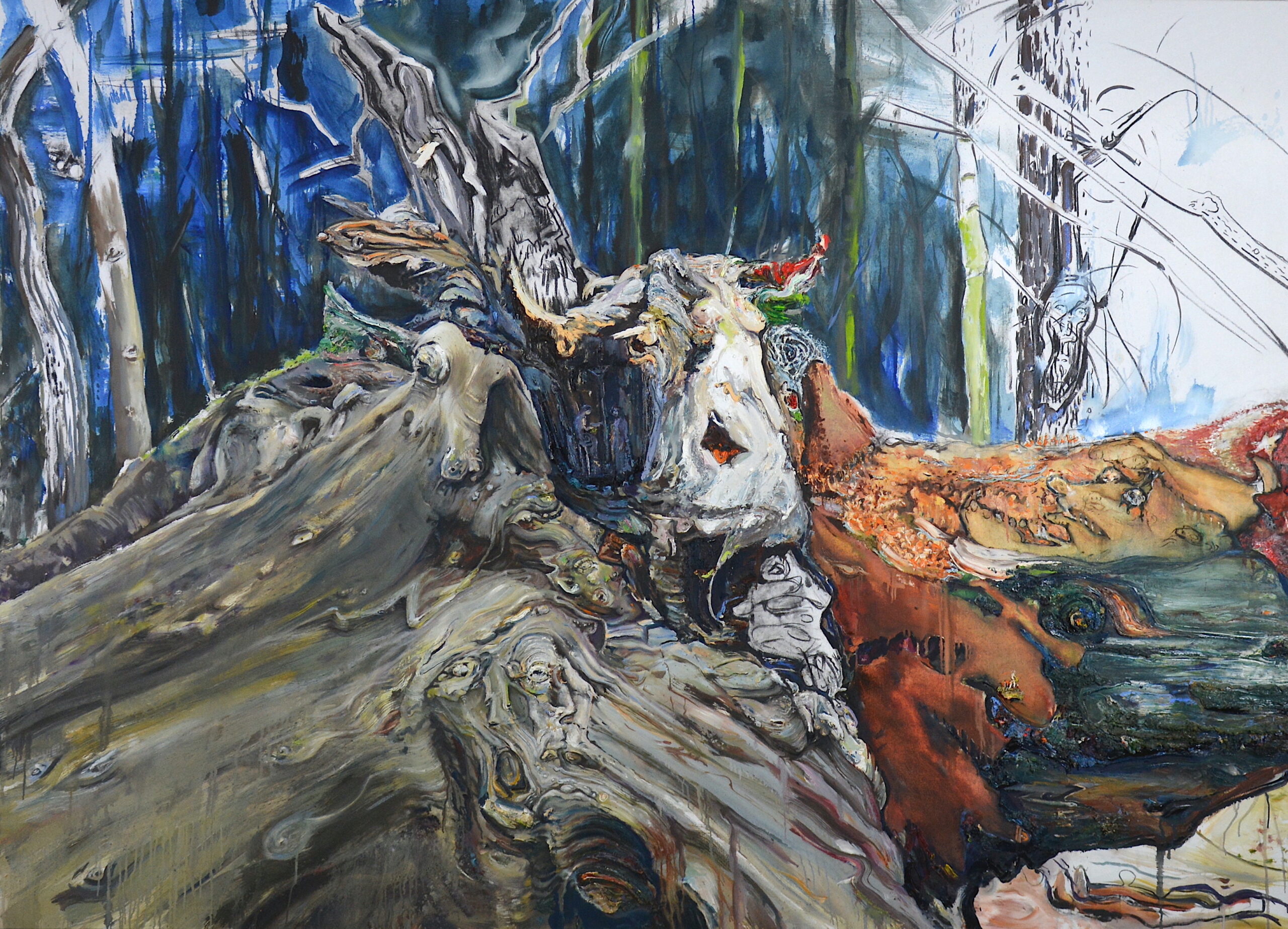
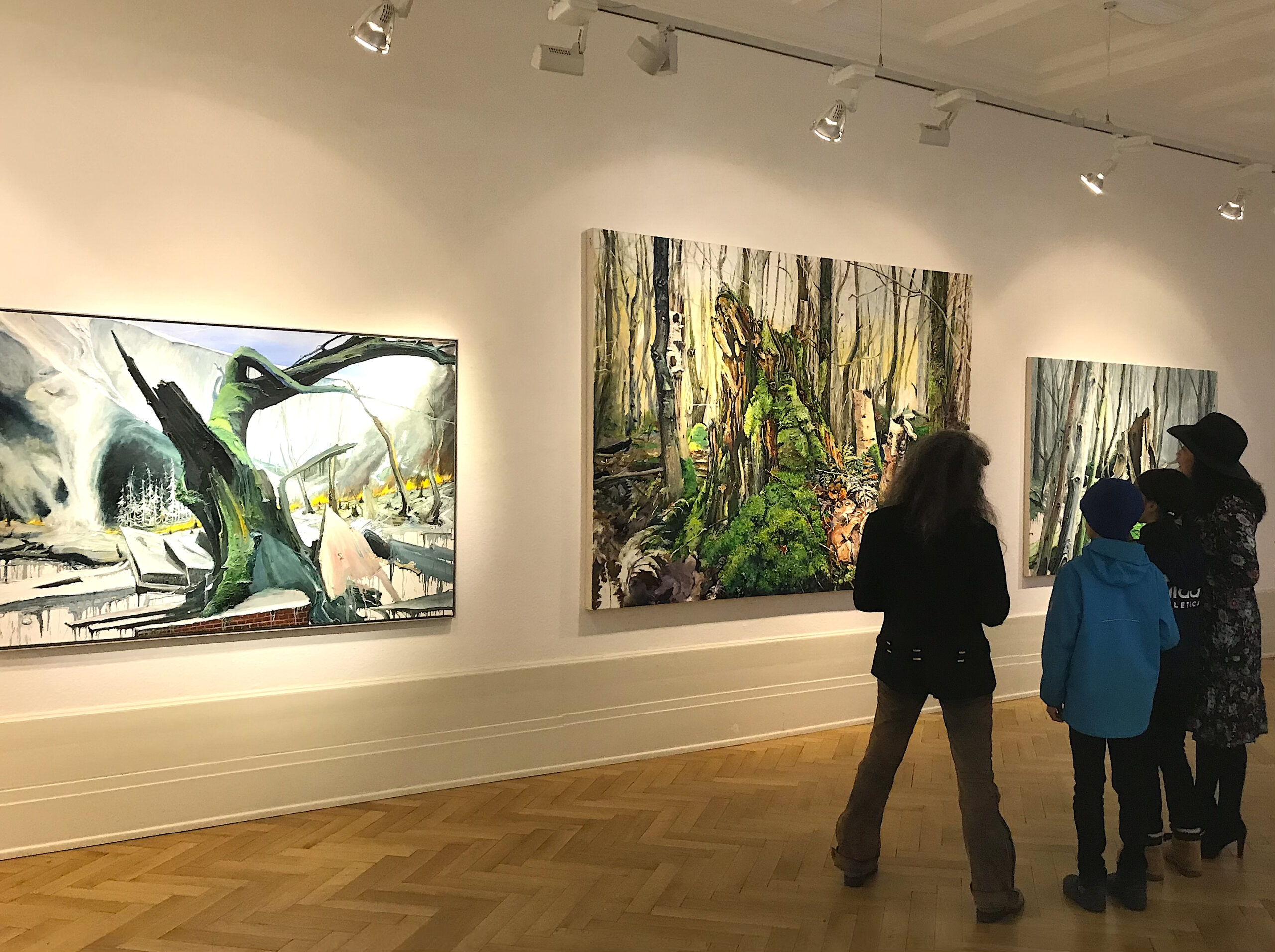
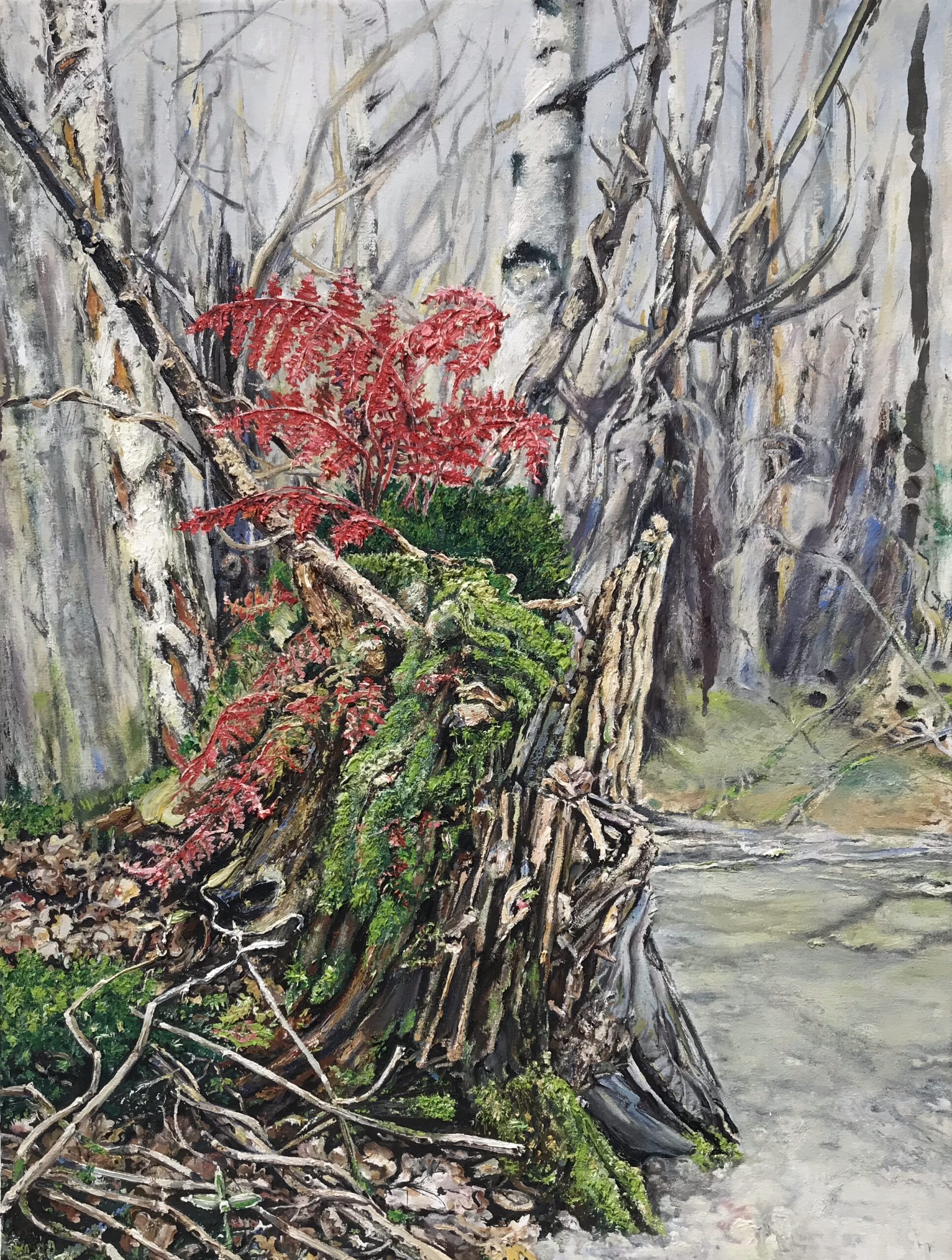
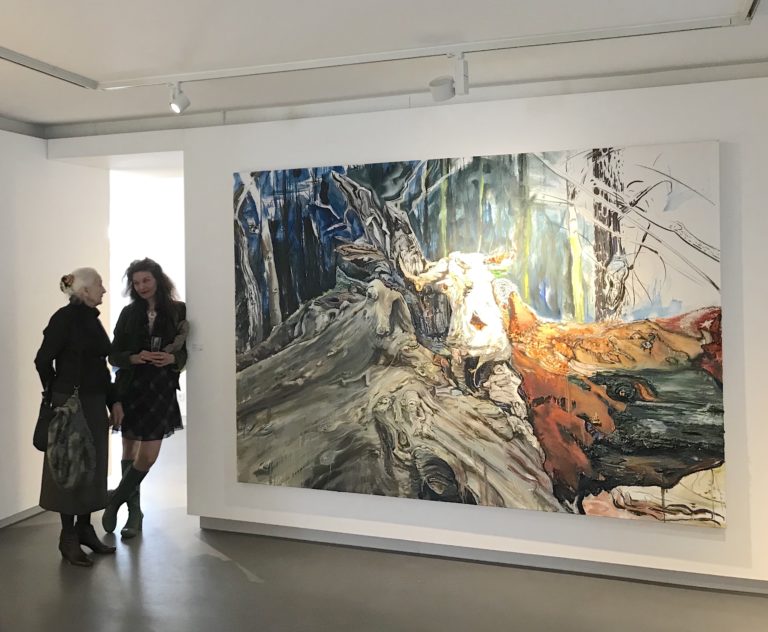
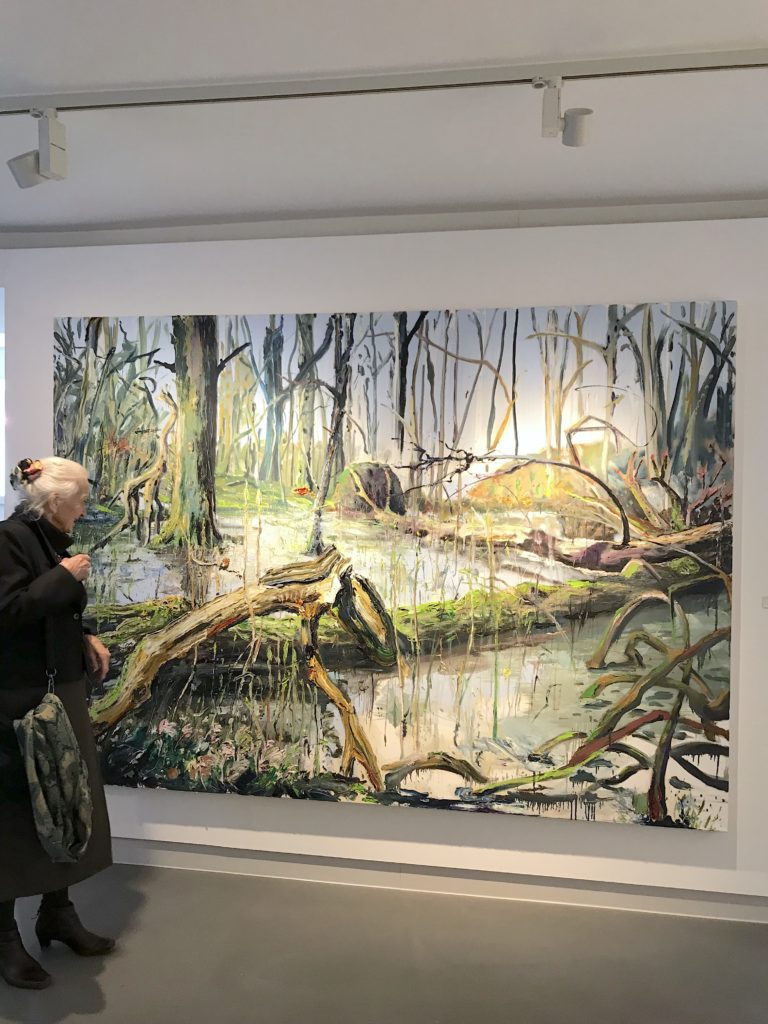
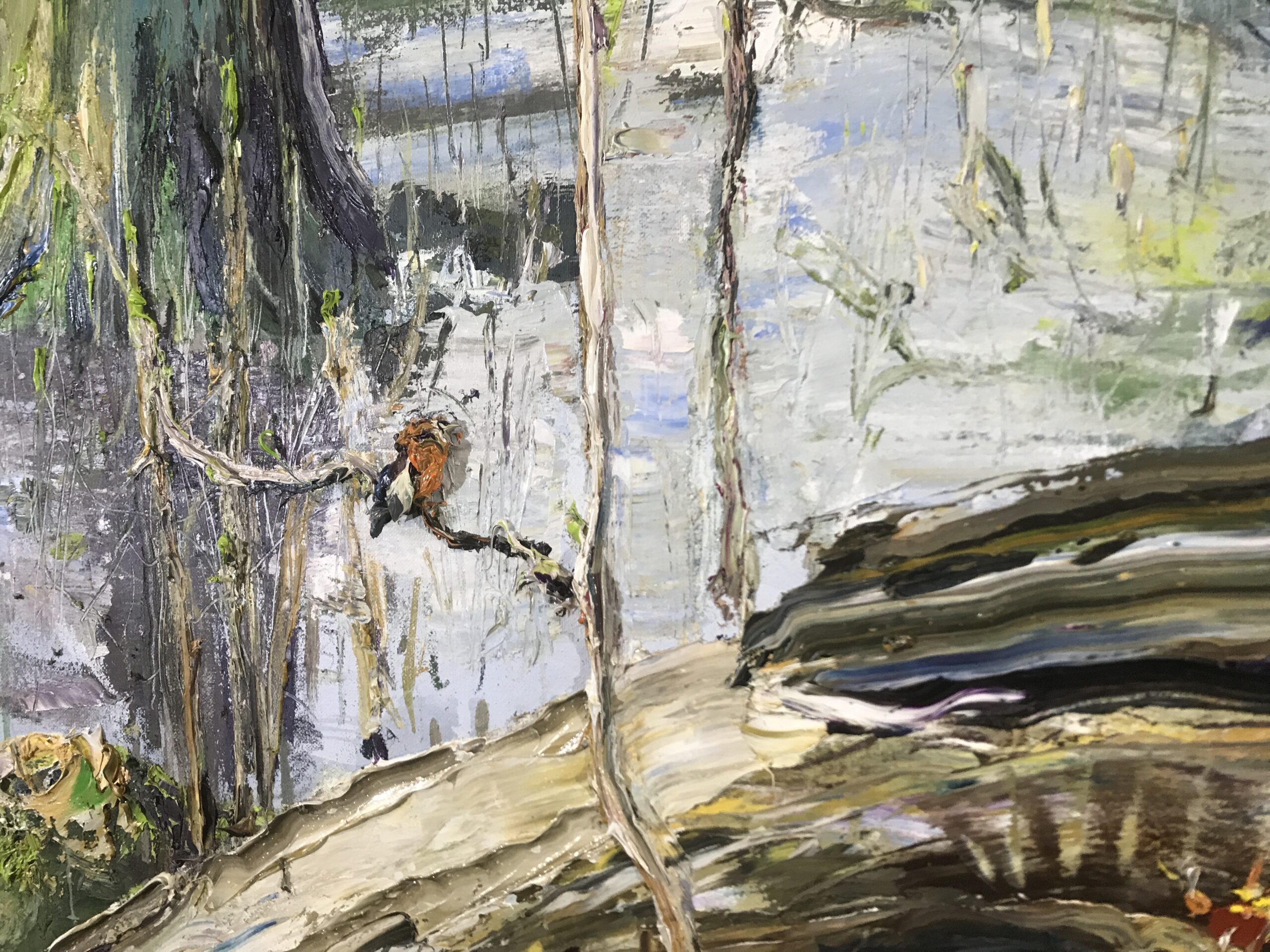
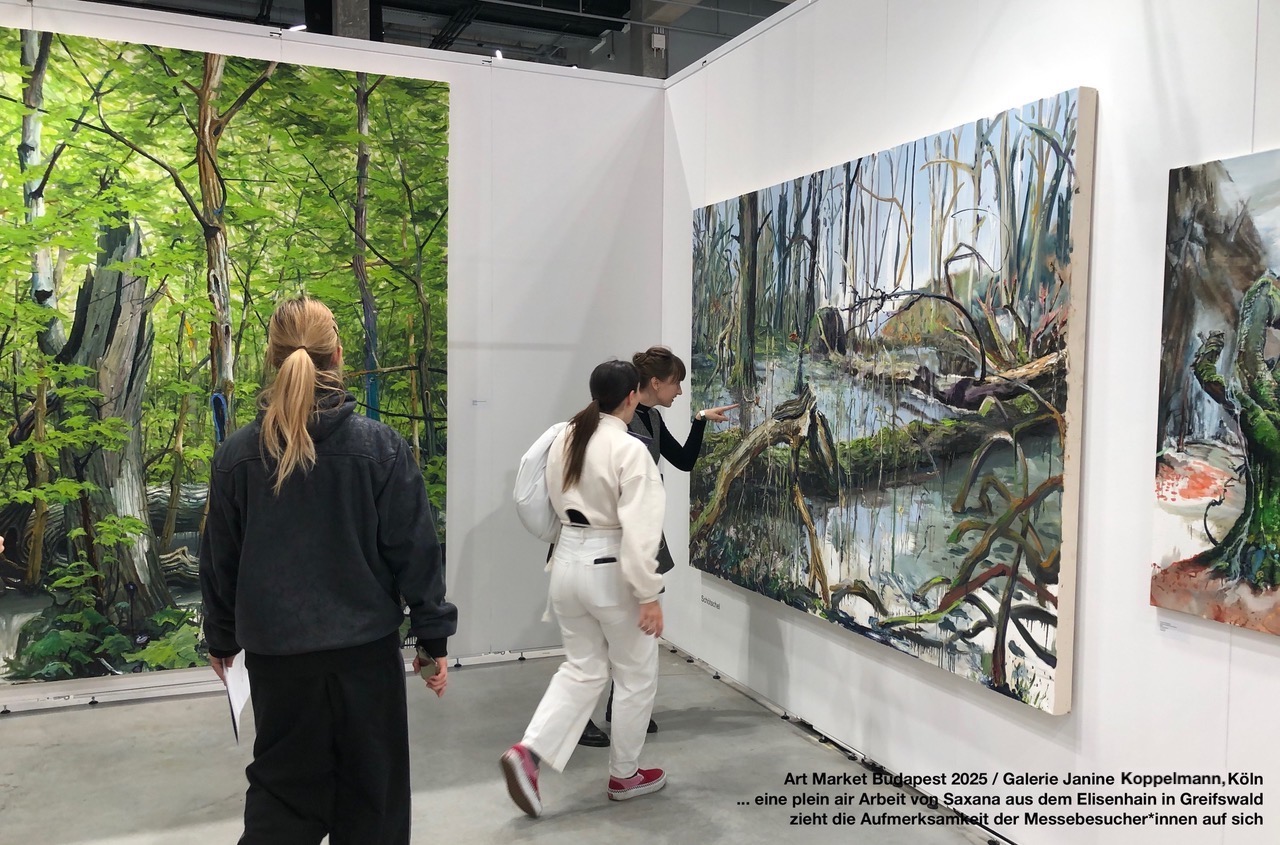
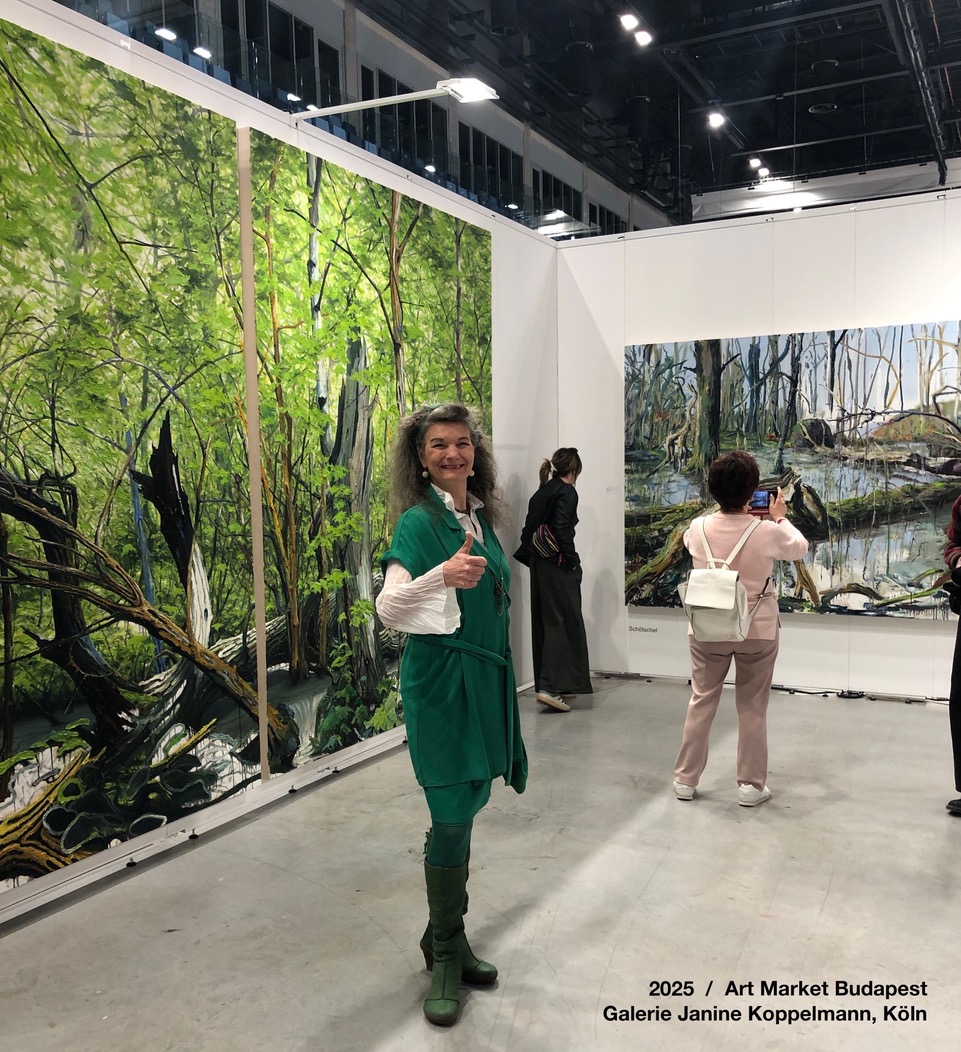
This section presents a cross-section of Saxana’s artistic oeuvre, featuring details from various paintings as well as views of exhibition installations. The focus is primarily on works created during the past ten years, a period in which her distinctive visual language has evolved through an intensive engagement with nature, ecological questions, and the relationship between humanity and the living world.