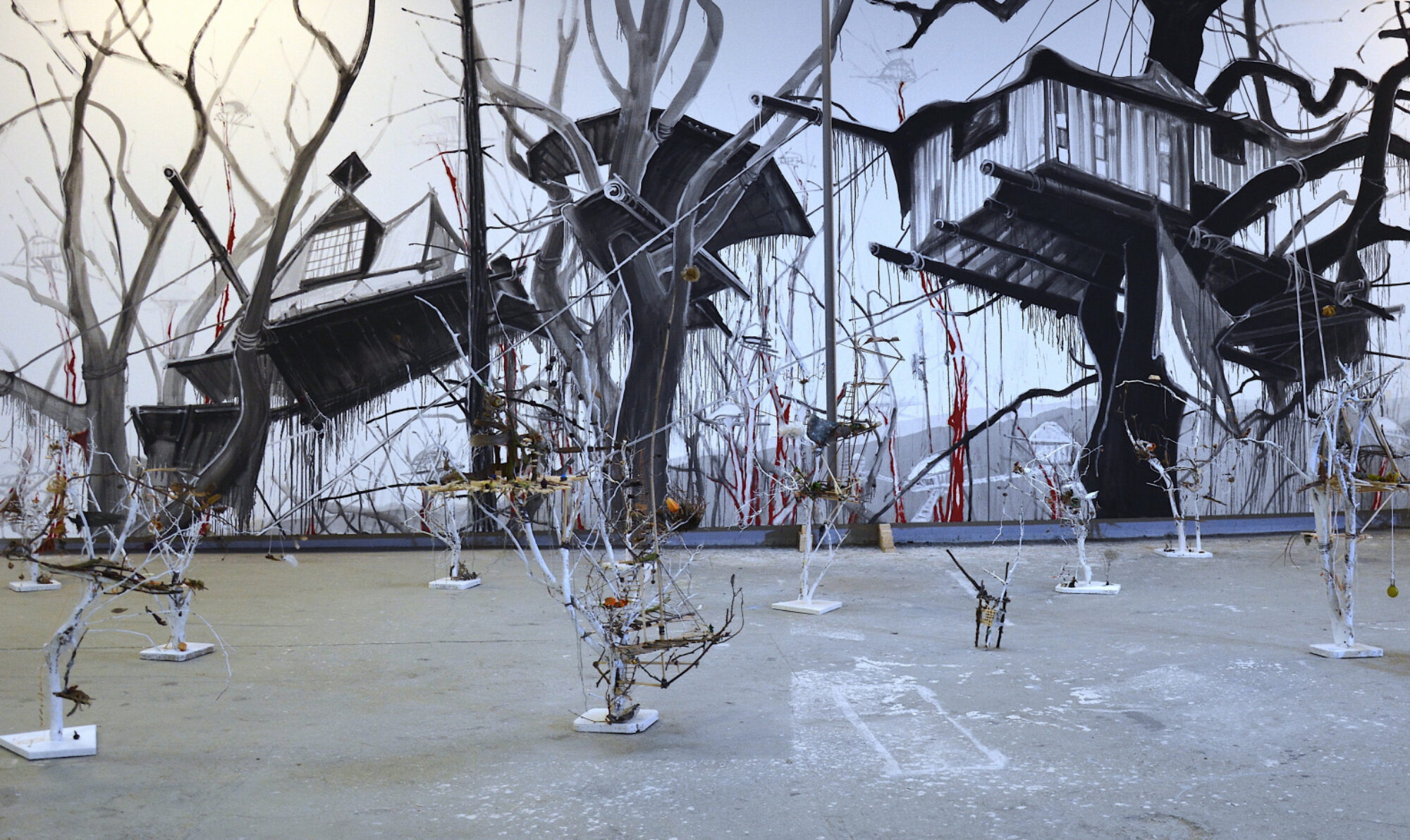
There are works created individually by Saxana Nicole Schötschel and by Helge Hommes that are clearly attributable to each artist’s independent practice. There are also works that originate as individual pieces by one of the artists and remain so, while at the same time being conceptually integrated into a collaborative project or a shared artistic framework. Finally, there are large-scale collaborative works in which both the formal execution and the conceptual development emerge jointly on a single support. These include the paintings HIMMELSKINDER (Children of the Sky, 300 × 400 cm), DAS GROSSE GELINGEN (The Great Success, 250 × 600 cm), and the history painting EINSKOMMAFÜNFGRAD (One Point Five Degrees, 260 × 810 cm
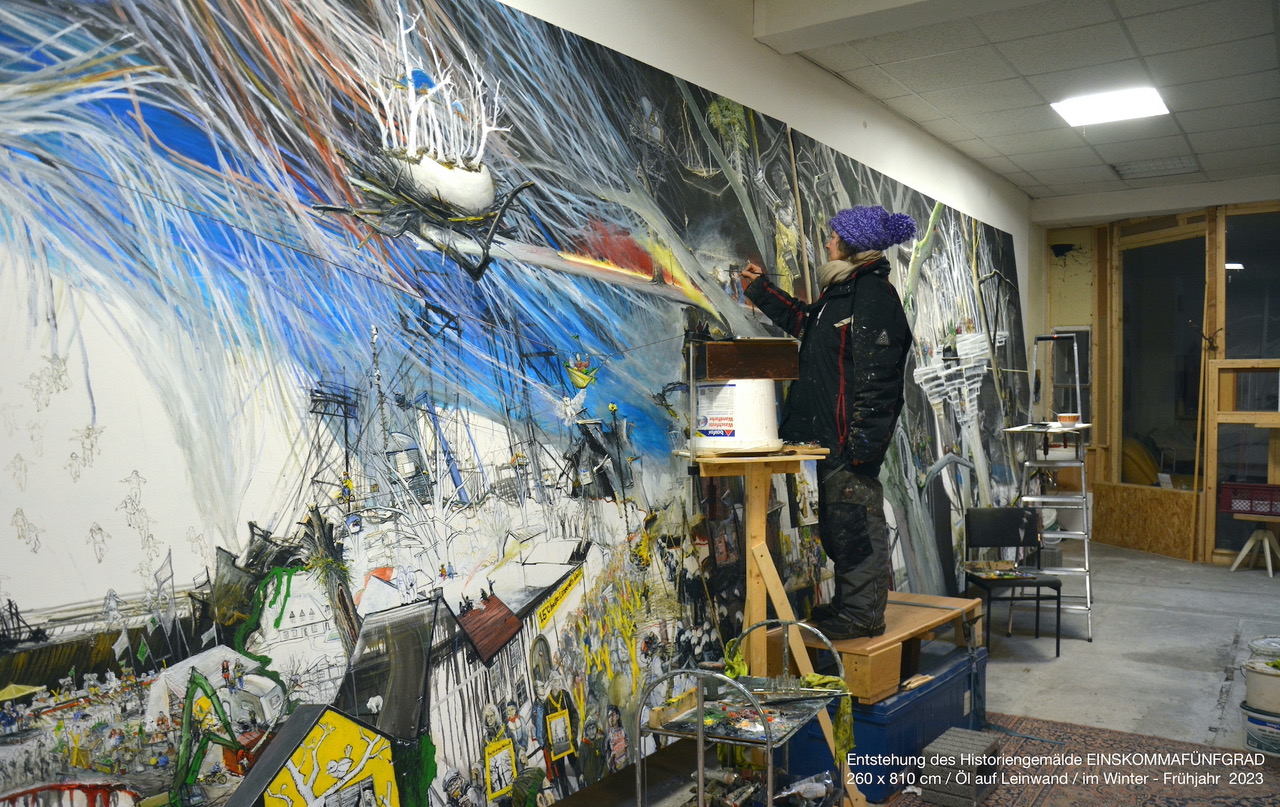
Our body of work encompasses painting, drawing, sculpture, performance, texts, artistic statements, political interventions in public space, as well as lectures and public talks. At its core lies the continuous development of the concept of Social Sculpture, which remains a central focus of our artistic practice.
For more than thirty years, the tree has occupied the centre of our artistic inquiry, standing as a representative living being within the complex ecology of nature. Today, it is increasingly transforming into a figure of collective longing and is, at least in part, beginning to be recognised as a being in its own right. In response to this development, Saxana formulated the statement in 2019: “The Tree Is the Messiah.”
For thousands of years, trees have been revered and worshipped in cultures around the world. Today, this ancient, deeply rooted sensibility is increasingly supported by scientific knowledge. Such recognition may prove invaluable—yet perhaps it has come too late. Too much precious time continues to be lost before politics and society respond adequately to the findings of science.
It is a profound indictment of our society that children have felt compelled to take to the streets—as exemplified by the Fridays for Future movement—because they justifiably fear for their own future and that of our planet.
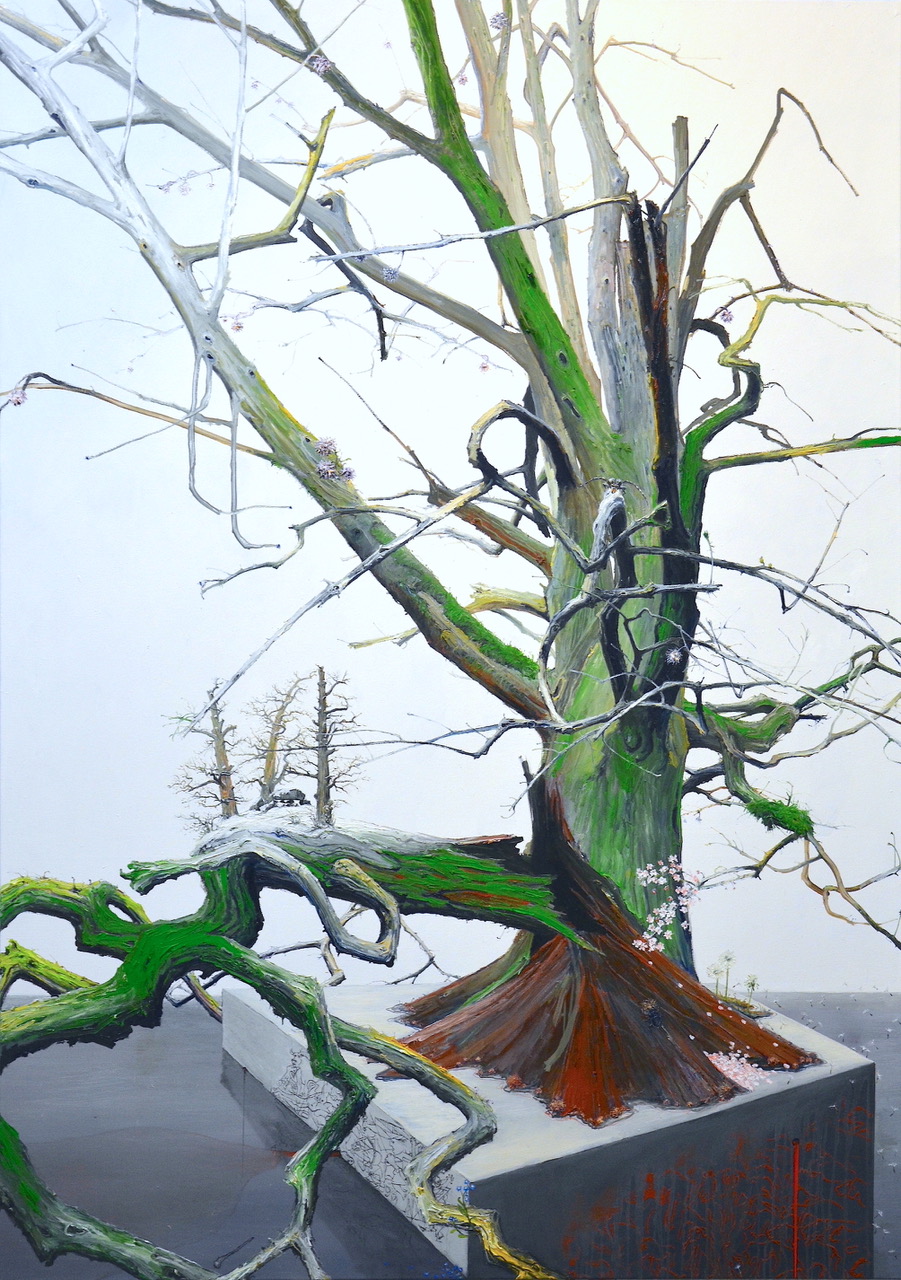
Our artistic attention is directed toward the architecture of nature: its structures, its intelligence, and its inherent spirituality. In the series TREE PORTRAITS, we honour the tree by portraying it as an equal presence, meeting it at eye level. At the same time, our gaze extends to the world of smaller living beings—from insects to the smallest forms of life, including microbes and bacteria.
Baumportrait / 220 x 155 cm / Öl auf Leinwand / 2021
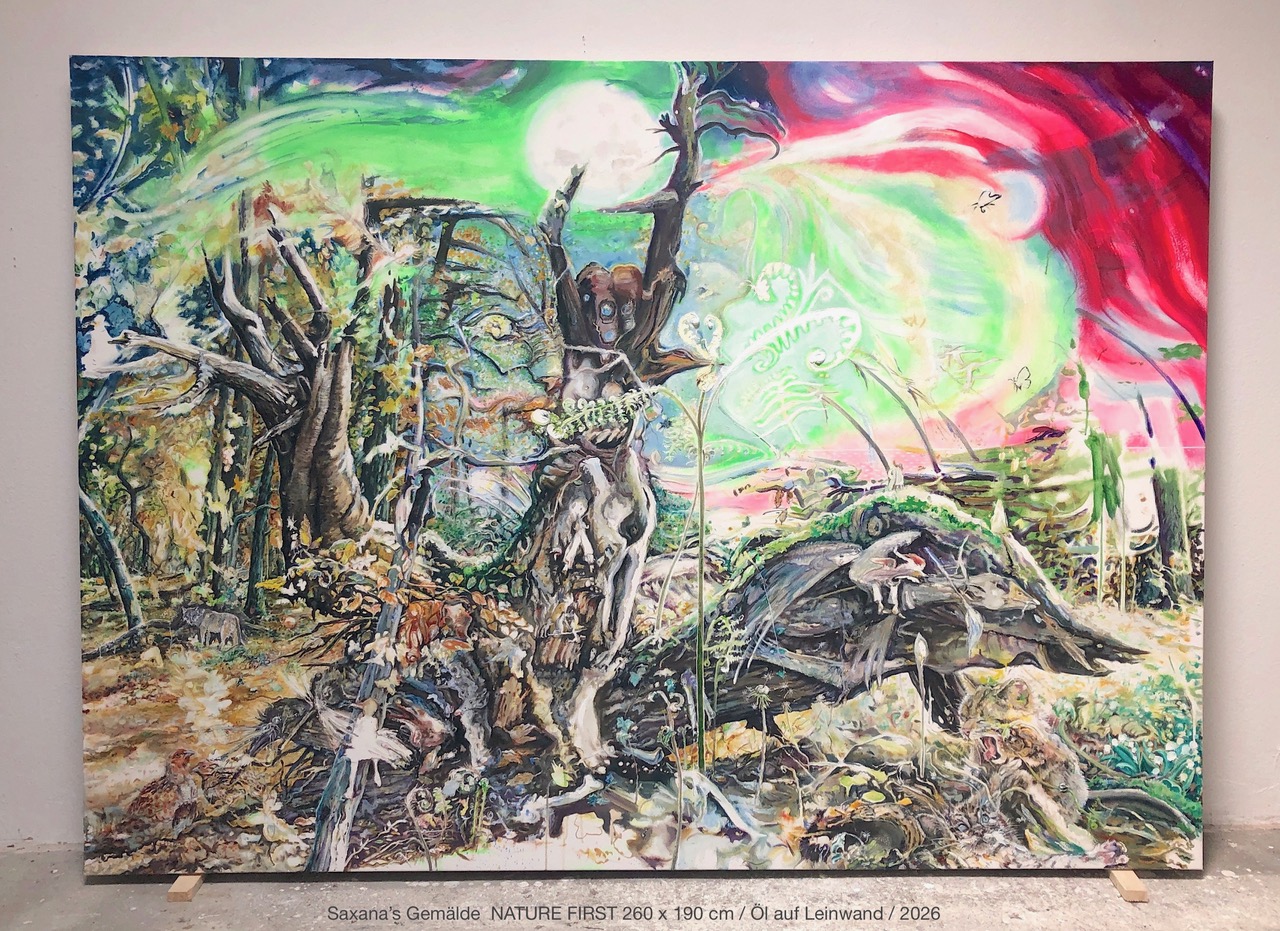
Saxana seeks to capture the essential nature of the living world. Her painting NATURE FIRST (2026) emphasises the complexity and interconnectedness of life. Wherever she looks, she discovers living forms—beings that gradually emerge within her paintings or seem to have been quietly present all along, waiting to reveal themselves.
She conceals animals, fairies, elves, and other nature beings within her compositions, inviting viewers to discover them. Those who spend time with the paintings will gradually perceive these hidden presences, rewarding attentive observation.
Everything is interwoven. Saxana embarks on what she describes as “Humboldtian journeys of discovery,” inspired by Alexander von Humboldt’s holistic understanding of nature. The celestial cosmos fascinates her just as much as the life forms of the deep sea.
Water—in the form of a droplet, a snowflake, mist, or as the very source of all life—occupies a central place in her work. Panta rhei—“everything flows.” Whether approached as a philosophical idea or experienced as a formal visual principle, this notion permeates her pictorial universe.
NATURE FIRST / 190 x 260 cm / Öl auf Leinwand / 2026
For more than thirty years, Helge Hommes has centred his artistic practice on the question of Being. Like Saxana, he is driven by the act of close observation. Whether his attention is directed toward forests, mountains, drops of water, the deep sea and its inhabitants, the cosmos of the stars, deserts, the Arctic, human beings and their actions—or their inaction—the thawing of permafrost, or the beauty and the abysses of our world, his work begins with looking closely.
The tree has become his principal source of insight into the structures of life—into the continuous cycle of becoming, passing away, and becoming again. As he puts it:
“The architecture of nature is the source from which I quench my thirst for knowledge.”
Questions of proportion occupy a central place in his work: How much—or how little—can coexist? How do things relate to one another in space and time? These formal considerations are always understood as equivalents of the conditions of real life.
Years of quiet observation of trees have gradually enabled him to develop a heightened sensitivity to the underlying fabric of life and an ever-deepening understanding of its complex structures.
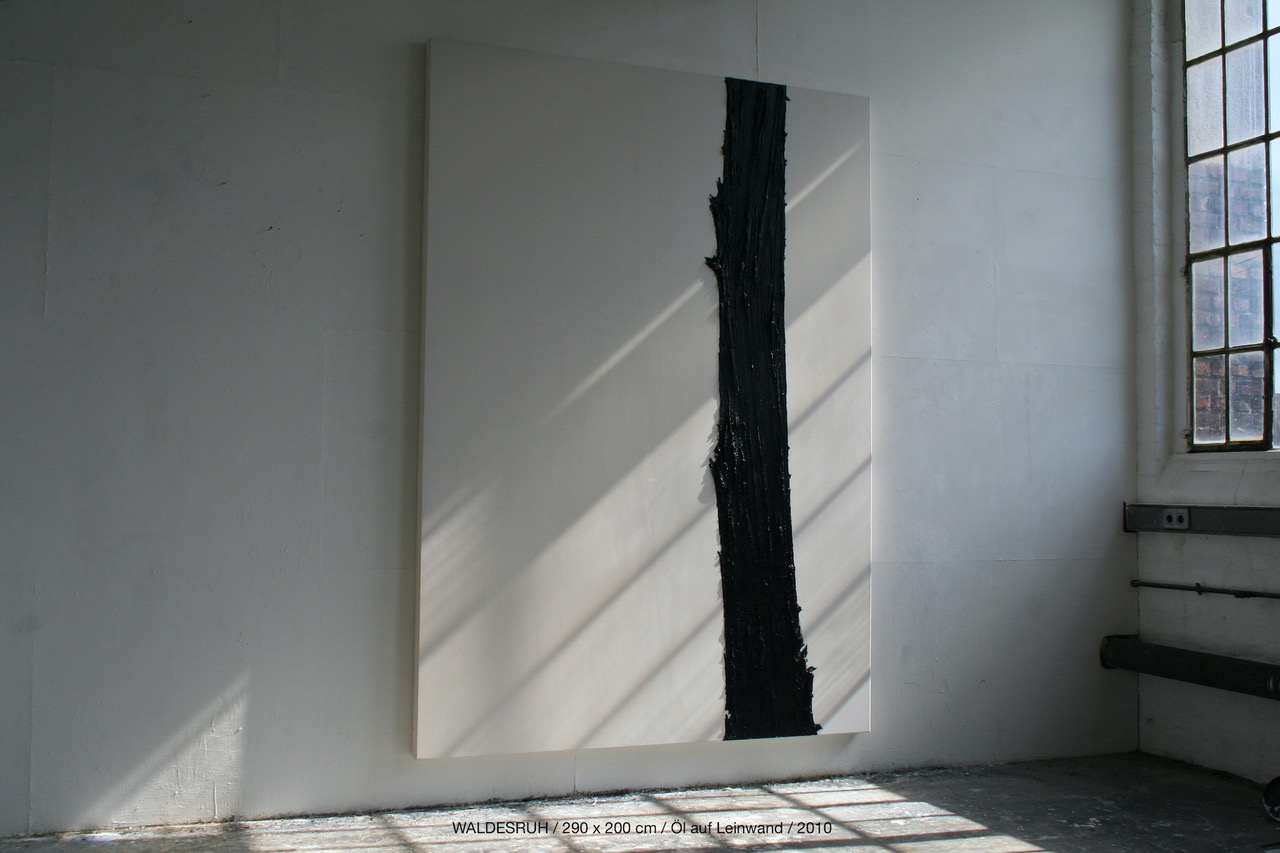
At first glance, one might think, “Helge has spent his entire life painting nothing but trees.” Yet those who look more closely—and more deeply—will discover that the tree serves not as a motif, but as a key to understanding the world.
Waldesruh / 290 x 200 cm / Öl auf Leinwand / 2010
What does it mean to work and position oneself as an artist duo? One of the most fascinating aspects is embracing the mutual exchange of ideas and creative inspiration while preserving the integrity of each individual artistic voice.
Within the enduring dynamic between woman and man, we often find ourselves looking in the same direction, sometimes even focusing on the very same tree. From this shared yet independent perspective emerge unique plein-air double portraits, such as our depiction of the ancient oak MARGARETE.
These works embody a dialogue rather than a fusion: two distinct artistic sensibilities engaging with the same subject, each enriching the other without relinquishing its own identity. It is precisely this balance between individuality and collaboration that defines our shared artistic practice.
MARGARETE – A Plein-Air Double Portrait of an Ancient Oak consists of two paintings, each measuring 250 × 360 cm, executed in oil on canvas and painted en plein air in the Reinhardswald in 2019.
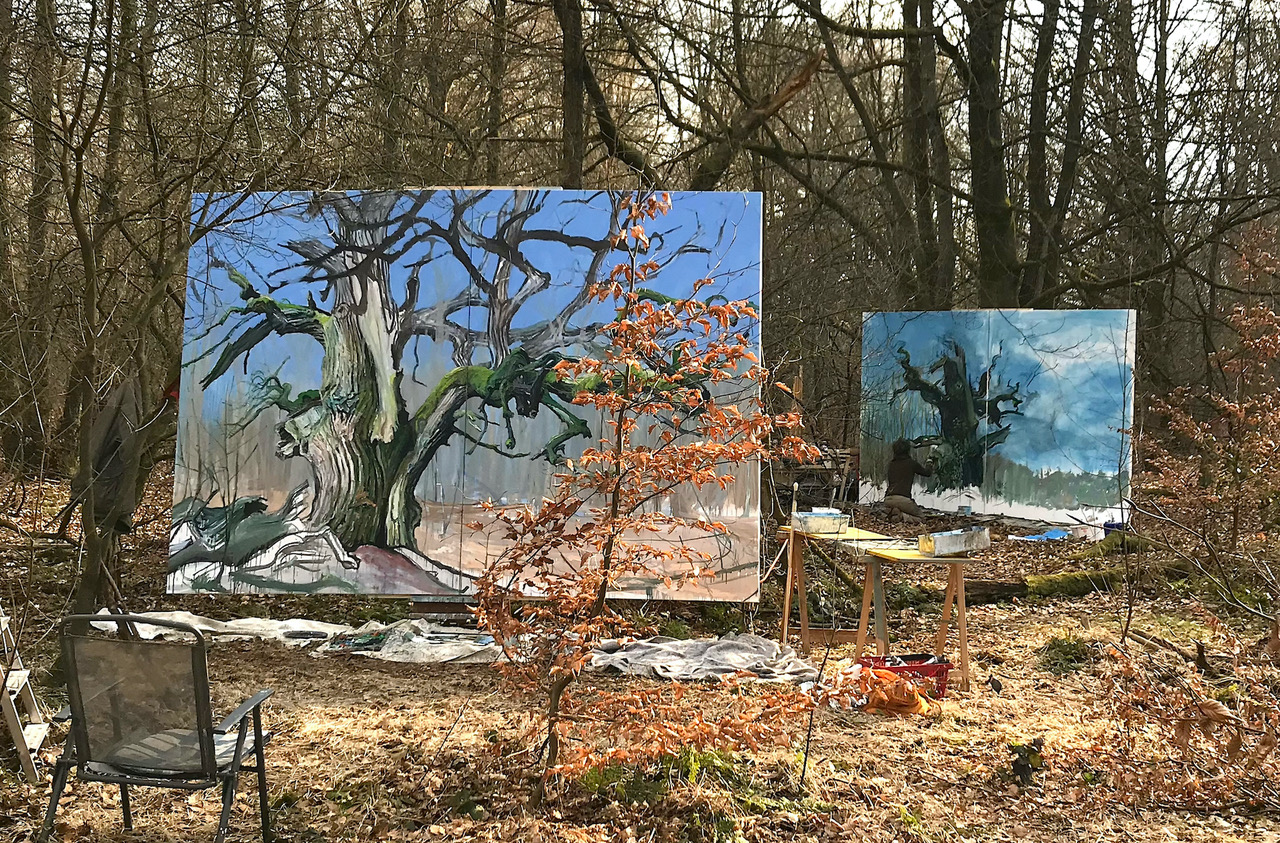
Painting is our primary artistic medium, alongside installation, drawing, sculpture, and political discourse. Our studio in Leipzig serves as our home base—a place of reflection and concentrated work, where complex ideas take shape—while the forest is our external studio.
In 2018, Professor Dr. Wolfgang Becker, the founding director of the Ludwig Gallery Aachen and later of the Ludwig Forum, invited us to turn our attention to the trees condemned to be felled in the Hambach Forest. He encouraged us to come to the forest and, through art, express solidarity with those fighting for its preservation.
At the time, we could not have imagined what would grow from this invitation. Over the years, it has developed into an ongoing artistic and political engagement—one whose end is still nowhere in sight.
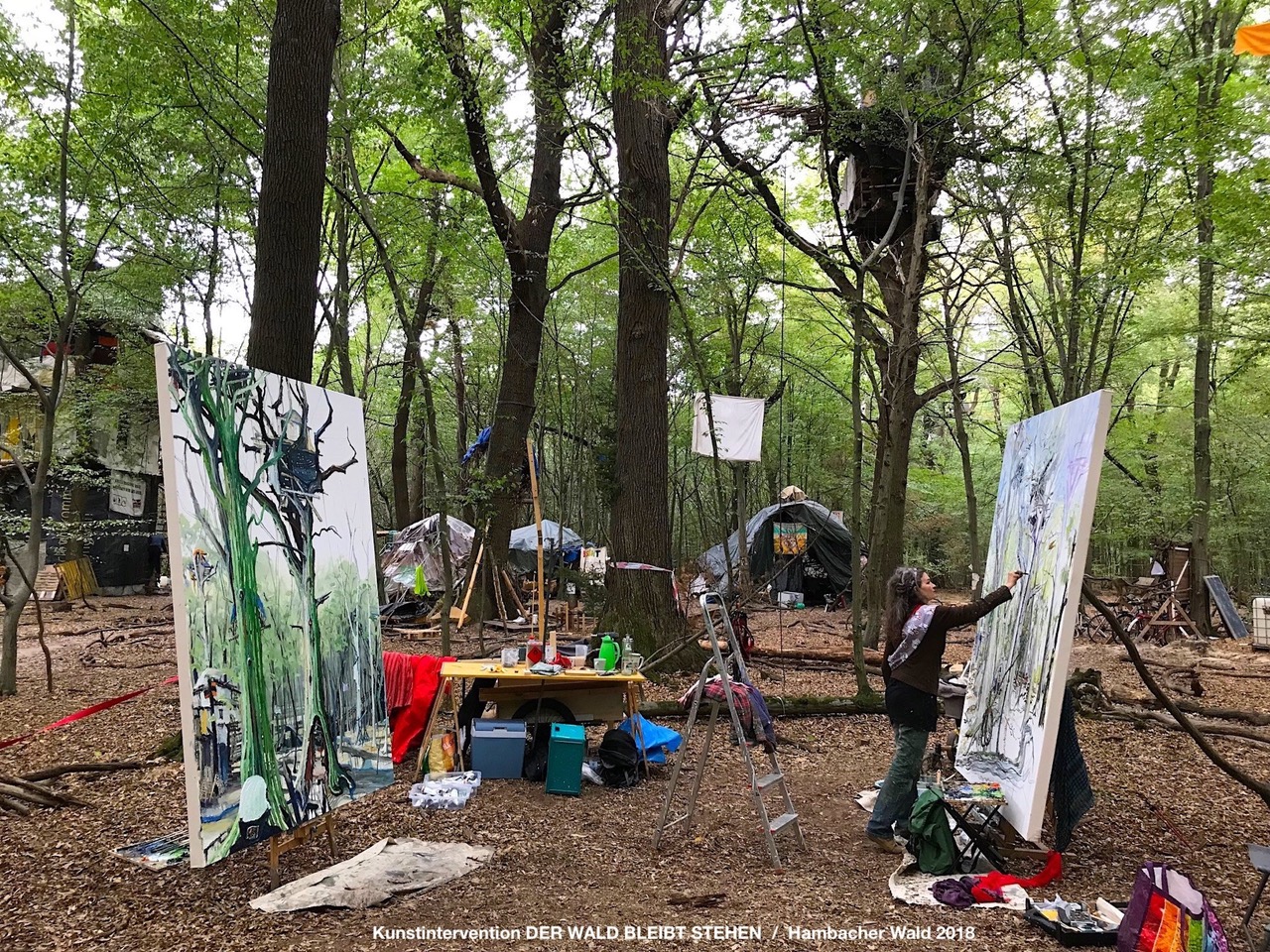
Immanuel Kant’s four fundamental questions—“What can I know? What ought I to do? What may I hope? What is the human being?”—together with Bertolt Brecht’s words, “When injustice becomes law, resistance becomes duty,” became our moral and artistic compass.
Within this context, we created twelve large-scale paintings in the Hambach Forest during the summer of 2018 (featured in art magazine, Issue 5, May 2020). Since then, the project has continued to grow, encompassing numerous additional paintings, a large-scale sculpture entitled SPACESHIP HAMBACH FOREST – DEPARTURE INTO NEW WORLDS, as well as a series of delicate sculptures bearing the evocative title HA(M)BI-TATE.
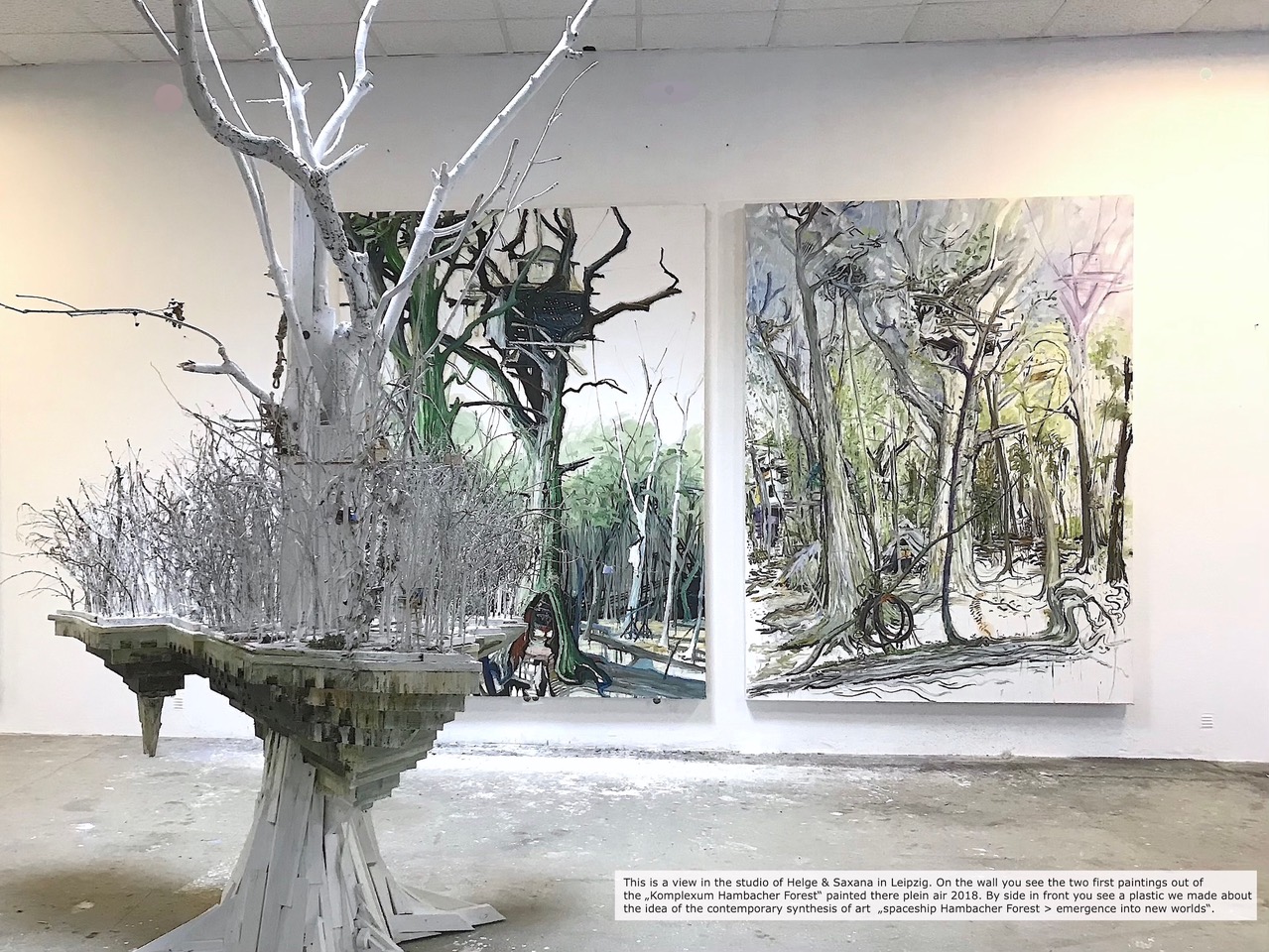
One day before the tragic death of the art student Steffen Meyn in the Hambach Forest, an event that Saxana witnessed firsthand from a neighbouring treehouse, we declared the Hambach Forest a Gesamtkunstwerk—a total work of art.
By this we meant the conscious shaping of both society and our own lives in harmony with nature: understanding ourselves as part of it, rather than presuming to rule over it, and recognising this as an ongoing, ever-evolving responsibility.
“Free land and a free cabin,
a free spirit and a free word,
free people and a free way of life—
this place will always draw me back.”
These well-known words, inscribed on many forest cabins and attributed to the anarchist Max Barwert (Meiningen, c. 1927), captured, perhaps better than anything else, the spirit and way of life of the people living in the treetops whom we came to know during that time.
We called them CHILDREN OF THE SKY (HIMMELSKINDER) and declared—to politicians, the police, and RWE:
THE FOREST WILL STAND.
Today, we would add that our artistic practice became a statement in support of the preservation of the Hambach Forest. We believe that our artistic intervention contributed to strengthening the cultural visibility of the movement and to broadening public awareness of its cause. In retrospect, the struggle for the Hambach Forest has become, alongside Wackersdorf and Germany’s Peaceful Revolution of 1989, one of the defining chapters in the history of successful civil resistance in Germany.
Since then, one strand of our artistic practice has been devoted to a painterly homage to this forest—a body of work that continues to grow and, over the years, is intended to become a unique painted testimony to its time.
Our work in the Hambach Forest was featured, among other publications, in the art magazine art, Issue 5 (May 2020).

