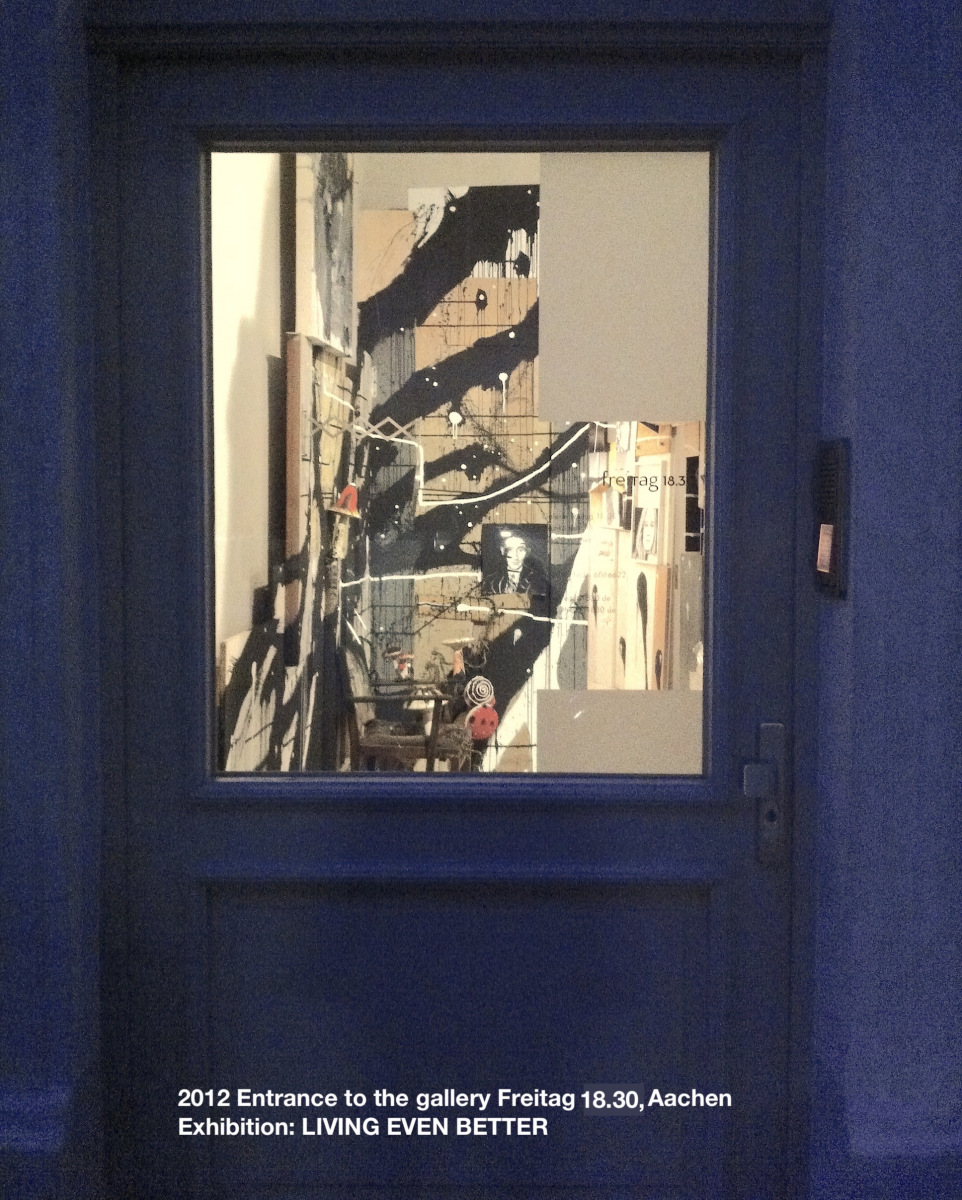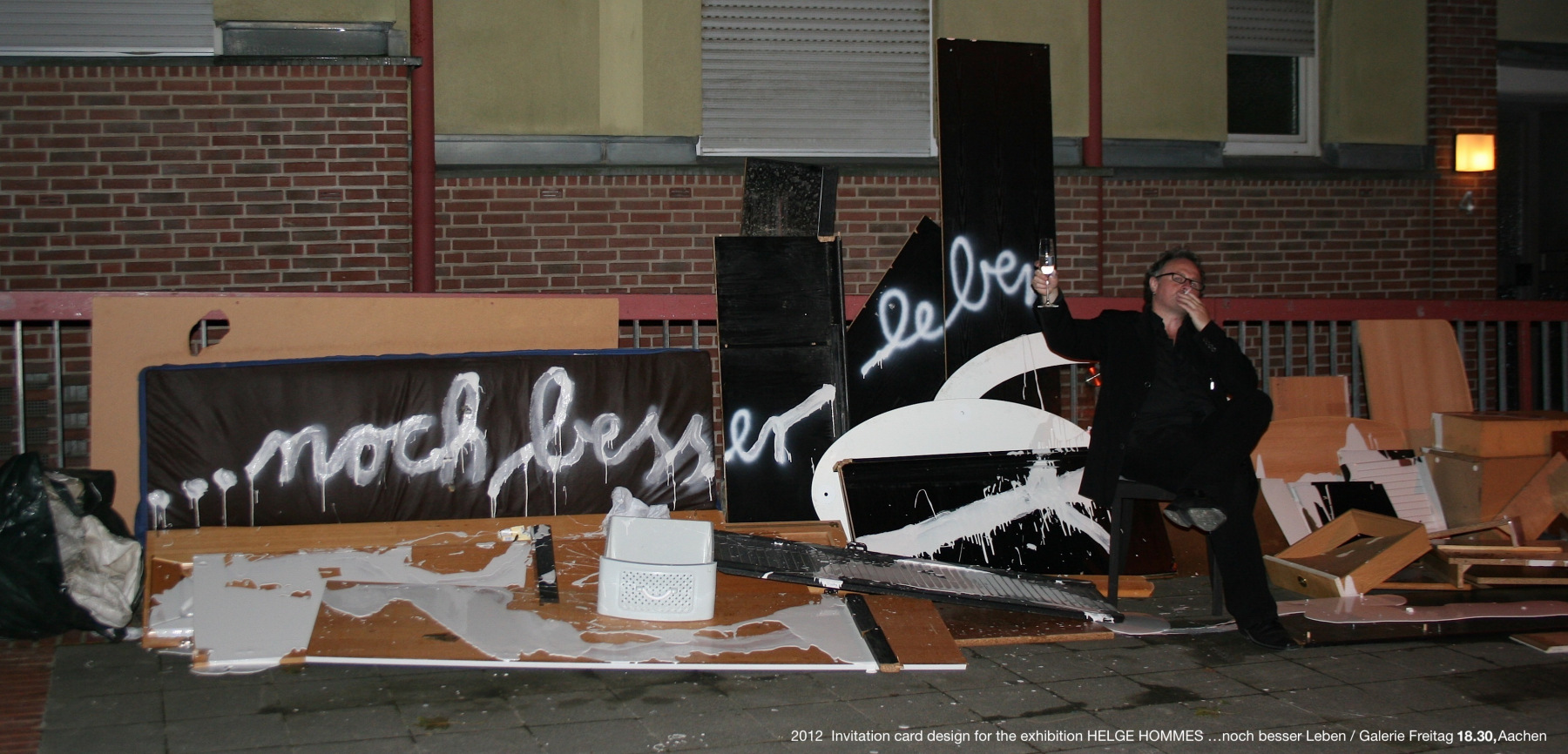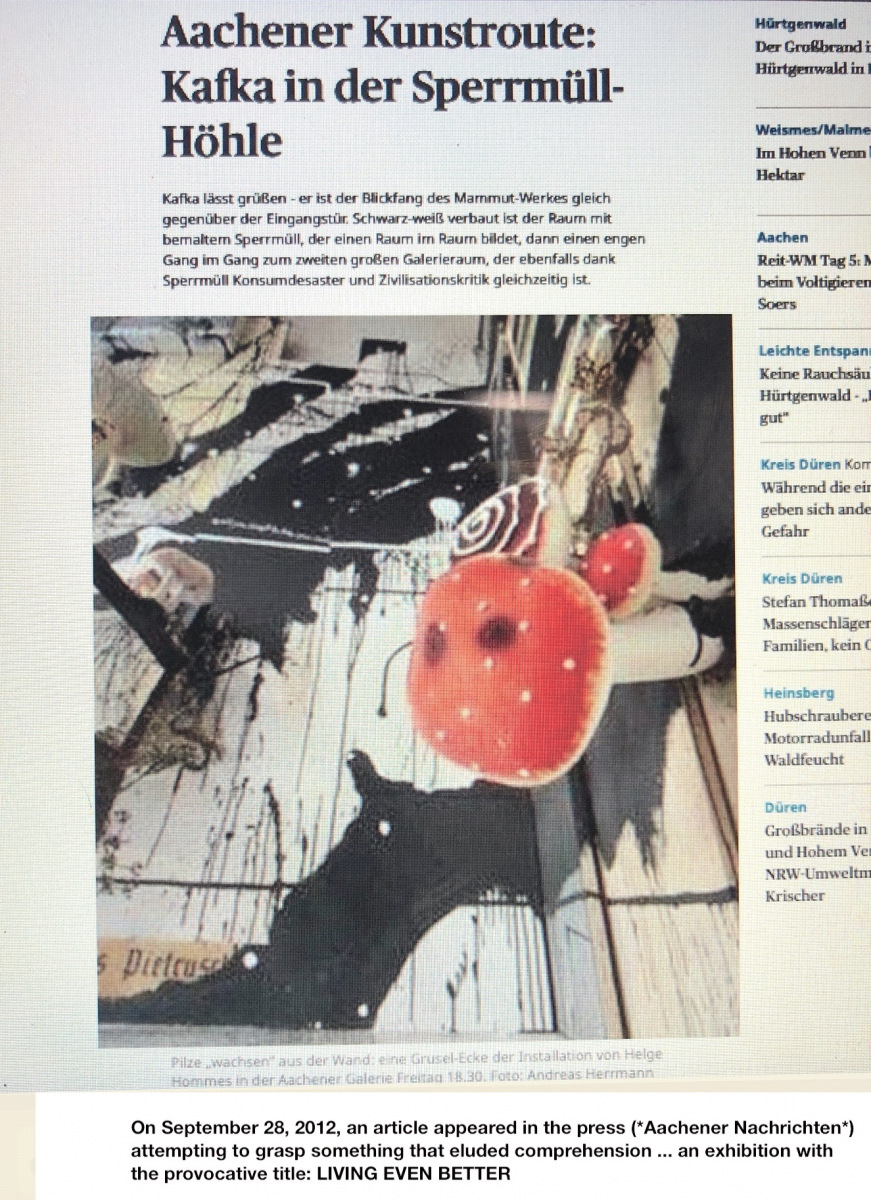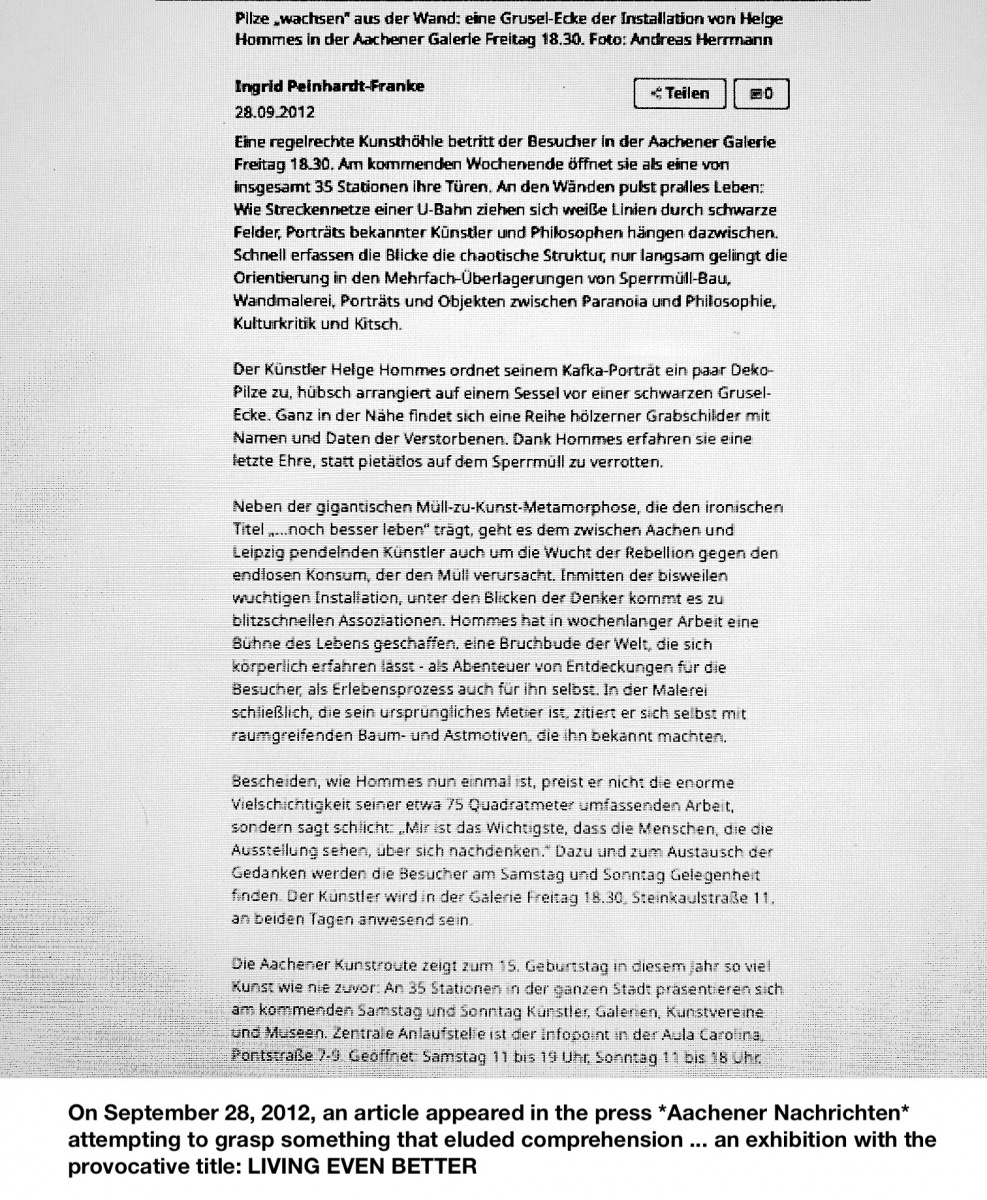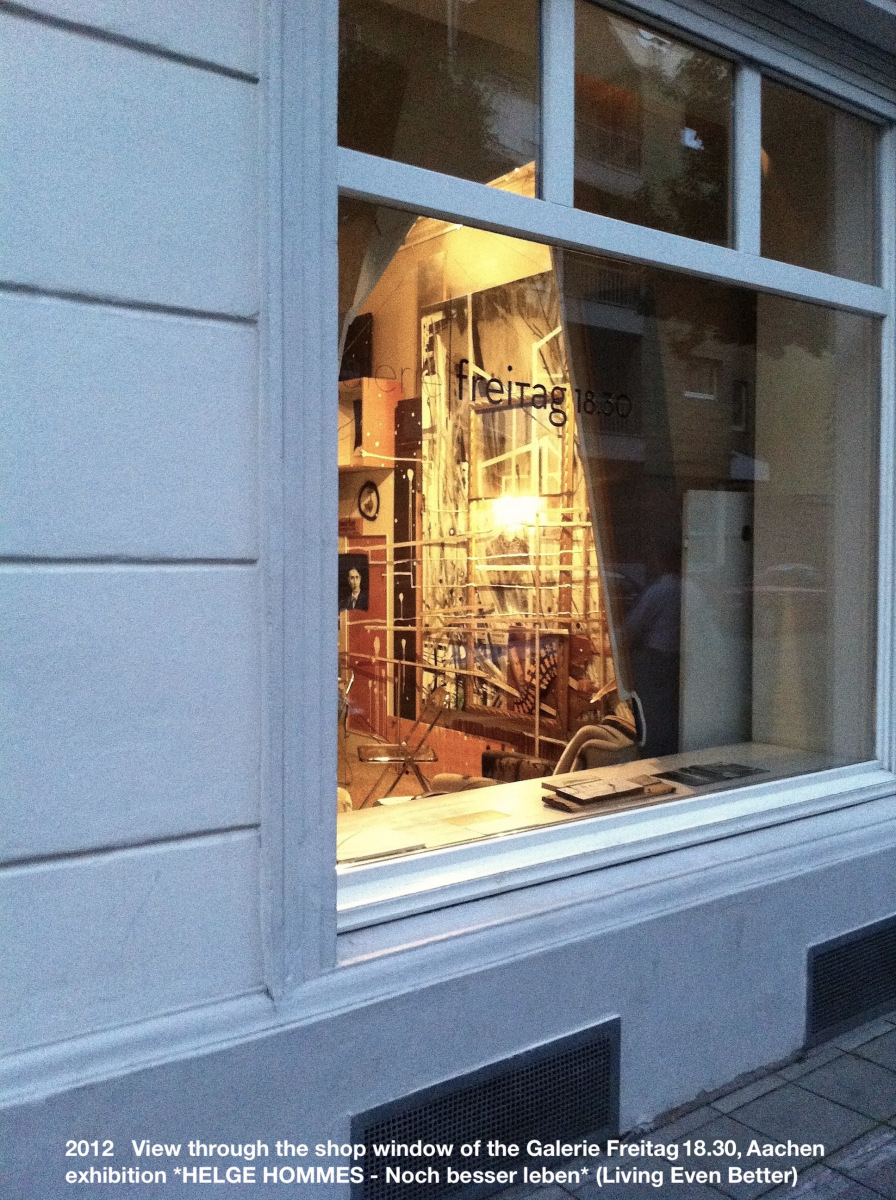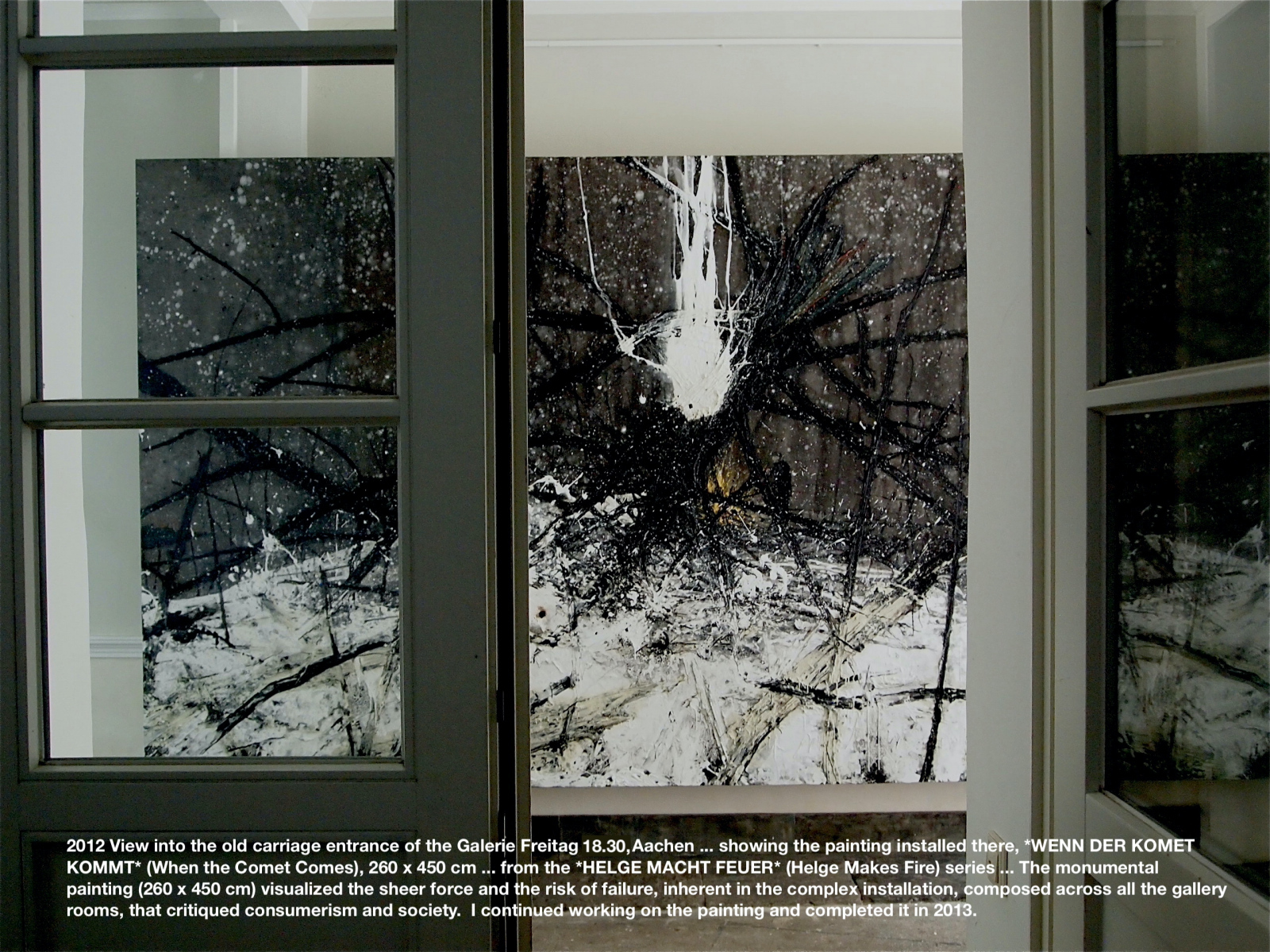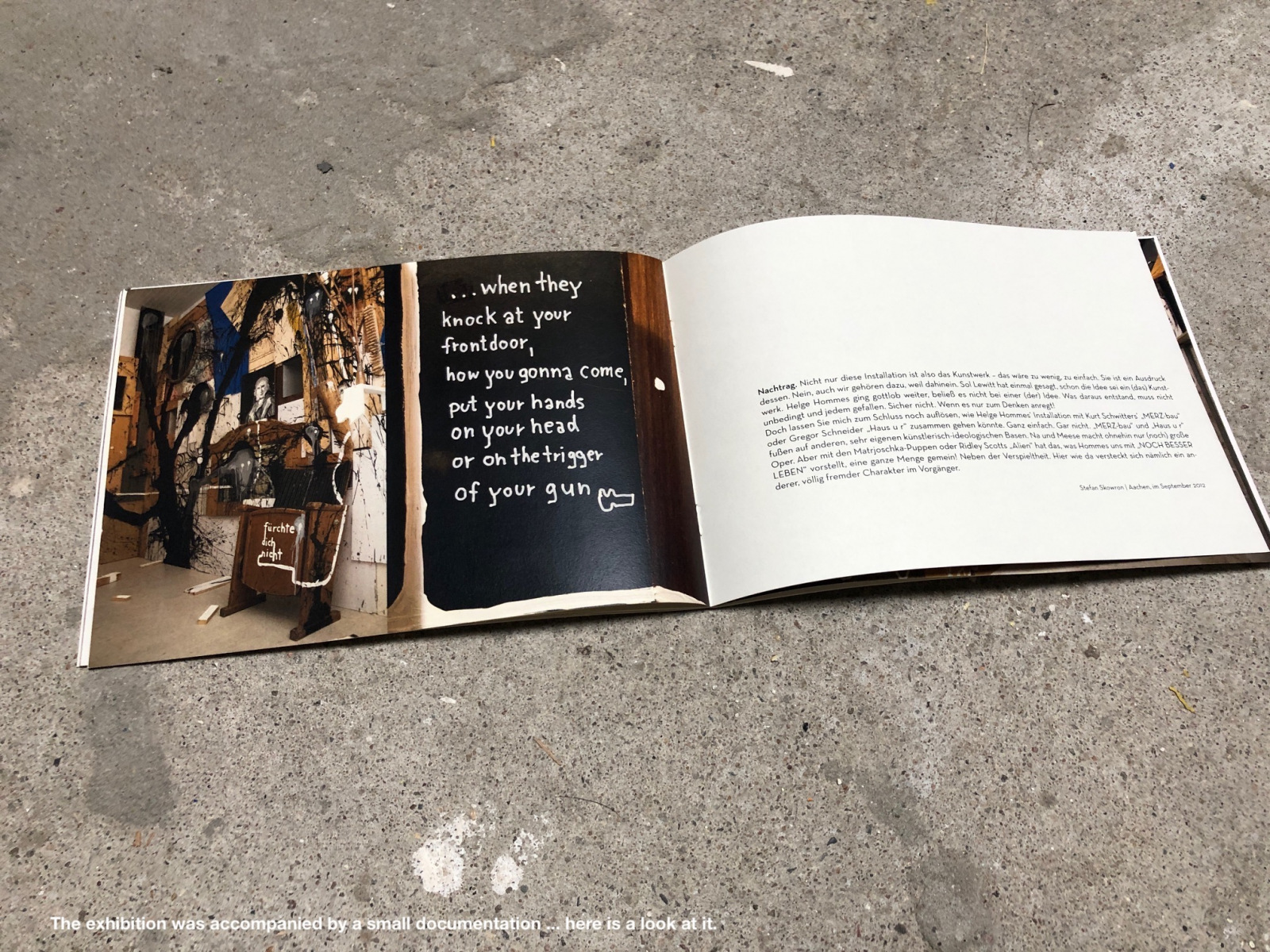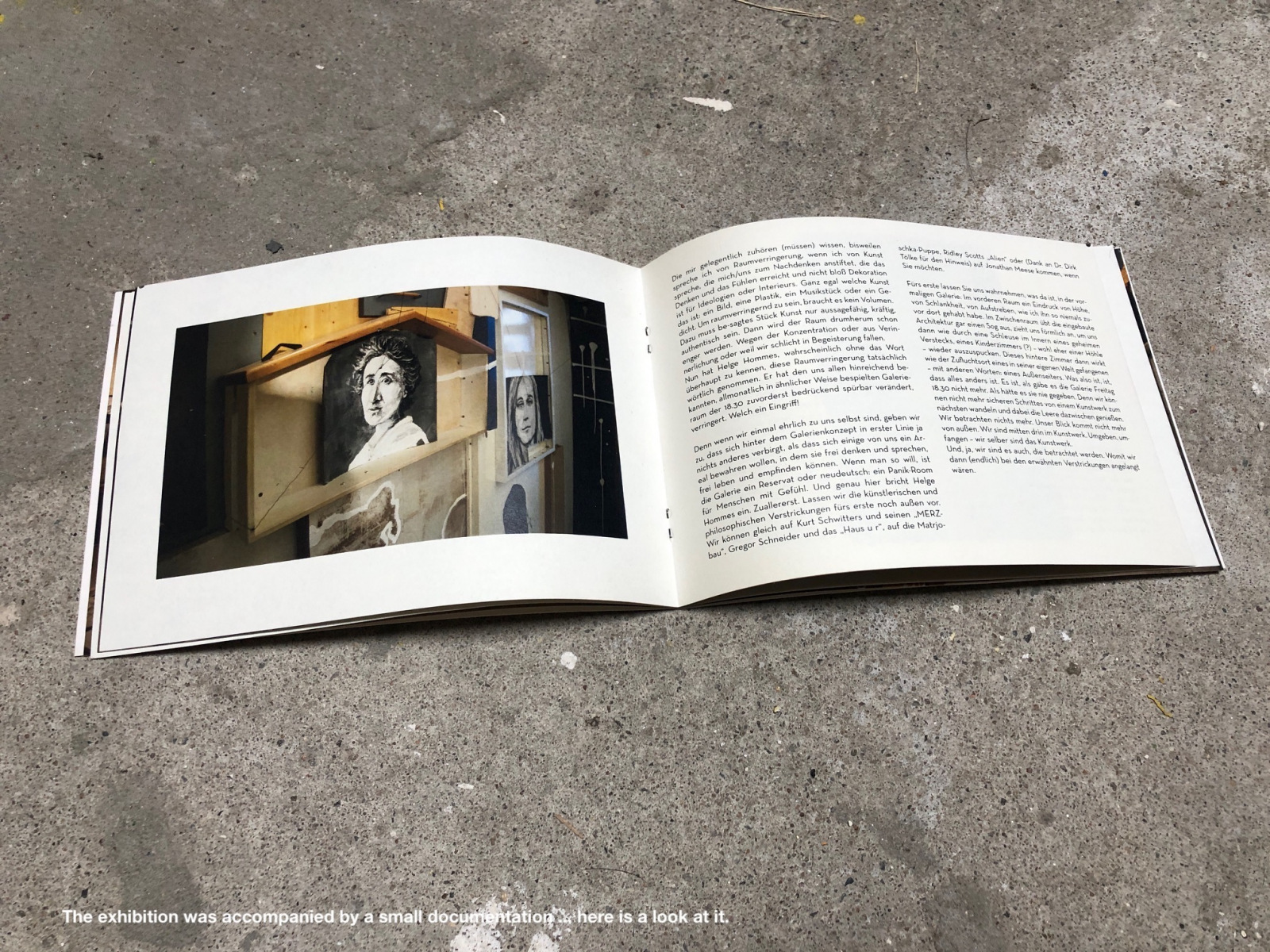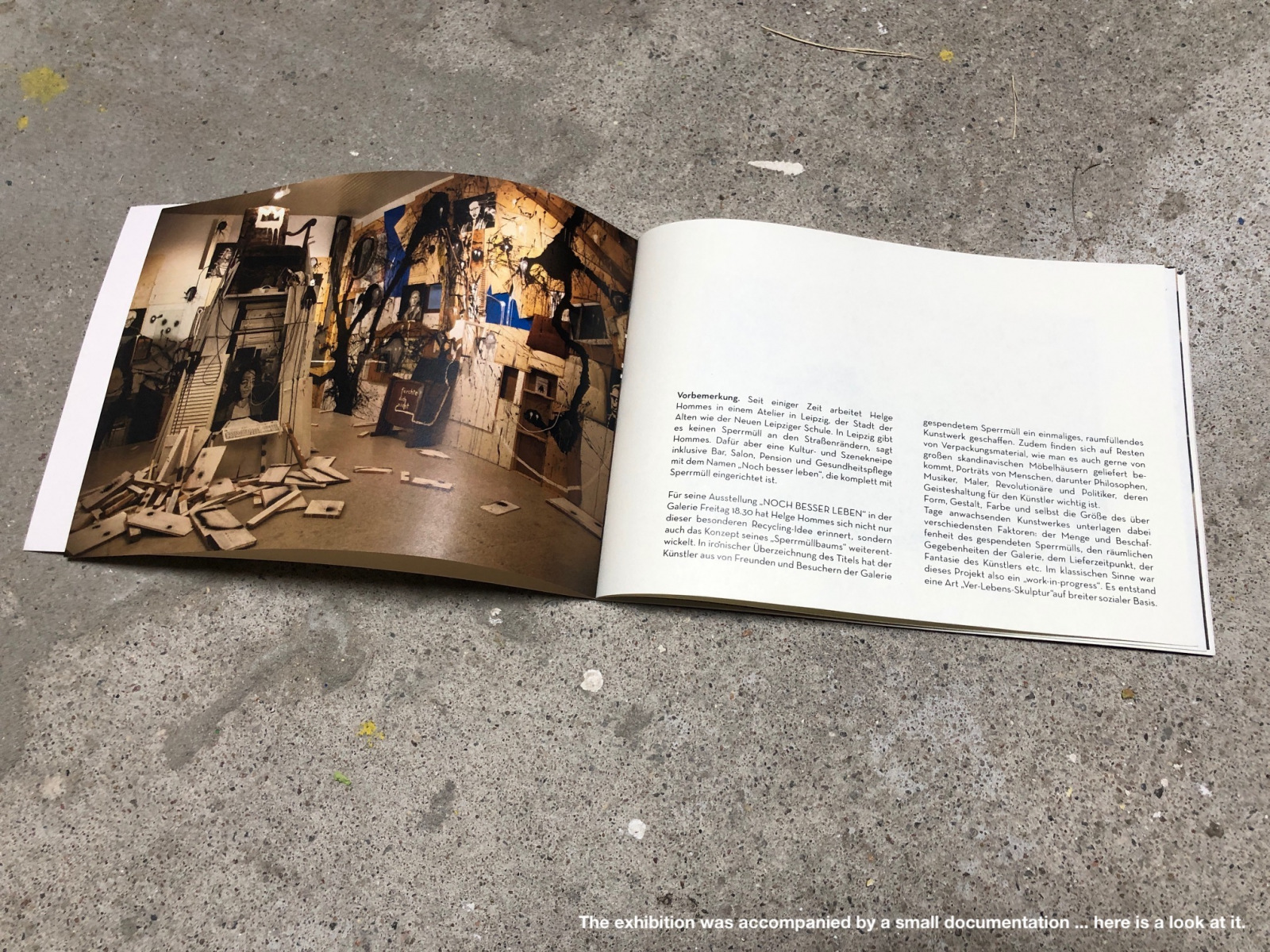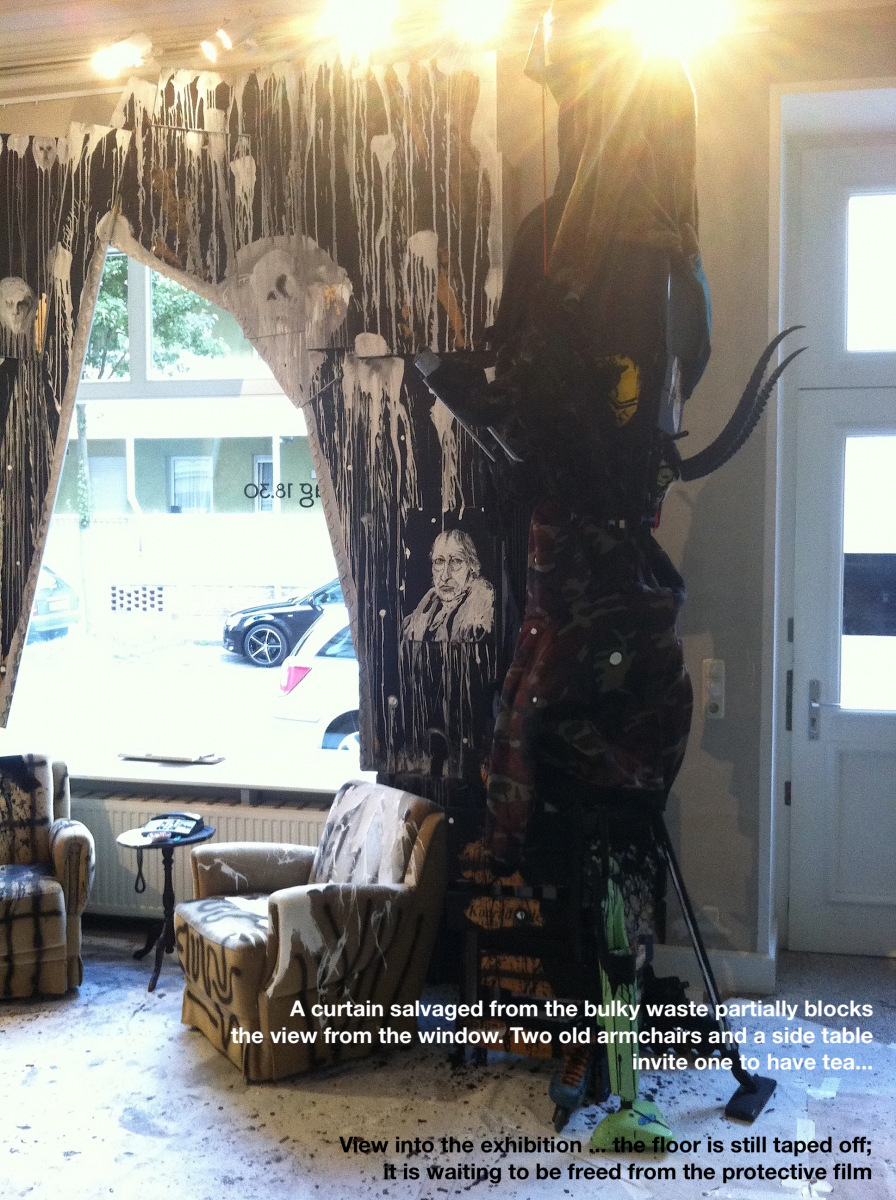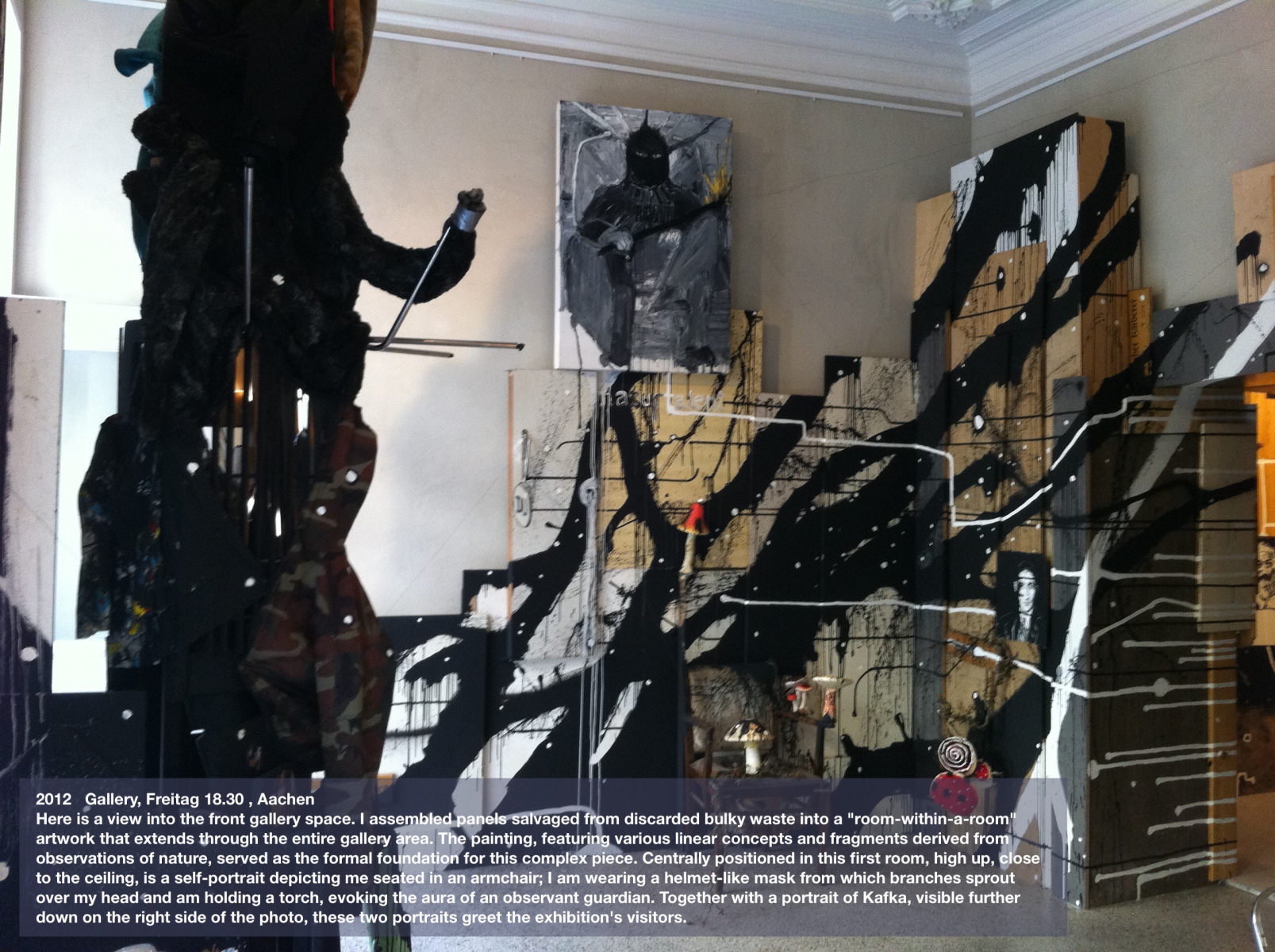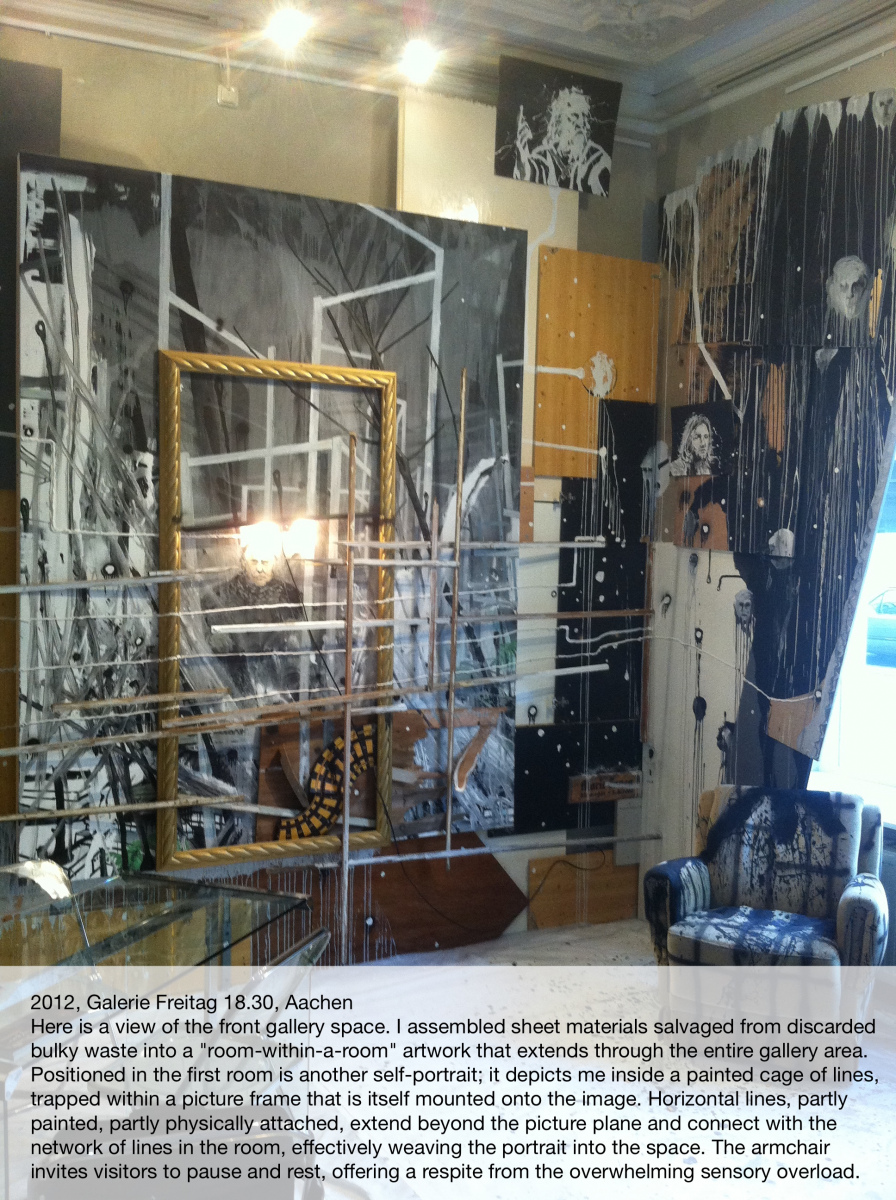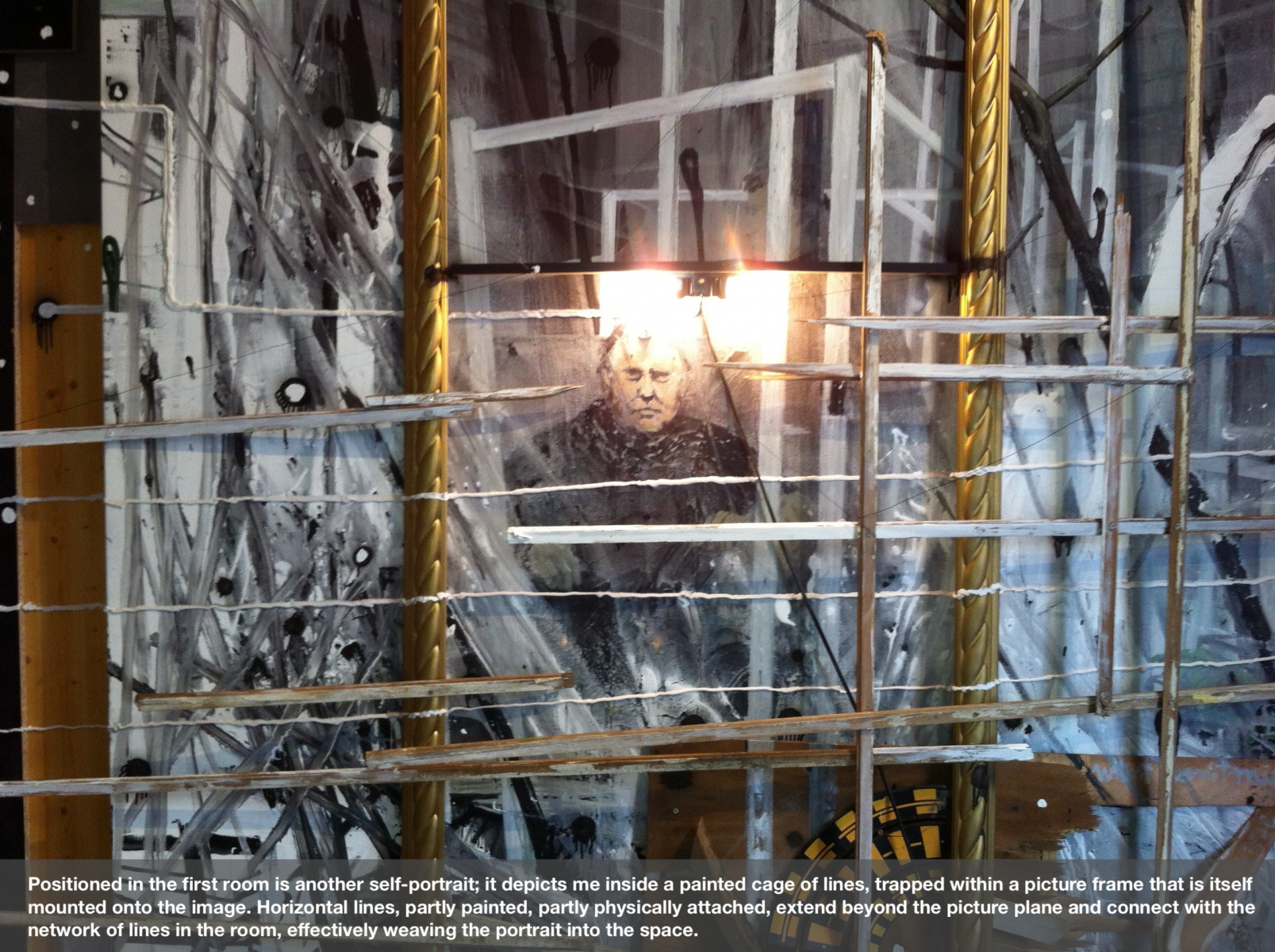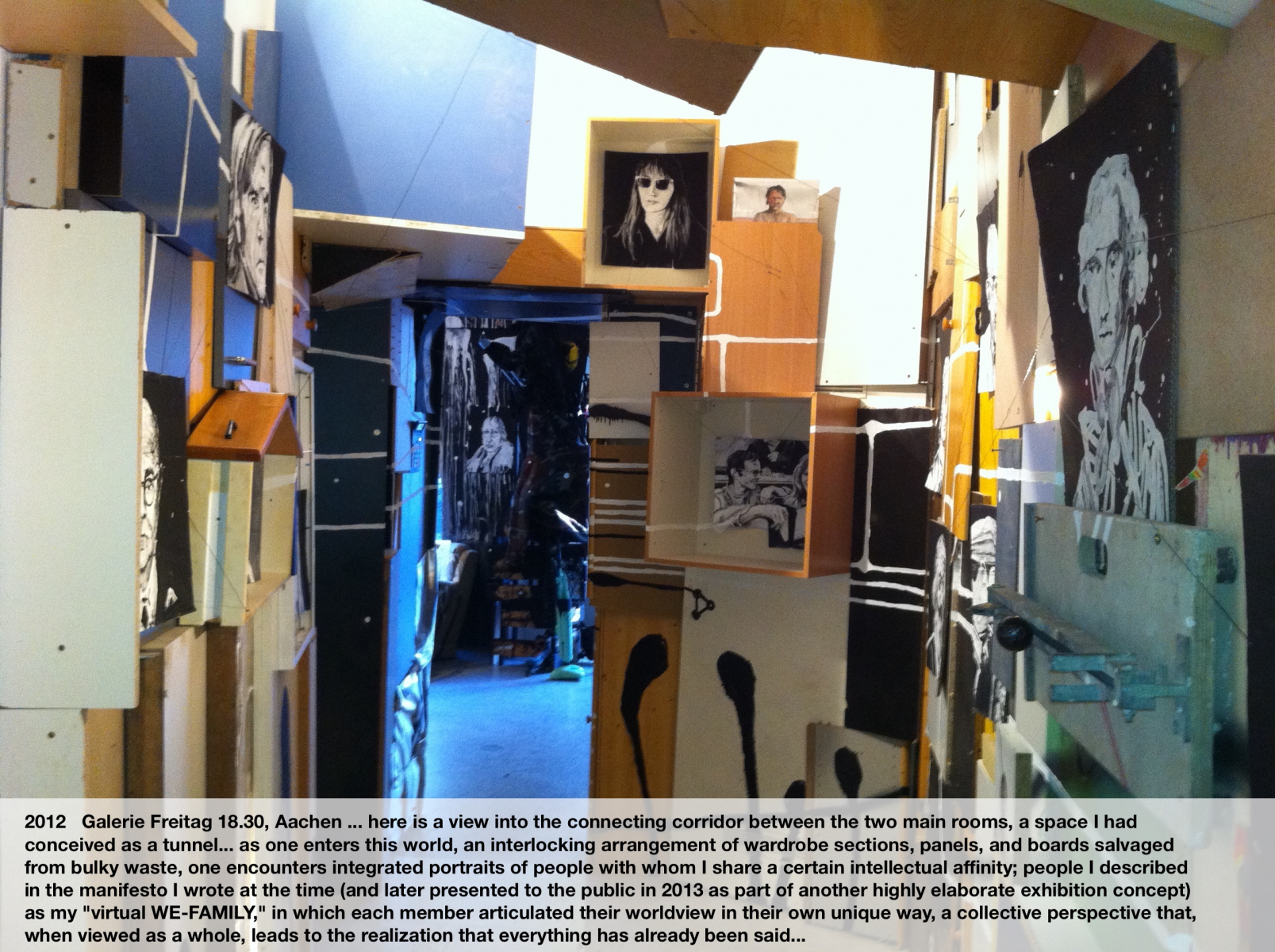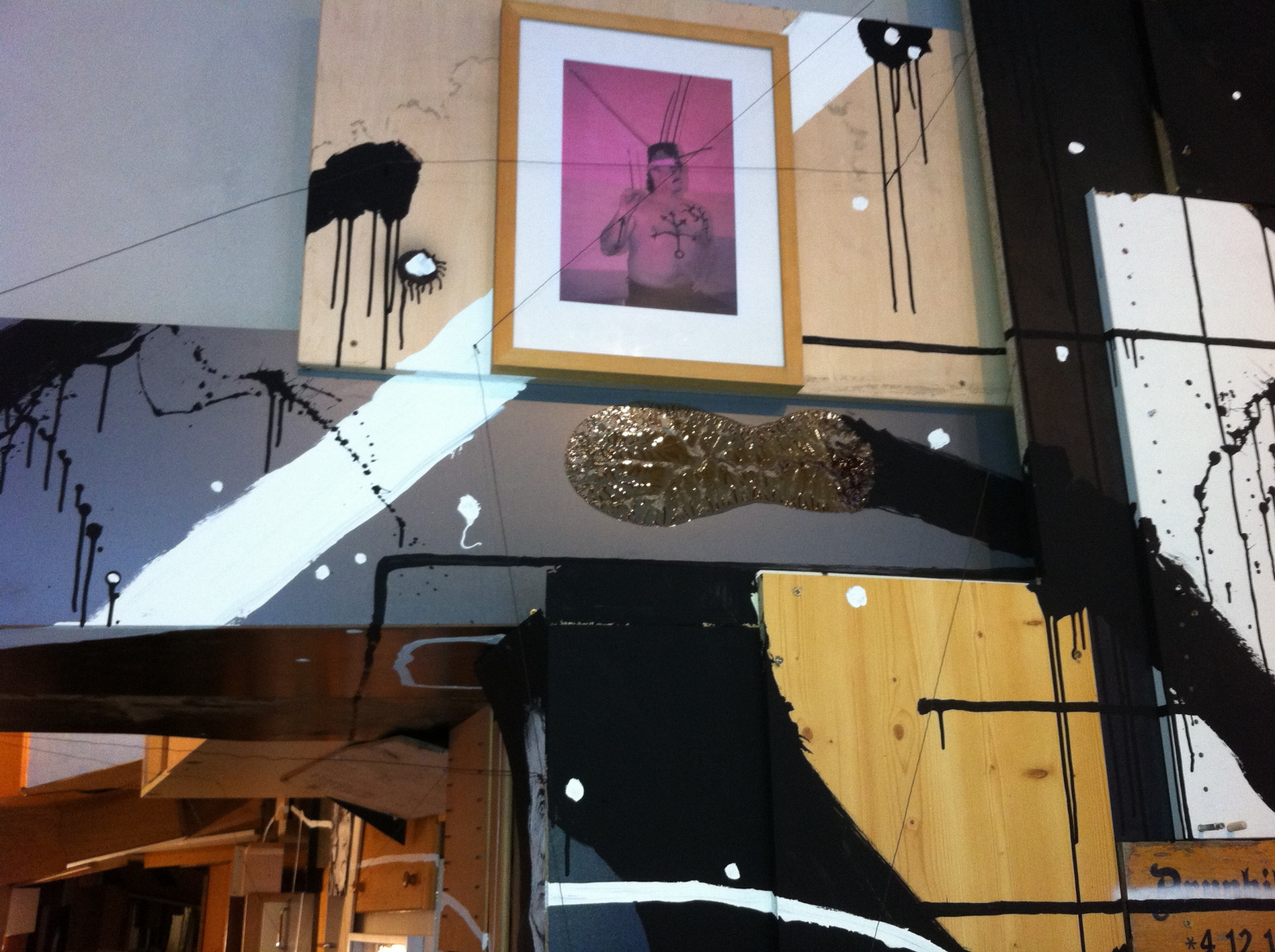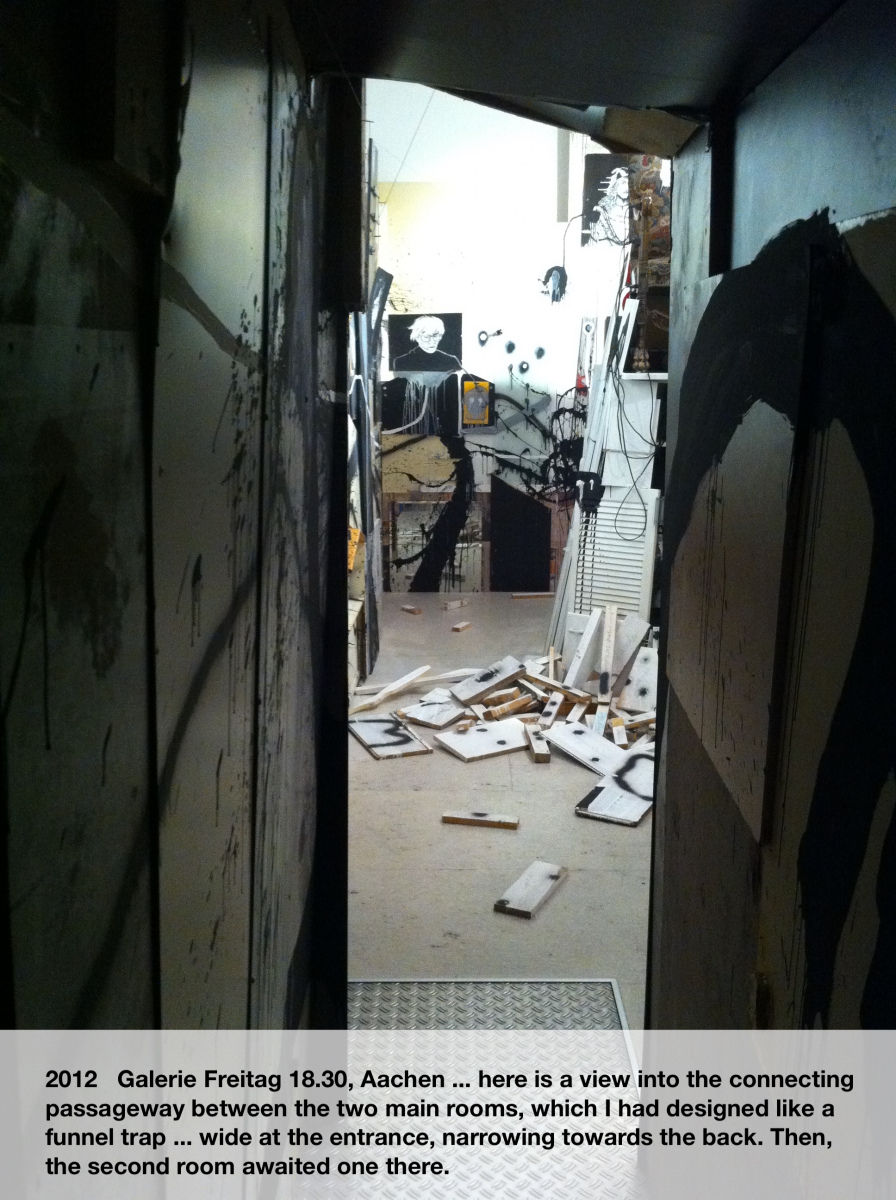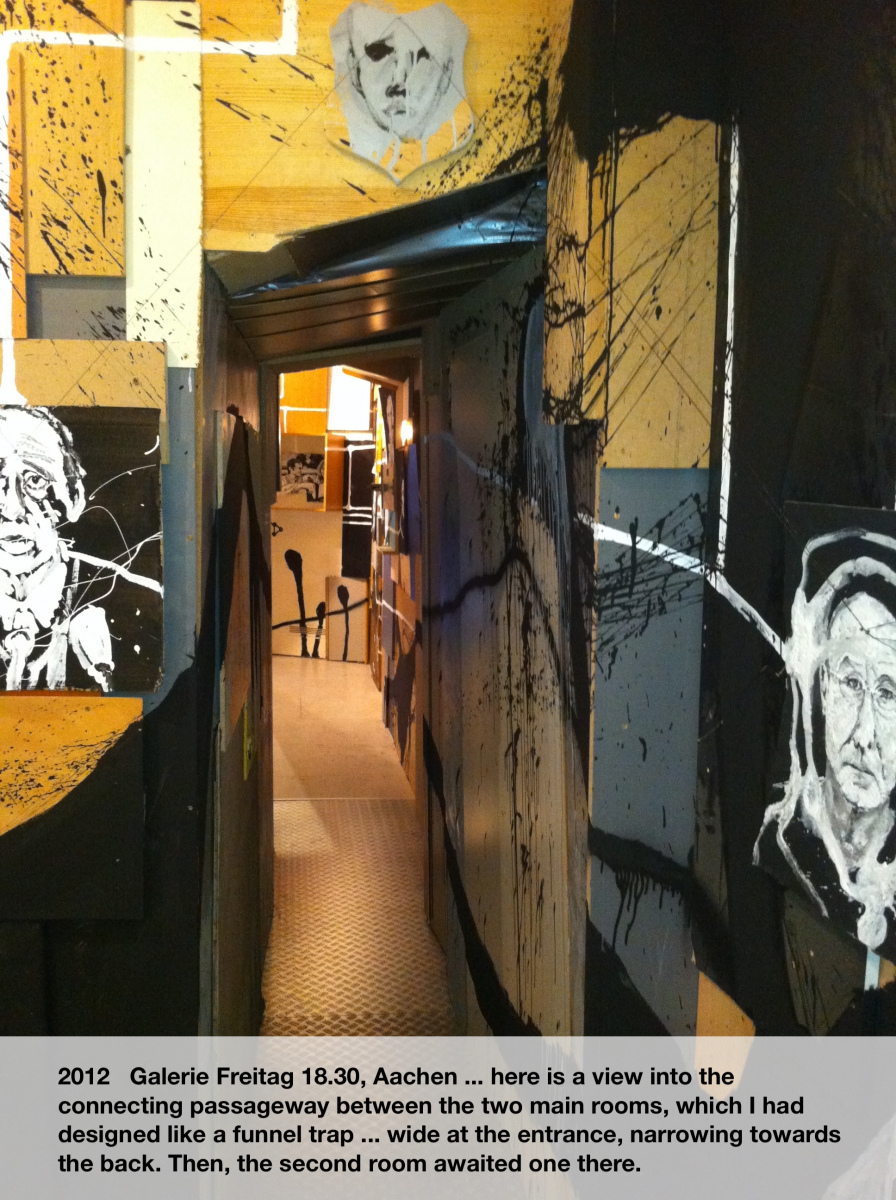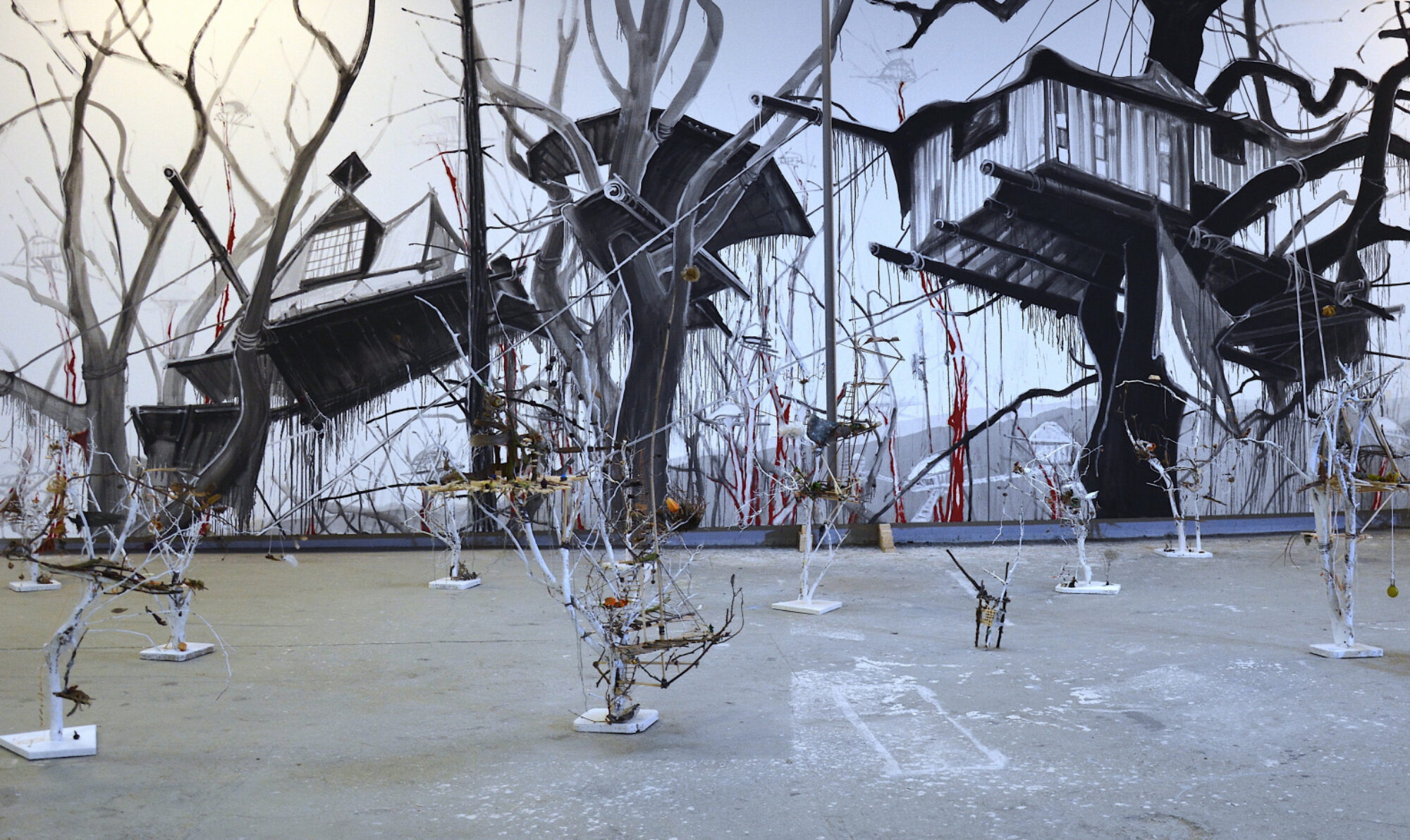
2012 … an exhibition project back then in Aachen at the Galerie Freitag 18.30
I realized a complex, highly elaborate exhibition concept at the gallery,
one that would actually have been better suited to an art association.
Yet, the exhibition is still remembered today.
It belongs to a group of exhibition projects I realized between 2011 and 2014, all rooted
in profound self-reflection, a process involving a critical look at social structures and how
they function (or fail to function) that Iengaged with, lived through, and ultimately
translated into art.These other projects and exhibitions include:
2011 Sperrmüll-Baum (Bulky Waste Tree), Aachen / 2012 Exhibition FOLGE MIR
translated into art.These other projects and exhibitions include:
2011 Sperrmüll-Baum (Bulky Waste Tree), Aachen / 2012 Exhibition FOLGE MIR
(Follow Me) … Galerie Teapot, Cologne / 2012–2013 Writing the manifesto
HELGE MACHT FEUER (Helge Starts a Fire) / 2013 Exhibition
HELGE MACHT FEUER, Galerie Queen Anne, Baumwollspinnerei Leipzig
2014 DAS URLICHT (The Primal Light), Leipzig … a project that took place within the
context of commemorating the Peaceful Revolution of 1989 but went far beyond it …
2014 WIE WOLLEN WIR LEBEN (How Do We Want to Live?), Panel discussion,
Halle 14 Center for Contemporary Art, Baumwollspinnerei Leipzig
The title of the exhibition, NOCH BESSER LEBEN (Living Even Better), is slightly
deceptive; it draws focus to an inevitably complex web of interconnections that only
become apparent upon closer inspection, after all, one tends to agree with such a slogan
quickly and without hesitation at first, doesn’t one? In Leipzig, there is a trendy pub that
goes by this name. Gathered under this title is a diverse array of things: longings, cynical
observations of life, undoubtedly sincere ideas and intentions, the desire to truly do better,
as well as philosophical and sociological reflections.
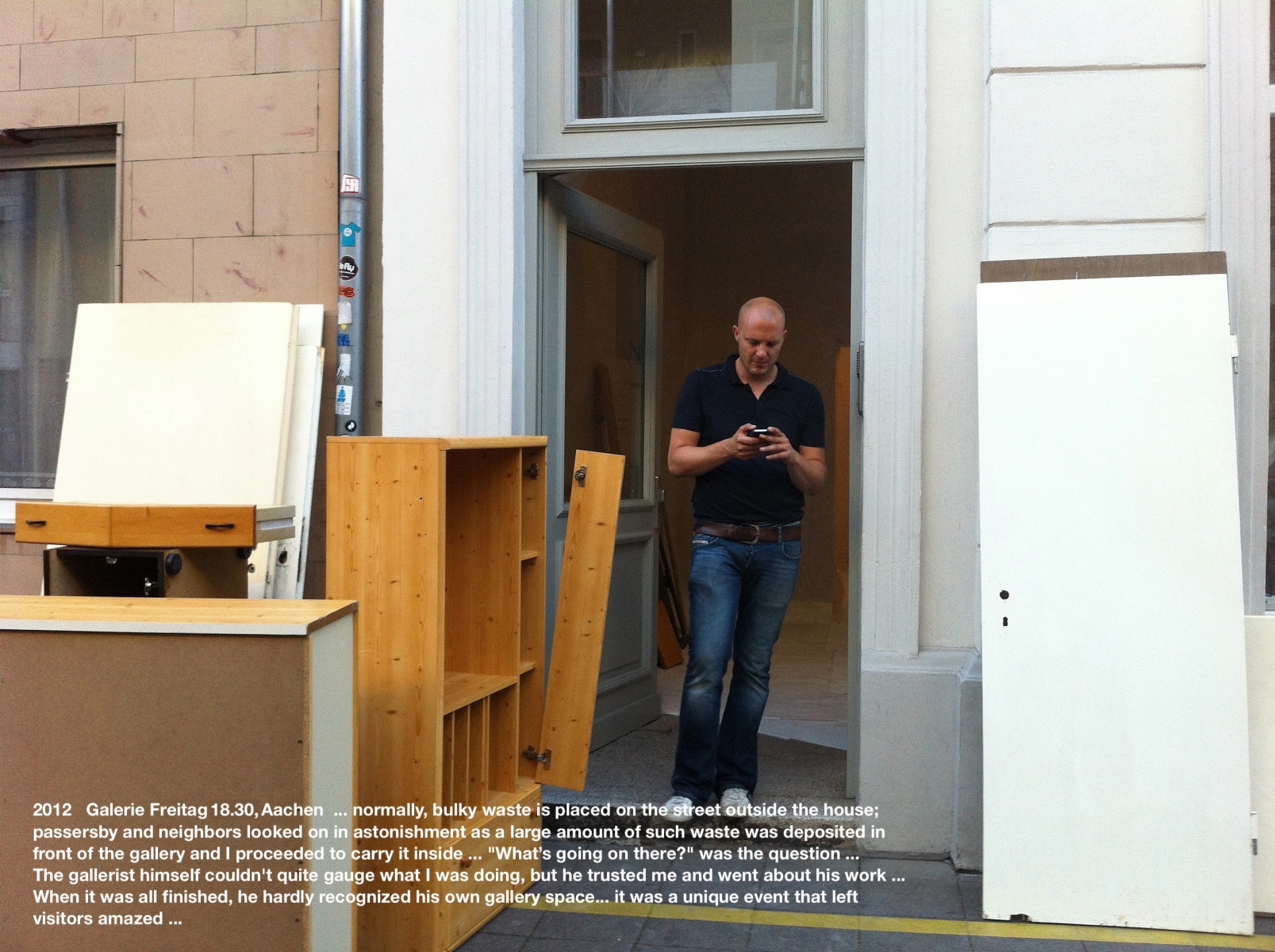
As I began stacking the bulky waste, which I had collected beforehand and carried inside,
in front of the gallery, the first skeptical and curious glances began to gather. What was
happening there? The exhibition had been announced under a specific title, after all, not as
a collection point for stuff like that. Tension mounted.The gallerist and the visitors failed
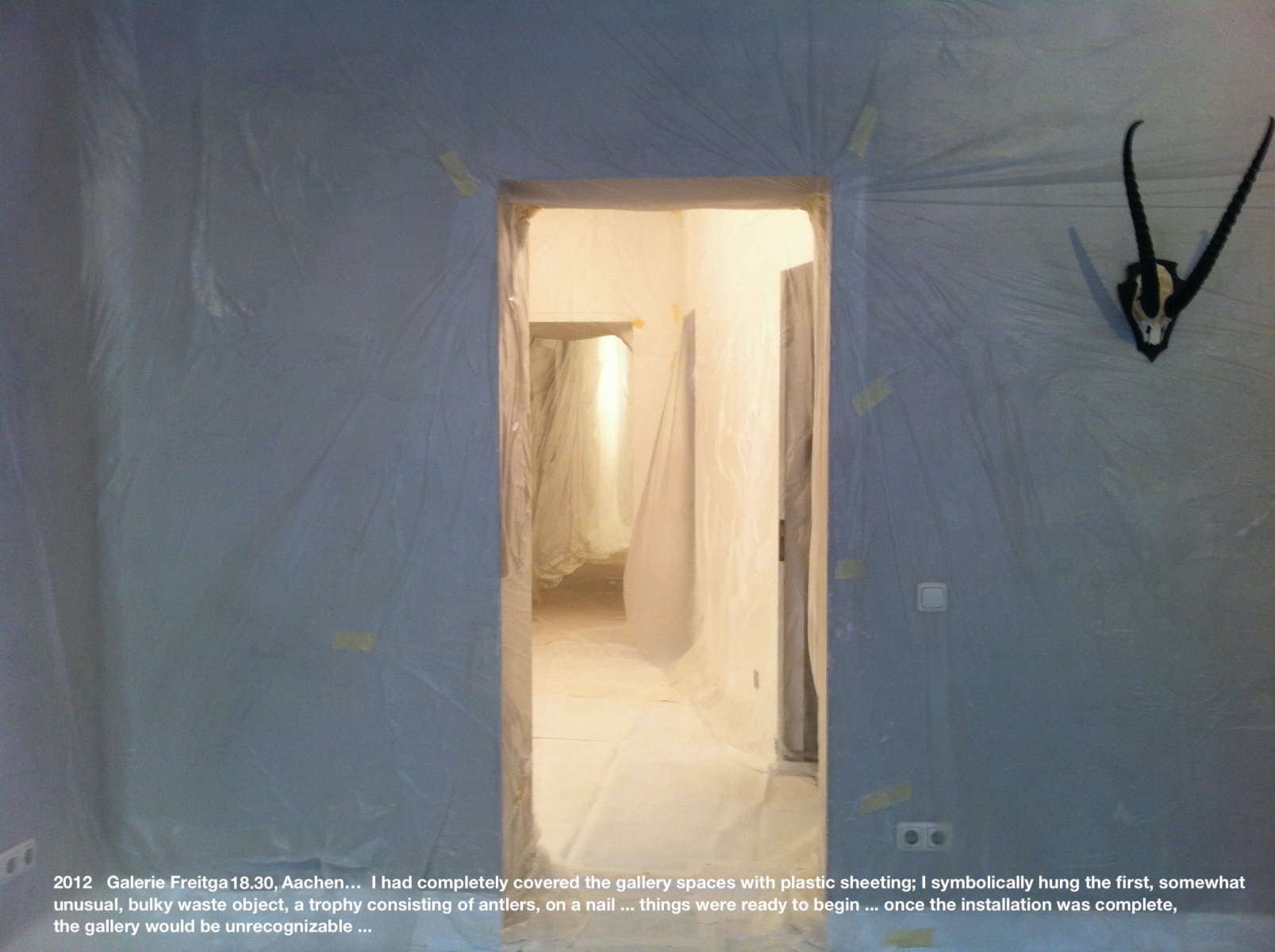
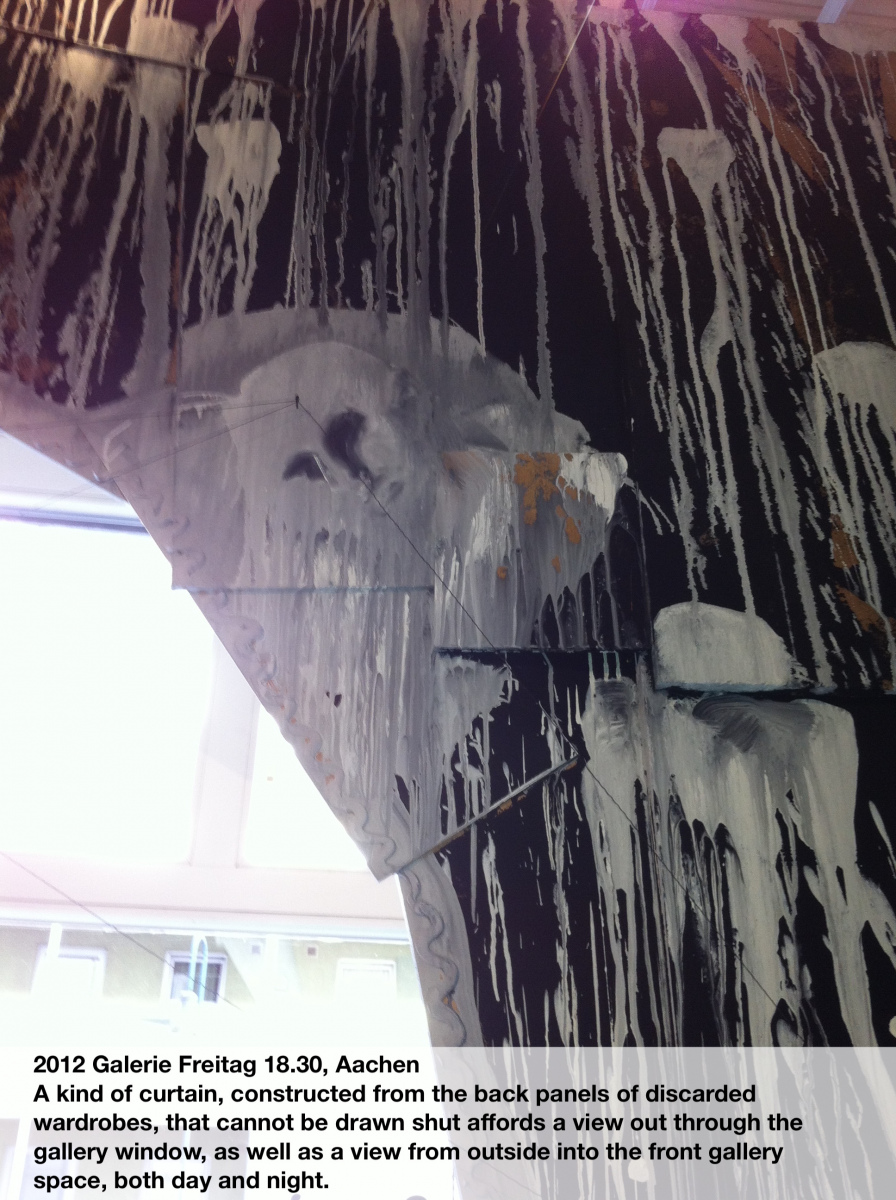
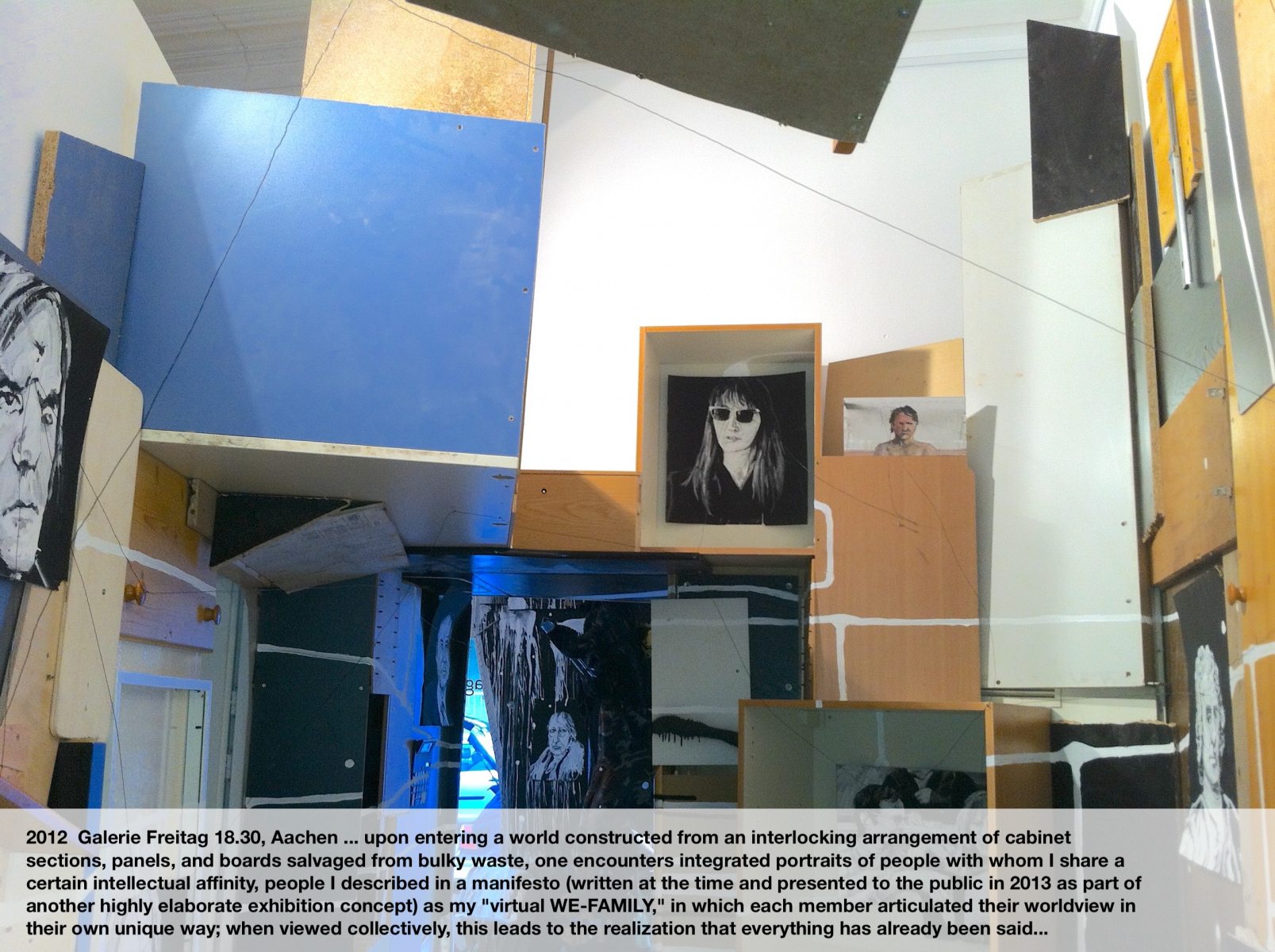
to recognize their familiar gallery space. I had constructed an entire environment out of
bulky waste that spanned every room, a cavern or an inferno of discarded items,
yet perhaps also a place for insight and reflection? It became the talk of the town.
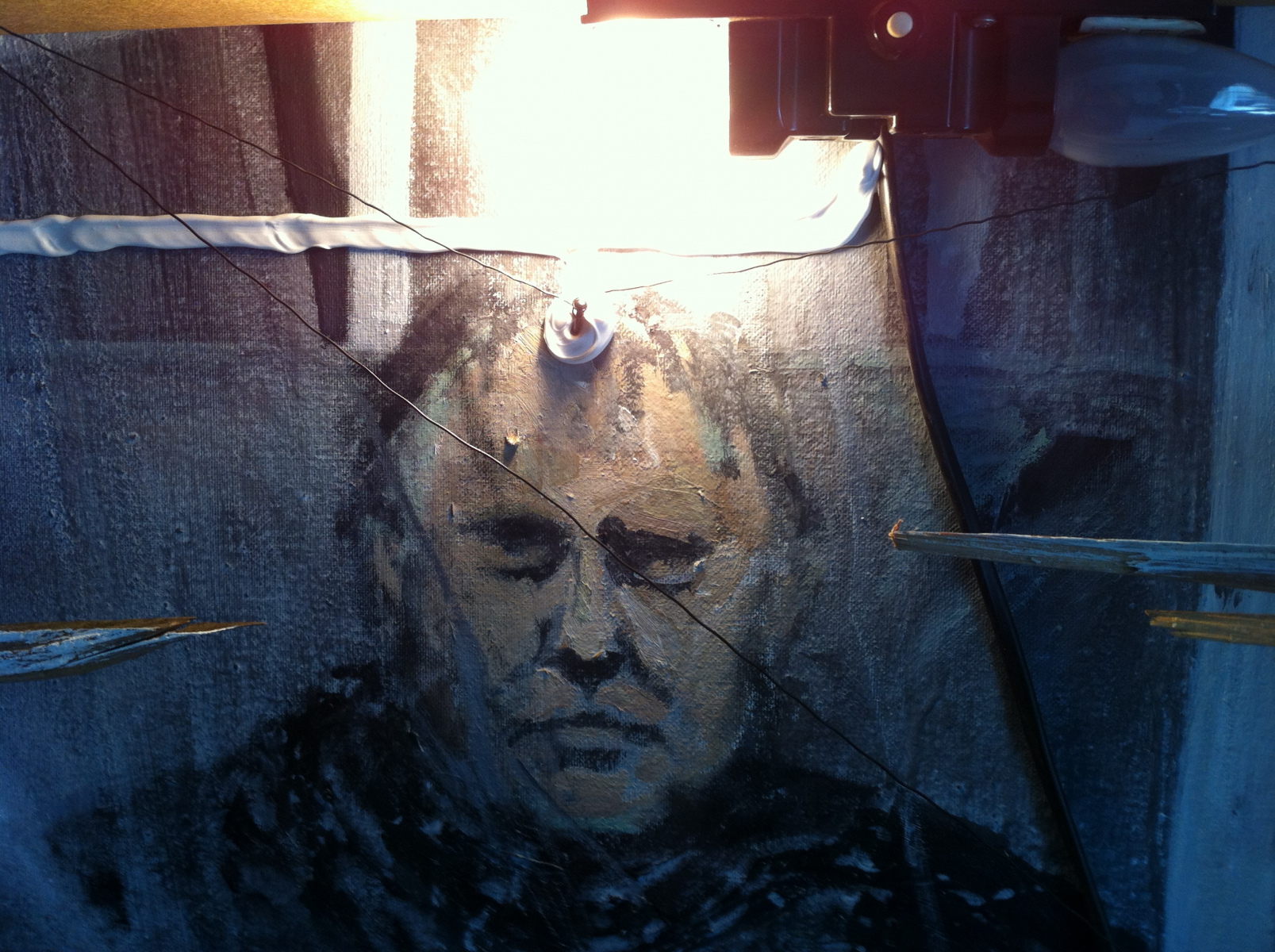
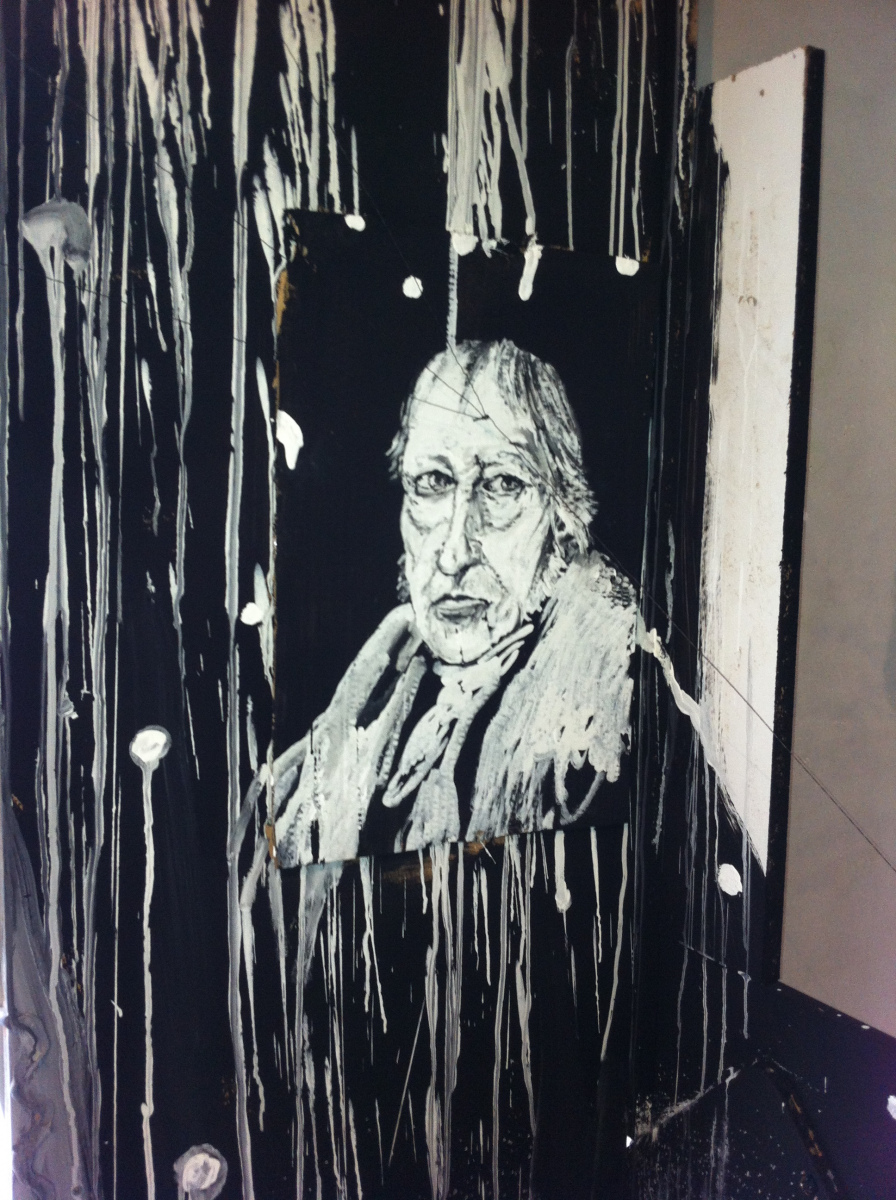
Embedded within these walls of refuse, I installed portraits of a diverse group of people I had selected, individuals with whom I shared varying degrees of intellectual affinity and whom I deemed worthy of contemplation; I also included a few self-portraits. In a sense, I was assembling a virtual family of ‘us‘, members who had already shared their ideas with the world, or were currently doing so. They stood as representatives for the many people who act out of a desire to do good, to wield power, or, God knows what else, by stepping onto a pedestal or stage, writing books, manifestos, laws, and so on.
Why did I choose bulky waste as my base material? It is a commodity charged with diverse
meanings. It embodies transience, whether artificially accelerated or natural, and serves as a testament to our consumer culture, which views discarding things as an intrinsic strategy,
as part of its DNA, as a fundamental concept … and so on.
The “Cradle to Cradle” model would be the healthy alternative.
At the heart of the exhibition in Aachen, in the rear gallery space, stood a throne.
A throne that, hopefully, no one else desired to ascend in order to make a proclamation;
myself included. A decaying, crumbling throne, surrounded on the floor by countless plaques bearing proclamations I had gradually carved or written onto them, statements and thoughts from the portrait subjects and from myself. I recognized the trivial, the fateful, and at the same time, what is likely always necessary: there is always the next “now” where one picks up the thread again, thoughts like maybe this is how it could work, and so it goes on and on … that is life.
For a long time, at least several years now, it has been evident just how urgently
humanity needs a stop sign. If we could manage not to misuse “less is more” but rather to
cultivate it, that would surely be a positive step … This, too, is nothing new, yet it seems
necessary, doesn’t it? There is no planet B